
Beer Yeast Helps Save Labor, Water Use in Growing Rice; Govt Hopes to Make Method Common Practice
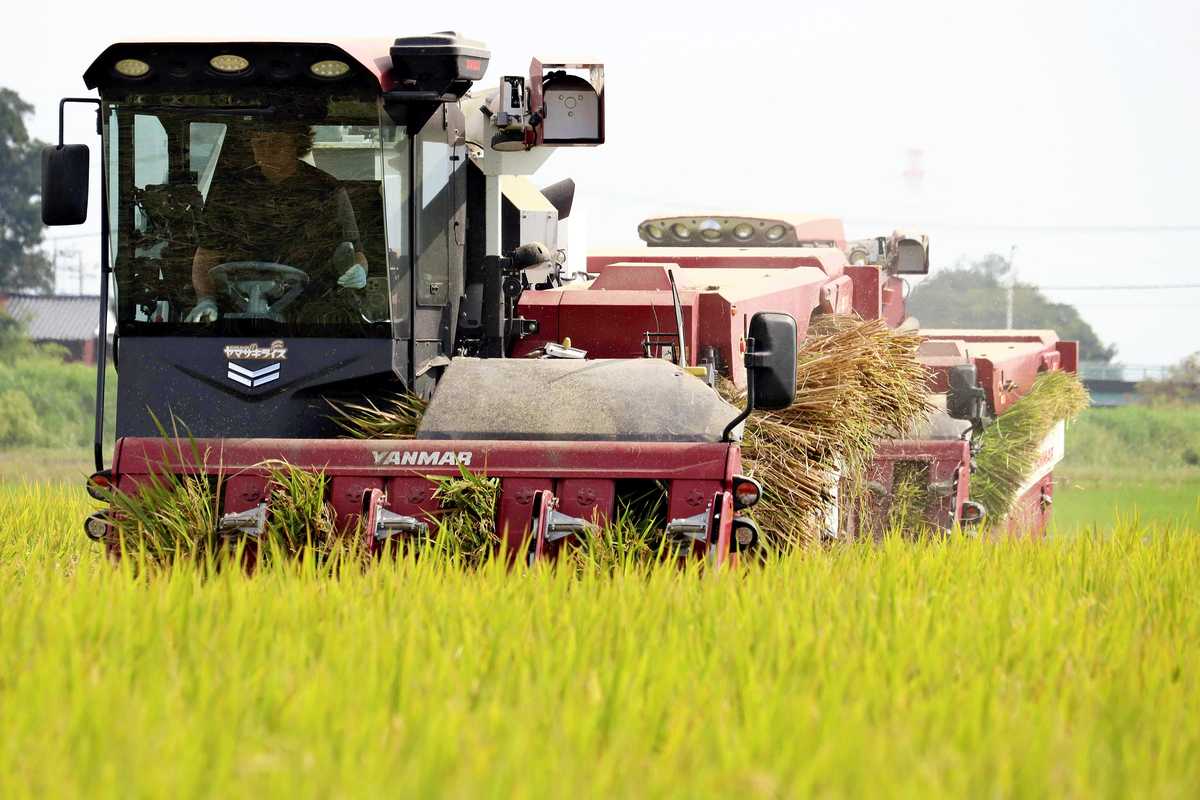
Yoshio Yamazaki harvests rice in a dry field in Sugito, Saitama Prefecture, last September.
2:00 JST, February 1, 2026
KASUKABE, Saitama — A new rice cultivation method using the power of beer yeast is attracting attention because it eliminates the need to keep the rice fields flooded.
In Japan, rice farming usually involves plowing a rice field, filling it with water and planting seedlings that were germinated elsewhere, but the new method involves sowing the seeds directly in the dry rice paddy without flooding it.
The method is expected to significantly reduce the amount of labor required to farm rice and was introduced in 36 prefectures last year by agricultural corporations.
The agriculture ministry has decided to launch research and development to establish the technique as a common practice, as it believes that this will help solve problems facing the agricultural industry such as labor shortages at farms.
Yamazaki Rice, an agricultural production corporation in Sugito, Saitama Prefecture, which annually produces about 600 tons of rice, has been using the water-saving technique for seeding in 10% of its rice fields since 2024.
Looking back on last year’s rice harvest, President Yoshio Yamazaki, 51, said, “It was comparable to rice grown from seedlings.”
Other rice cultivation methods required long-term water management, but the new cultivation method, which involves sowing seeds mechanically in dry rice fields, only requires watering a few times before harvest.
“Working hours were reduced by 70%. Costs can also be reduced,” says Yamazaki.
Planting seedlings is one of the hardest parts of rice cultivation in Japan, and while farming methods to eliminate the step have been attempted in the past, there have been challenges due to the difficulty of growing rice plants.
Rice can now be grown relatively consistently even when sowed in dry paddy fields thanks to an agricultural material containing beer yeast, which was developed in 2015 by Asahi Biocycle Co., an Asahi Group Holdings, Ltd. company. When the material is sprayed onto seeds, the seeds try to boost their immunity, extend their roots into the soil and improve water absorption.
Fukuda Nojo F4 in Abashiri, Hokkaido, began using the material with beer yeast in 2020, and expanded the area of its dry-field rice paddies to 1.5 hectares by 2025.
“It’s revolutionary because it allows us to grow rice even in fields that aren’t equipped to draw in large amounts of water,” said Minoru Fukuda, 44, a representative of the farm.
According to Asahi Biocycle, the beer yeast material was used in at least 36 prefectures last year.
The Agriculture, Forestry and Fisheries Ministry conducted a rice cultivation demonstration project at eight agricultural corporations across the country in 2024. As some fields saw a decline in yield, the ministry decided to launch research into the amount of water needed to ensure a high yield and methods for preventing the spread of weeds. An analysis of whether the method can contribute to agricultural management is also planned.
“The method will lead to more effective use of water resources and may also reduce agricultural labor,” said Hisao Kuroda, a professor emeritus at Ibaraki University and a specialist in agricultural engineering. “However, there have been cases in which the quality of the harvested rice has declined. In order to popularize it, the government needs to provide guidelines for cultivation methods.”





Most Read
Popular articles in the past 24 hours
-

McDonald's Japan Raises Prices; Big Mac to Cost ¥500, Double Chee...
-

Nepal Bus Crash Kills 19 People, Injures 25 Including One Japanes...
-

Japan’s Nikkei Stock Average Rises as AI-Related Stocks Shine; Co...
-

Aggression against Ukraine: Malignant Precedent Must Not Be Set t...
-
Joruri Bunraku Narrative Performed in Honor of Donald Keene by La...
-

Milano Cortina 2026: Gold Medal Olympic Figure Skaters Riku Miura...
-
Kanto's 1st Spring Wind Blows as Tokyo Sees Unseasonably High Tem...
-

How Keri Russell's Suede Coach Boots Ended up in My Closet
Popular articles in the past week
-

Producer Behind Pop Group XG Arrested for Cocaine Possession
-

Sanae Takaichi Elected Prime Minister of Japan; Keeps All Cabinet...
-

Japan's Govt to Submit Road Map for Growth Strategy in March, PM ...
-

Bus Carrying 40 Passengers Catches Fire on Chuo Expressway; All E...
-

Japan, U.S. Name 3 Inaugural Investment Projects; Reached Agreeme...
-

Riku-Ryu Pair Wins Gold Medal: Their Strong Bond Leads to Major C...
-

iPS Treatments Pass Key Milestone, but Broader Applications Far f...
-
Tokyo Skytree's Elevator Stops, Trapping 20 People; All Rescued (...
Popular articles in the past month
-
Producer Behind Pop Group XG Arrested for Cocaine Possession
-

Japan PM Takaichi’s Cabinet Resigns en Masse
-

Japan Institute to Use Domestic Commercial Optical Lattice Clock ...
-

Man Infected with Measles Reportedly Dined at Restaurant in Tokyo...
-

Israeli Ambassador to Japan Speaks about Japan’s Role in the Reco...
-

Videos Plagiarized, Reposted with False Subtitles Claiming ‘Ryuky...
-

Man Infected with Measles May Have Come in Contact with Many Peop...
-

Prudential Life Insurance Plans to Fully Compensate for Damages C...
Top Articles in Society
-
Producer Behind Pop Group XG Arrested for Cocaine Possession
-
Man Infected with Measles Reportedly Dined at Restaurant in Tokyo Station
-
Man Infected with Measles May Have Come in Contact with Many People in Tokyo, Went to Store, Restaurant Around When Symptoms Emerged
-

Woman with Measles Visited Hospital in Tokyo Multiple Times Before Being Diagnosed with Disease
-

Australian Woman Dies After Mishap on Ski Lift in Nagano Prefecture
JN ACCESS RANKING
-
Producer Behind Pop Group XG Arrested for Cocaine Possession
-
Japan PM Takaichi’s Cabinet Resigns en Masse
-
Man Infected with Measles Reportedly Dined at Restaurant in Tokyo Station
-
Israeli Ambassador to Japan Speaks about Japan’s Role in the Reconstruction of Gaza
-
Videos Plagiarized, Reposted with False Subtitles Claiming ‘Ryukyu Belongs to China’; Anti-China False Information Also Posted in Japan