
Inclusive Society / Accepting Foreign Residents as Members of Japanese Society
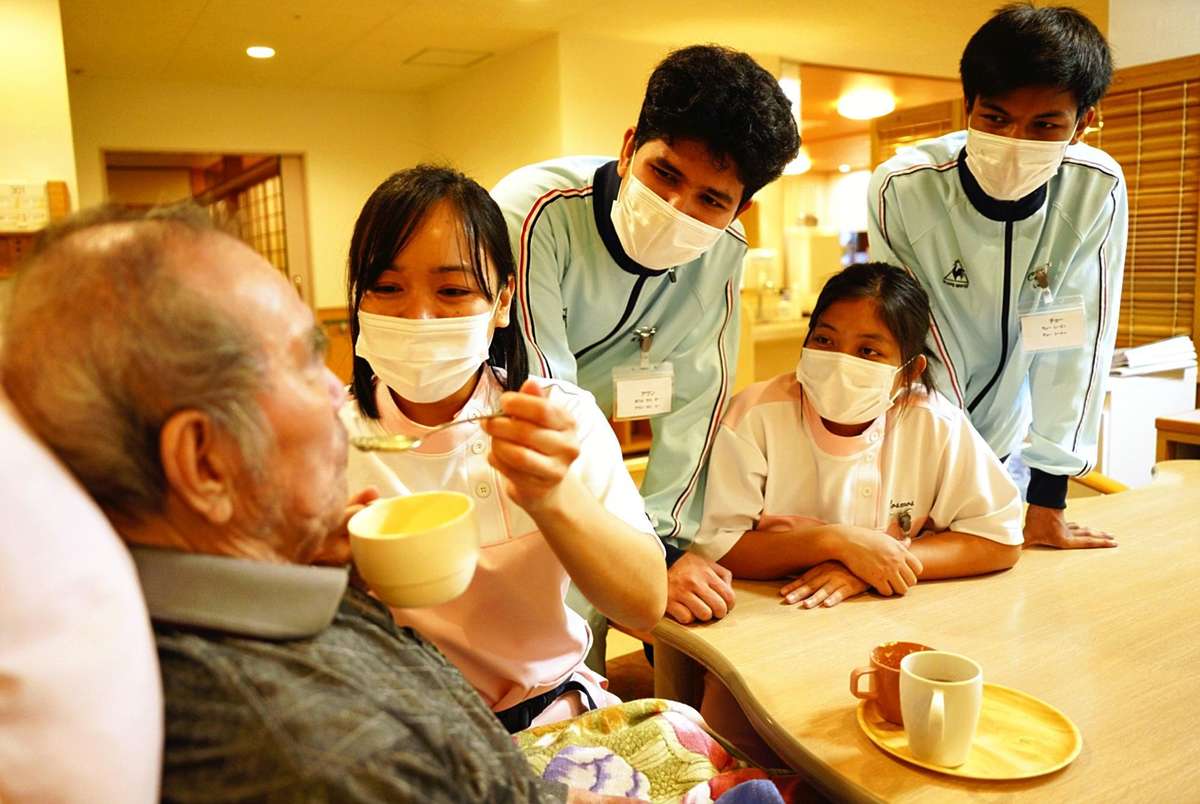
Budod Marie Joyce, second from left, feeds a man at a nursing home in Noto, Ishikawa Prefecture.
12:29 JST, January 9, 2026
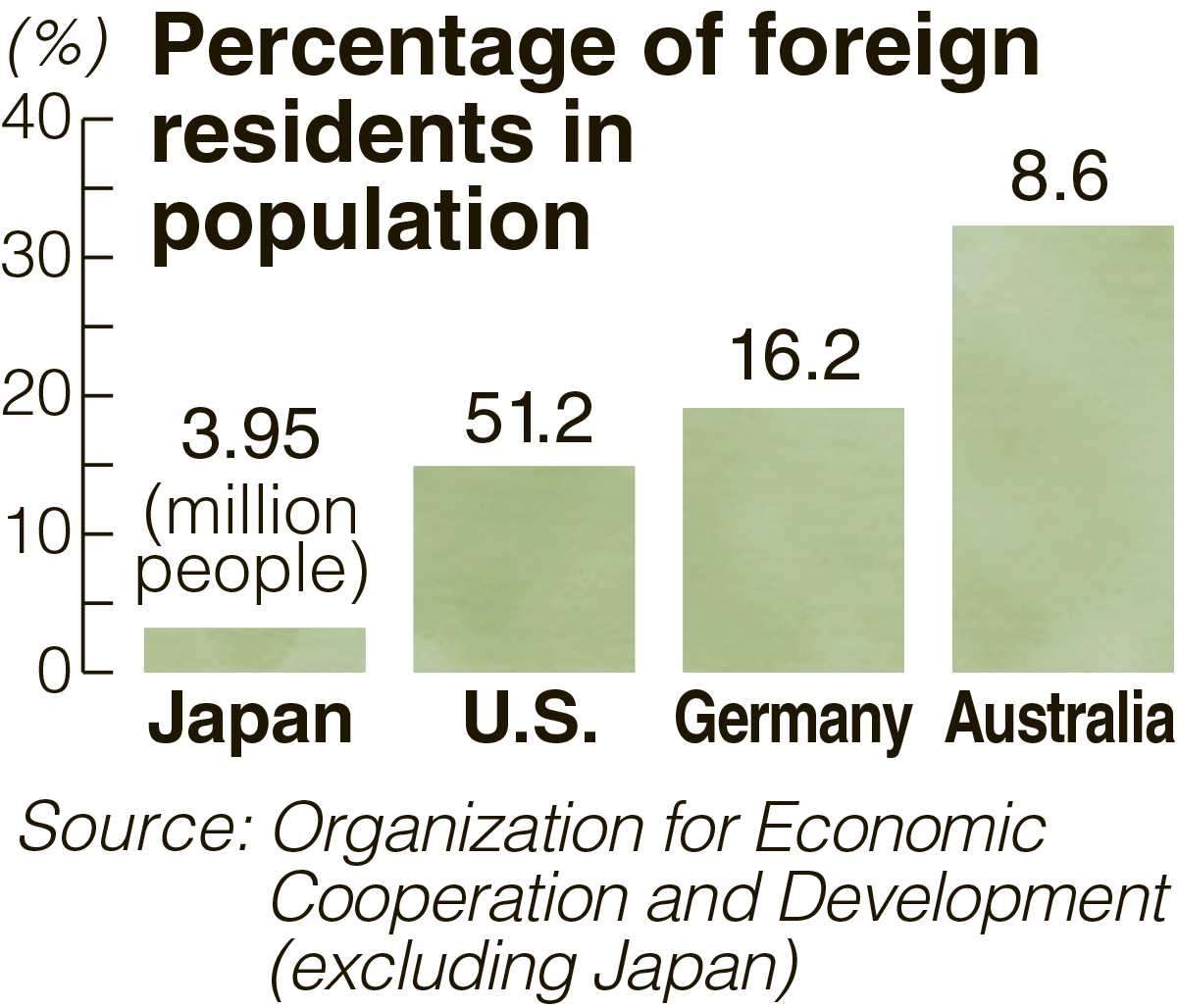
The number of foreign residents living in Japan is at a record high and continuing to rise, ushering in an era that sees more Japanese people living together with foreign nationals. While foreign residents are seen as valuable for the labor force, xenophobic sentiments are spreading on social media, partly due to illegal activities by some foreigners.
This is the first installment in a seven-part series that explores a path toward the coexistence of Japanese and foreigners rather than toward division.
On a recent day, Budod Marie Joyce, a nursing care worker from the Philippines, used a spoon to feed rice porridge to a man at a special nursing home in Noto, Ishikawa Prefecture. Three less-experienced workers watched her work.
The corporation which runs the care home, Cosmos, began accepting workers from the Philippines and Myanmar in 2021.
About 30 workers from the area have left their jobs at the facility within the past two years because they were affected by the Noto Peninsula Earthquake in January 2024 and heavy rains in September the same year. As it has been difficult to find employees among local residents, the facility has continued to accept more workers from the two countries. There are now 26 of them, making up nearly half of Cosmos’ care workers.
“The labor shortage is a matter of survival for us. Foreign workers are essential for us to maintain operations,” corporation chair Yasuhiro Kamitani said.
Foreign workers at Cosmos live in a dormitory near the nursing home. The organization supports them by organizing language lessons with a Japanese instructor and offering transportation when they go shopping. “The organization is good to us, and senior staff members kindly teach us at the workplace. It is very easy to work here,” Marie Joyce said.
According to the Health, Labor and Welfare Ministry, the number of nursing care workers was 2.12 million nationwide in fiscal 2023, marking the first decline from the previous year. With the aging population, 2.72 million workers are expected to be needed by fiscal 2040, but there will be an estimated shortage of 570,000.
In April 2025, home-visit care was added to the list of categories for the specified skilled worker residential status for highly skilled foreign nationals. Since November, Tokyo-based CUC Inc., which operates care facilities nationwide, has so far accepted about 50 foreign workers. “The workforce supply cannot catch up with demand. Assigning foreigners to relevant jobs will expand further,” a CUC official said.
The labor shortage in Japan, which is facing a shrinking population, has been growing worse. The working-age population, defined as people between the ages of 15 and 64, was 73.72 million in 2024, a decrease of more than 13 million from its peak in 1995.
According to Tokyo Shoko Research, Ltd., there were 359 bankruptcies due to labor shortages from January to November 2025, surpassing 292 in 2024 and setting a record high. Industries across the board are rushing to employ skilled foreigners to alleviate the shortages.

Workers from Vietnam load cargo in Fukuyama, Hiroshima Prefecture.
Anticipating a shortage of truck drivers, Hiroshima-based Fukuyama Transporting Co. launched a program to secure and train personnel in Vietnam. Fifteen individuals who studied Japanese language and traffic rules in Vietnam began working at the company as technical interns last year. Mai Pham Son Duy, who currently works loading cargo at the company, said he wants to quickly grasp what to do for his job and start working as a driver.
Huynh Trong Hien, chairperson of an agency that dispatches people to Japan from Vietnam, said he instructed the 15 to manage their time using alarms to adapt to the punctuality strictly observed in Japan and taught them Japan’s waste sorting system using color-coded bins. He added that he wants them to build good relationships with their colleagues.
Some prefectures, including Tokyo and Kanagawa Prefecture, saw a significant influx of foreigners in 2024. This is seen as an increase of people moving to urban areas to seek higher wages, leading to a growing concentration of population in specific areas.
Amid worsening labor shortages in rural areas, Tottori Prefecture launched a pilot project in fiscal 2025 to relocate foreign workers to the prefecture during peak farming seasons. During summer and autumn last year, it accepted eight foreign workers from Nagasaki, where summer is the off-season, to harvest local specialties like rakkyo shallots in Tottori Prefecture. “We are considering continuously using the system as it allows us to employ people only when we need them,” an official of the prefectural government said.
Hosei University Prof. Hisashi Yamada, a specialist in labor economics, said the reality is that Japanese society cannot function without foreign workers. “To achieve an inclusive society, it is necessary to accept them at a pace that does not increase social anxiety, while improving employment and environmental conditions that allow foreigners to lead stable lives,” he said.


Related Tags





Popular Articles
Popular articles in the past 24 hours
-
Japan Govt Seeks to Boost AI Development With Looser Data Protect...
-
Fire Near Osaka's Tsutenkaku Tower
-

Japan Household Spending Unexpectedly Picks up, Signals Steady Co...
-

Aircraft Collision at Haneda Airport: What Should be Done to Prev...
-

Junichi Okada Wears Three Hats in ‘Last Samurai Standing,’ Servin...
-

China Curbs Rare Earth Exports to Japanese Companies after Dual-U...
-

Sri Lankan Arrested in Tokyo after Woman Injured in Robbery-Assau...
-

Mass Grave of Japanese Soldiers Found on Tinian in Northern Maria...
Popular articles in the past week
-
M6.2 Earthquake Hits Japan's Tottori, Shimane Prefectures; No Tsu...
-

China Confirmed to Be Operating Drilling Vessel Near Japan-China ...
-

Mcdonald's, Starbucks in Japan Move Away from Paper Straws Amid C...
-

Sanyo Shinkansen Train Service Fully Resumed (Update 2)
-

Hakone Ekiden 2026: Aoyama Gakuin Hakone Ekiden Runners Kept Depa...
-

Taiwan Alarmed by China’s AI-Driven Election Interference; Beijin...
-

Tokaido Shinkansen, Sanyo Shinkansen Nozomi Trains to Have Reserv...
-

Business Leaders Praise Takaichi's Economic Policies; Executives ...
Popular articles in the past month
-
As Chinese Tourists Shun Japan, Hotels and Stores Suffer
-

Tokyo Economic Security Forum to Hold Inaugural Meeting Amid Tens...
-

Osaka-Kansai Expo's Economic Impact Estimated at ¥3.6 Trillion, T...
-

BOJ Gov. Ueda: Highly Likely Mechanism for Rising Wages, Prices W...
-

Economic Security Panels Debate Supply Chains, Rare Earths; Parti...
-

Japan Govt Adopts Measures to Curb Mega Solar Power Plant Project...
-

Japan, U.S. Start Talks on Tokyo's $550 Bil. Investment in U.S.; ...
-

Tokyo Ranks 2nd in Global Power City Index, Highest-Ever Position...
"Society" POPULAR ARTICLE
-

Tokyo Zoo Wolf Believed to Have Used Vegetation Growing on Wall to Climb, Escape; Animal Living Happily after Recapture
-

Israeli Tourists Refused Accommodation at Hotel in Japan’s Nagano Pref., Prompting Protest by Israeli Embassy and Probe by Prefecture
-

Tsukiji Market Urges Tourists to Avoid Visiting in Year-End
-

Snow Expected in Tokyo, Neighboring Prefectures from Jan. 2 Afternoon to Jan. 3; 5-Centimeter Snow Fall Expected in Hakone, Tama, and Chichibu Areas
-

Tokyo, Yokohama Observe First Snowfall of Season; 1 Day Earlier than Average Year
JN ACCESS RANKING
-
As Chinese Tourists Shun Japan, Hotels and Stores Suffer
-
Tokyo Economic Security Forum to Hold Inaugural Meeting Amid Tense Global Environment
-
Osaka-Kansai Expo’s Economic Impact Estimated at ¥3.6 Trillion, Takes Actual Visitor Numbers into Account
-
BOJ Gov. Ueda: Highly Likely Mechanism for Rising Wages, Prices Will Be Maintained
-
Economic Security Panels Debate Supply Chains, Rare Earths; Participants Emphasize Importance of Cooperation Among Allies