
Omiwatari Freezing of Japan Lake Absent for 7 Years; May Tie Ancient Record If Phenomenon Doesn’t Appear This Winter
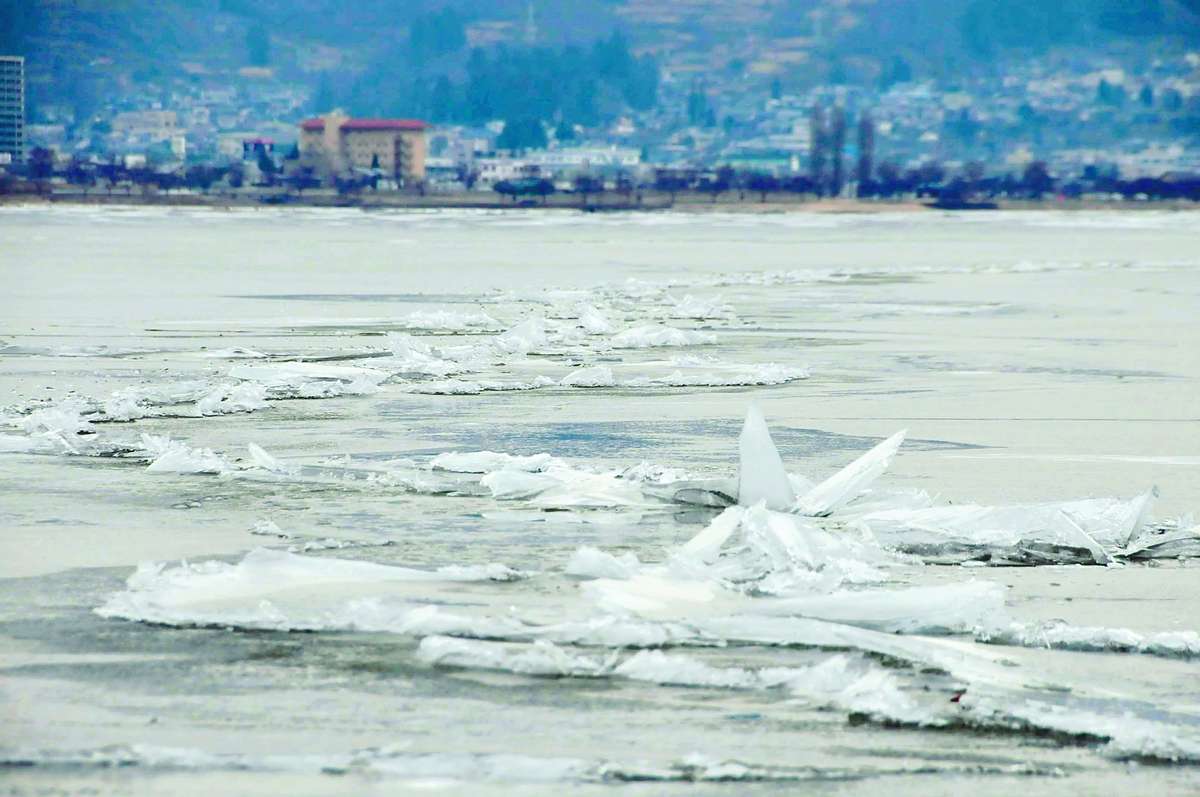
The Omiwatari phenomenon is seen on Lake Suwa on Feb. 1, 2018.
2:00 JST, January 7, 2026
SUWA, Nagano — Almost every winter for hundreds of years, a mystical phenomenon known as “Omiwatari” or “Miwatari” would occur on Lake Suwa in Nagano Prefecture. Cracks would appear in the frozen lake and protrusions of ice would rise from these cracks, forming a long path across the surface.
Due to the effects of global warming, however, “Omiwatari” has not appeared since 2018.
If Omiwatari fails to occur again this year, it will tie the previous record from 1507 to 1514 preceding even Tokugawa shogunate, a gap of eight consecutive winter seasons. Overseas researchers are closely watching whether the phenomenon will occur, as a symbol of the changes brought about by global warming.
Omiwatari is caused by repeated cycles of the ice shrinking due to the falling temperature from night to early morning and then expanding as the temperature rises in daytime.
Every year from early January to early February, the chief priest of Yatsurugi Shrine in Suwa City and other concerned people have checked the conditions each morning. Local residents have recorded such factors as temperature and the thickness of the ice on the shores of the lake to gauge whether the Omiwatari phenomenon will occur that winter season. They started the observation on Monday this year.
According to chief priest Kiyoshi Miyasaka, 75, if there are several days in a row when the lowest daily temperature is around minus 10 C, the entire surface of the lake freezes, increasing the possibility of Omiwatari.
Two ancient documents from the area record occurrences of Omiwatari since 1443. Omiwatari used to occur almost every year, but the frequency has declined recently. Now, the number of winter seasons without the phenomenon is larger than the number of winter seasons when Omiwatari has occurred.
According to forecasts by the Japan Meteorological Agency, the average temperatures in the Kanto and Koshin regions, including Nagano Prefecture, will be “almost the same as past average years” in January and February.
If Omiwatari does not occur this season, the extended absence will tie the previous record about 500 years ago.
People overseas have shown strong interest in whether the phenomenon will occur, as an indication of how global warming has progressed. A short movie about the change, titled “Miwatari” and produced by Greenpeace Japan, won the top award at an international film festival held in Thailand in February 2024.
Miyasaka attended online one of the world’s largest international conferences about how to cope with climate change, which was held in New Zealand in October.
“Omiwatari has not occurred for seven years in a row, and this is definitely abnormal,” he said at the conference.
Miyasaka also recently said: “Global warming can lead to forest wildfires, droughts and floodings. A series of winters without Omiwatari should be regarded as a warning.”
According to Prof. Naoko Hasegawa of Ochanomizu University, an expert in physical geography: “Daily low temperatures have become higher, so the gap between the highest and lowest temperatures in a day is smaller than before. The shrinking and protrusion of the ice are happening on a smaller scale, so the Omiwatari phenomenon is less likely to occur.”
Hasegawa said it was unknown why the phenomenon did not occur for eight years in a row in the 16th century. “I’m examining whether there is evidence indicating that the winters in that period were unusually warm,” she said.
Fewer minus 10 C days
Using data from the Japan Meteorological Agency, The Yomiuri Shimbun analyzed the daily lowest temperatures between Jan. 1 and Feb. 15 in Suwa, Nagano Prefecture, from 1946 to 2025 with a data visualization method known as a heat map.
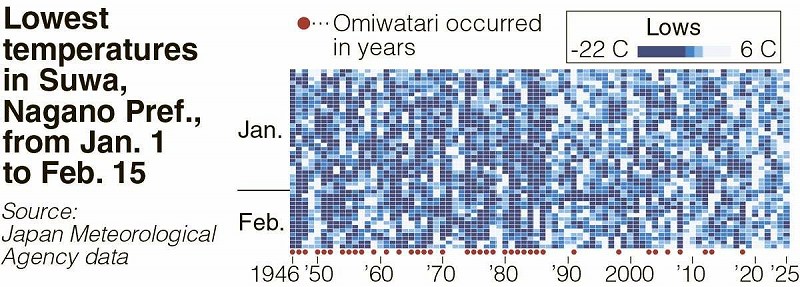
Years are indicated on the horizontal axis and dates of the month on the vertical axis. Cells indicating days when the lowest temperatures fell below minus 10 C, at which the water of Lake Suwa could freeze, are colored in blue. The higher the temperature, the lighter the color.
The heat map clearly shows that the daily lowest temperatures have risen.
On average, there were about 12 days annually when the lowest temperature fell below minus 10 C in the first 40-year period (1946 to 1985). In the second 40-year period (1986 to 2025), that number dropped to about four, down to one-third the earlier level.


Related Tags




Most Read
Popular articles in the past 24 hours
-

Voters Using AI to Choose Candidates in Japan's Upcoming General ...
-
Japan's Snow-Clad Beauty: Camellia Flowers Seen in Winter Bloom a...
-
Monkey Strikes Junior High School Girl from Behind in Japan's Yam...
-
Genichiro Inokuma's Mural in Ueno Station That Gave Hope in Postw...
-

Senior Japanese Citizens Return to University to Gain Knowledge, ...
-
Heavy Snow Linked to 30 Deaths across Japan since Late Jan.; JMA ...
-

Tokyo Police Arrest Head of Resignation Assistance Firm
-

Foreign and Security Policy: Political Parties Must Discuss How T...
Popular articles in the past week
-

Japan Institute to Use Domestic Commercial Optical Lattice Clock ...
-
Australian Woman Dies After Mishap on Ski Lift in Nagano Prefectu...
-
Foreign Snowboarder in Serious Condition After Hanging in Midair ...
-

Chinese Embassy in Japan Reiterates Call for Chinese People to Re...
-
Narita Airport, Startup in Japan Demonstrate Machine to Compress ...
-

Toyota Motor Group Firm to Sell Clean Energy Greenhouses for Stra...
-

Sakie Yokota, Last Surviving Parent of a North Korea Abductee, Ur...
-

Beer Yeast Helps Save Labor, Water Use in Growing Rice; Govt Hope...
Popular articles in the past month
-
Univ. in Japan, Tokyo-Based Startup to Develop Satellite for Disa...
-
JAL, ANA Cancel Flights During 3-day Holiday Weekend due to Blizz...
-
China Confirmed to Be Operating Drilling Vessel Near Japan-China ...
-

China Eyes Rare Earth Foothold in Malaysia to Maintain Dominance,...
-
M6.2 Earthquake Hits Japan's Tottori, Shimane Prefectures; No Tsu...
-
Japan Institute to Use Domestic Commercial Optical Lattice Clock ...
-

Japan, Qatar Ministers Agree on Need for Stable Energy Supplies; ...
-

Japan, Italy to Boost LNG Cooperation; Aimed at Diversifying Japa...
Top Articles in Society
-
JAL, ANA Cancel Flights During 3-day Holiday Weekend due to Blizzard
-
Record-Breaking Snow Cripples Public Transport in Hokkaido; 7,000 People Stay Overnight at New Chitose Airport
-
Australian Woman Dies After Mishap on Ski Lift in Nagano Prefecture
-
Foreign Snowboarder in Serious Condition After Hanging in Midair from Chairlift in Nagano Prefecture
-
Train Services in Tokyo Resume Following Power Outage That Suspended Yamanote, Keihin-Tohoku Lines (Update 4)
JN ACCESS RANKING
-
Univ. in Japan, Tokyo-Based Startup to Develop Satellite for Disaster Prevention Measures, Bears
-
JAL, ANA Cancel Flights During 3-day Holiday Weekend due to Blizzard
-
China Confirmed to Be Operating Drilling Vessel Near Japan-China Median Line
-
China Eyes Rare Earth Foothold in Malaysia to Maintain Dominance, Counter Japan, U.S.
-
Japan Institute to Use Domestic Commercial Optical Lattice Clock to Set Japan Standard Time