
Appropriate Environment Must Be Built for Use of AI; Japan Must Act to Develop Domestic AI Systems That Protect Japan’s Values, Economy, People

The Open AI logo is seen in in this illustration taken on Aug. 26.
7:00 JST, December 17, 2025
Expanding appropriate use of artificial intelligence will require dealing with numerous problems in fields including education, employment and industry. As the use of generative AI rapidly grows, we must review its development and usage and establish an appropriate environment for the use of this technology.
The Yomiuri Shimbun has compiled a set of proposals on coexistence with trustworthy generative AI to establish an environment for utilizing generative AI. These emphasize the need to protect Japan’s autonomy, recognizing that AI is a technology deeply linked to national strength and the lives of citizens, as it affects everything from economic security to the formation of new ideas.
The United States and China currently lead in AI development, with U.S.-based OpenAI and China’s DeepSeek dominating the upper echelons of international rankings for generative AI system performance.
In Japan, companies like NTT, Inc. and SoftBank Corp. are developing domestic AI models. Preferred Networks, Inc. and the National Institute of Information and Communications Technology are jointly developing an AI system using computers from the National Institute of Advanced Industrial Science and Technology. The fact remains, however, that AI models developed by foreign entities are widely used in Japan.
The “contents” of AI models tend to be opaque in many respects, which is why it raises concerns that responses offered by one of these systems could be influenced by ideas and principles common in the country where it was developed. The impact this could have on children’s development in terms of ideology cannot be overlooked either, since it could steer their thoughts in specific directions.
Given the risks of excessive reliance on foreign-made AI systems, the proposal emphasizes the necessity for government-led development of reliable AI models which fully reflect the ethical standards and values which have been cultivated by Japanese society.
Increased use of Japan-made AI systems could reduce payments from Japan to foreign companies, potentially curbing the outflow of national wealth. Japan’s payments to overseas companies for digital services currently exceed receipts by more than ¥6 trillion annually.
The proposal states that data used for developing AI in Japan should ideally contain as much accurate information about Japan as possible.
It also notes that high-quality data in Japanese is essential for developing AI that fully understands Japanese ethics and values, adding that creating an environment that allows for broad data collection and utilization is urgently needed.
Circle of trustworthy AI
The proposal also outlines a vision for an international network connecting “trustworthy AI models” developed by various countries. Nations like Britain, France, India and South Korea are moving to develop and operate their own AI models to avoid dependence on foreign ones. The vision is meant to lead to the creation of an international circle of “trustworthy AI models,” in which member nations all recognize each other’s models.
When researching a country that is part of the network, for instance, an AI model in which the characteristics of the nation are fully reflected will be able to provide accurate information, reducing the risk of spreading misinformation. The proposal notes that this will also promote the use of Japan-made AI systems overseas, helping it to meet the needs of people in foreign nations.
In 2023, the Hiroshima AI Process, a set of international rules on generative AI, was agreed upon by the Group of Seven, spearheaded by Japan.
The proposal calls for the use of the Hiroshima AI Process Friends Group, an international framework for balancing the regulation and use of generative AI, when building a network of “trustworthy AI models.” The group comprises countries and regions which support the spirit of the Hiroshima AI Process.
Social, educational concerns
The proposal also calls for the government to address the negative aspects of AI, such as job losses and widening inequality, at an early stage.
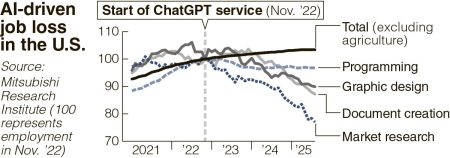
In the United States, employment has continued to decline in specific industries since the emergence of ChatGPT in 2022. According to the Mitsubishi Research Institute, the drop has been particularly large in sectors such as document creation, computer programming and market research. The market research sector has seen a decline in employment of as much as 23 percentage points since November 2022. “Effects on employment will also emerge in Japan within several years,” researcher Yuta Asai said.
The proposal calls for the government to implement countermeasures in advance to prevent social unrest.
The proposal also notes the dangers of dependence on AI and its impact on education, pointing out that increased daily use of generative AI could lead to people becoming overly dependent on the technology and cause them to stop thinking.
Emphasizing particular concern about the use of AI by younger generations, the proposal urges that generative AI be used with the utmost caution and an awareness of the risks of the technology during the years of compulsory education, a period during which children develop critical thinking and other skills.






Most Read
Popular articles in the past 24 hours
-

Tokyo Stocks Dive amid Crude Surge; Nikkei Down Over 4,000 Points
-

Foreign Influence Operations: This Issue Is No Longer Someone Els...
-

Japan's Lower House Holds Public Hearings on Budget Over Weekend ...
-

World's Oldest Bio-Business Is Japan's Seed Koji Retailing, Mold ...
-

Tokyo’s Classic ‘Pointed Hat’ Intake Tower Cameos in Films, Anime...
-

Former Unification Church Files Special Appeal to Supreme Court t...
-

208 Japanese Nationals Who Evacuated Qatar Arrive in Saudi Arabia
-

Man Attacked by Bear in Iwate Pref.; Injuries Not Life-Threatenin...
Popular articles in the past week
-

Ibaraki Pref.'s 1st Foreign Bus Driver Hired in Tsukuba
-

Amid Strait of Hormuz Blockade, Shipping Companies Scramble to Ge...
-

Strait of Hormuz Closure Shakes Markets; Prolonged Closure Could ...
-

2 Unpublished Early Novellas by Japan's Kenzaburo Oe Discovered, ...
-

Japan's 2nd Round of U.S. Investments May Be Worth Over $100 Bill...
-
Japan Govt Survey Finds Just 10% of Workers Want Working Hours to...
-
Iran Situation: Japan Must Exert Diplomatic Efforts without Merel...
-

Imperial Family Watches World Baseball Classic Game Against Austr...
Popular articles in the past month
-

Producer Behind Pop Group XG Arrested for Cocaine Possession
-

Japan PM Takaichi’s Cabinet Resigns en Masse
-

Man Infected with Measles Reportedly Dined at Restaurant in Tokyo...
-

Videos Plagiarized, Reposted with False Subtitles Claiming ‘Ryuky...
-

Prudential Life Insurance Plans to Fully Compensate for Damages C...
-

iPS Treatments Pass Key Milestone, but Broader Applications Far f...
-

Sanae Takaichi Elected Prime Minister of Japan; Keeps All Cabinet...
-

Nepal Bus Crash Kills 19 People, Injures 25 Including One Japanes...
Top Articles in Society
-
Producer Behind Pop Group XG Arrested for Cocaine Possession
-
Man Infected with Measles Reportedly Dined at Restaurant in Tokyo Station
-

Bus Carrying 40 Passengers Catches Fire on Chuo Expressway; All Evacuate Safely
-

Tokyo Skytree’s Elevator Stops, Trapping 20 People; All Rescued (Update 1)
-

U.S. Firm to Build Training Hub in Fukushima N-plant for Debris Removal; Plans to Establish Training Center by 2029
JN ACCESS RANKING
-
Producer Behind Pop Group XG Arrested for Cocaine Possession
-
Japan PM Takaichi’s Cabinet Resigns en Masse
-
Man Infected with Measles Reportedly Dined at Restaurant in Tokyo Station
-
Videos Plagiarized, Reposted with False Subtitles Claiming ‘Ryukyu Belongs to China’; Anti-China False Information Also Posted in Japan
-
Prudential Life Insurance Plans to Fully Compensate for Damages Caused by Fraudulent Actions Without Waiting for Third-Party Committee Review