
Govt to Beef Up Sewer Inspection Nationwide; Hopes to Prevent Recurrence of Yashio Sinkhole Accident
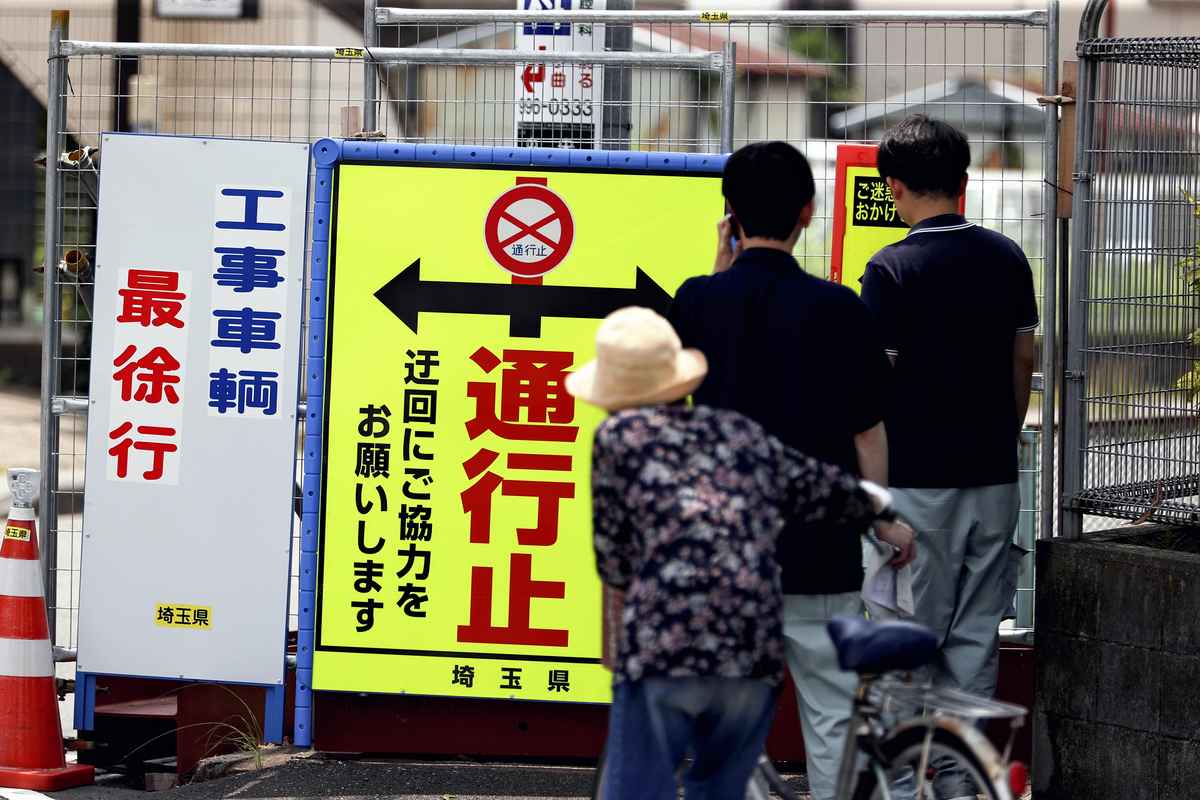
A road is closed for restoration work near the site where a sinkhole occurred in Yashio, Saitama Prefecture, in July.
7:00 JST, December 2, 2025
The Land, Infrastructure, Transport and Tourism Ministry has finalized plans for amending the nation’s Sewerage Law to strengthen regular inspections of sewer pipes, in response to January’s fatal sinkhole accident in Yashio, Saitama Prefecture.
The scope of inspections will be expanded beyond just pipes with high collapse risk to include critical pipelines for which an accident would have a significant impact on society. To enable prompt renewal and repair, the ministry will also introduce new metrics for assessing the extent to which pipes have deteriorated. The ministry intends to submit an amendment bill at next year’s ordinary Diet session.
A sinkhole 40 meters wide and 15 meters deep developed at a prefectural road intersection in Yashio on Jan. 28. It is believed that a sewer pipe laid in 1983 developed a hole due to hydrogen sulfide corrosion, allowing soil and sand to flow into it until the ground collapsed. A male truck driver died after falling into the pit, and residents in 12 municipalities in the prefecture were asked to temporarily refrain from using the sewer system.
The pipeline damaged in the Yashio accident was found to be partially corroded in a 2022 inspection by prefectural authorities, but immediate repair was determined to be unnecessary and no follow-up survey was conducted.
The law at present requires periodic inspections, at least once every five years, for pipelines which are at significant risk of corrosion for reasons such as having high concentrations of hydrogen sulfide. This applies to a total of about 3,500 kilometers of pipelines across Japan.
Under the ministry’s new plan, inspections will be required at least once every five years not only for pipelines at risk of corrosion but also for those at high risk of collapse due to geological or structural factors, such as those located in soft ground or which feature pipeline joints.
The ministry also plans to require inspections combining multiple methodologies — such as visual checks and tapping tests — at least once every ten years for critical pipelines.
Critical pipelines are expected to include those which fit such criteria as being two meters or more in diameter, connecting to a sewer treatment plant or being located directly beneath emergency transport routes which would be used by emergency vehicles in case of a disaster. There are at least 10,000 kilometers of pipelines across the nation that would qualify as critical.




Most Read
Popular articles in the past 24 hours
-

Japan Defense Agency to Develop AI Intelligence Analysis System f...
-

Moai Statue Shows Lasting Bond Between Miyagi Pref. Town, Easter ...
-

Milano Cortina 2026: Japan’s Oguri Wins Para Snowboard Silver at ...
-
Japan's Defense Ministry: North Korea Appears to Have Fired Balli...
-
Aichi Fisheries Cooperatives Use Smart Tech to Farm Triploid Oyst...
-
Teachers Support Students’ Inquiry Learning behind the Scenes
-
Japan's Lower House Passes Budget Proposal; Could Be Delayed in U...
-

National Intelligence Council: Proposed Body Must Be Utilized To ...
Popular articles in the past week
-

Japan Figure Skating Legend Yuzuru Hanyu Is Proud Disaster Surviv...
-
Govt to Utilize ODA for Ensuring Economic Security; Securing Ener...
-
15 Measles Patients Confirmed in Tokyo in Past 6 Days; 1 May Have...
-
Massive Sewer Pipe Found Jutting Out of Highway in Osaka
-
Japan Govt to Tighten Requirements to Receive Permanent Residency...
-
JR Tokai Breaks Ground on Yamanashi Maglev Station; Will Be Part ...
-

Beckoning Cats Get Makeover to Fit Modern Lifestyles with Sleek D...
-
Power Outage Forces About 980 Passengers in Yokohama to Walk to T...
Popular articles in the past month
-

Producer Behind Pop Group XG Arrested for Cocaine Possession
-

Japan PM Takaichi’s Cabinet Resigns en Masse
-

Man Infected with Measles Reportedly Dined at Restaurant in Tokyo...
-

Videos Plagiarized, Reposted with False Subtitles Claiming ‘Ryuky...
-
Japan Figure Skating Legend Yuzuru Hanyu Is Proud Disaster Surviv...
-

iPS Treatments Pass Key Milestone, but Broader Applications Far f...
-

Sanae Takaichi Elected Prime Minister of Japan; Keeps All Cabinet...
-

Nepal Bus Crash Kills 19 People, Injures 25 Including One Japanes...
Top Articles in Society
-
Producer Behind Pop Group XG Arrested for Cocaine Possession
-
Man Infected with Measles Reportedly Dined at Restaurant in Tokyo Station
-
15 Measles Patients Confirmed in Tokyo in Past 6 Days; 1 May Have Come into Contact with Many in Shibuya
-

Bus Carrying 40 Passengers Catches Fire on Chuo Expressway; All Evacuate Safely
-

Ibaraki Pref.’s 1st Foreign Bus Driver Hired in Tsukuba
JN ACCESS RANKING
-
Producer Behind Pop Group XG Arrested for Cocaine Possession
-
Japan PM Takaichi’s Cabinet Resigns en Masse
-
Man Infected with Measles Reportedly Dined at Restaurant in Tokyo Station
-
Videos Plagiarized, Reposted with False Subtitles Claiming ‘Ryukyu Belongs to China’; Anti-China False Information Also Posted in Japan
-
Japan Figure Skating Legend Yuzuru Hanyu Is Proud Disaster Survivor and Gold Medalist, Vows to Continue Support Efforts