
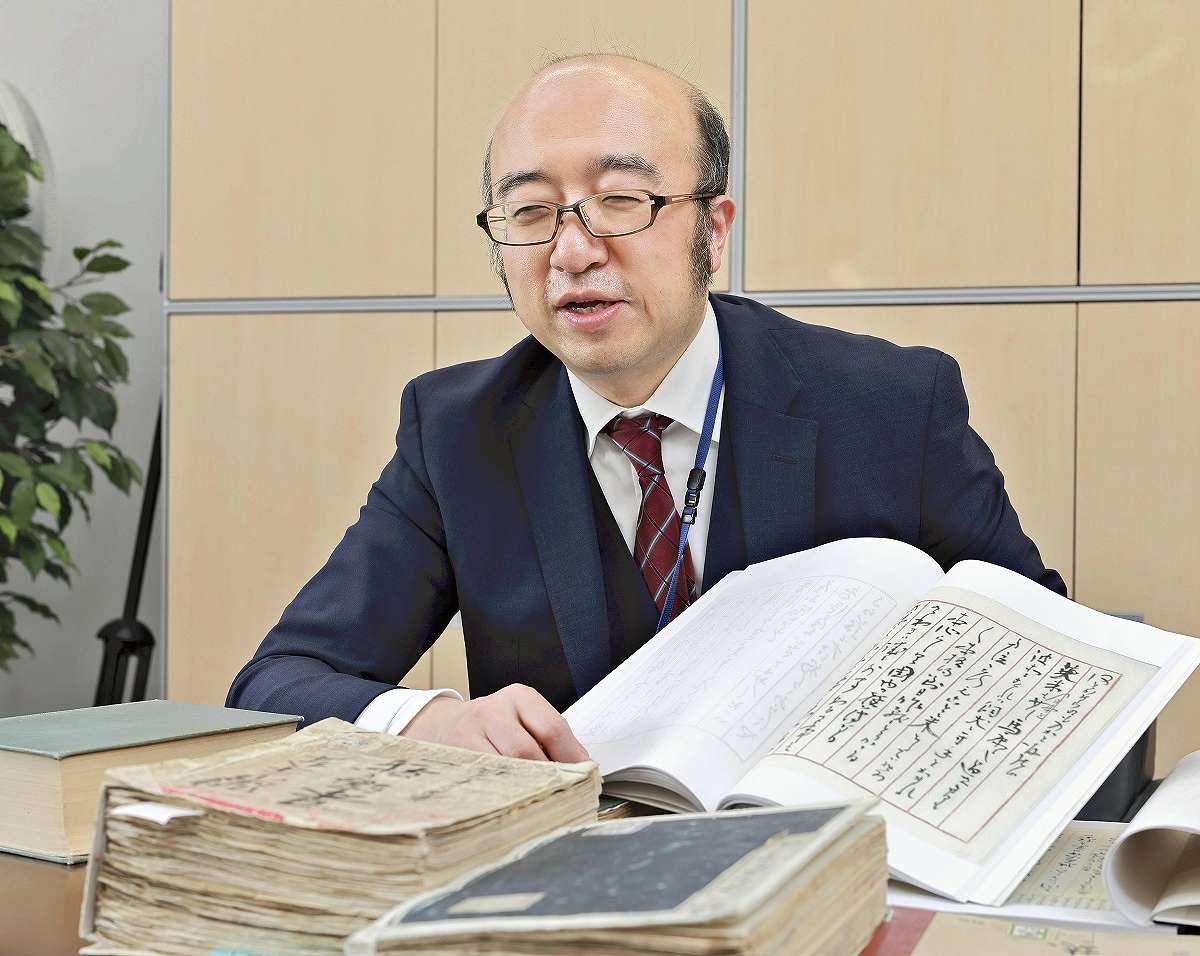
Naoki Kanno, chief of the Center for Military History, explains a copy of a letter written by Isoroku Yamamoto, commander-in-chief of the navy’s Combined Fleet during World War II, in April, in Shinjuku Ward, Tokyo.
15:52 JST, May 9, 2025
The National Institute for Defense Studies (NIDS) has decided to convert its vast collection of Japanese military records into text data with the help of artificial intelligence, after which the records will be made available online.
Many prewar and wartime records are handwritten in cursive, often requiring an expert to decipher. Once the documents are transcribed, it should be possible for anyone to easily trace the movements of individual units during the war and see how decisions were made. The project could contribute to new historical discoveries.
In a letter addressed to senior naval officials after the attack on Pearl Harbor in December 1941, Isoroku Yamamoto, commander-in-chief of the navy’s Combined Fleet, expressed his frustration over the “mood of victory” prevailing at the time.
The letter reads: “It seems that the United States is finally ready to launch a serious operation against Japan, and the frivolity at home is truly degrading. If things continue on this way, I fear that a single strike on Tokyo will instantly cower them.”
The NIDS’ Center for Military History in Tokyo’s Ichigaya district holds about 100,000 historical documents related to the Japan’s former Imperial military. Some of these have been digitized as images and made available on the center’s website, where they can be searched by document title. However, the content of the documents has not been transcribed, preventing users from doing keyword searches. Moreover, the cursive style of the texts presents a challenge to the average reader.
In the transcription project, the NIDS will use a technology called AI-OCR (optical character recognition). OCR can recognize text in documents that have been made into image files, and can transcribe this text. This technology will be paired with AI that has been trained to read the cursive characters.
AI-OCR will be fed sample documents, and any errors in the output will be corrected by humans. This learning process will be repeated until the accuracy improves, at which point the institute will begin transcribing the entire collection.
The Defense Ministry has allocated ¥70 million in its initial budget for fiscal 2025, the first year of the project, and will contract out the project work.
The NIDS is aiming for over 90% accuracy, and the data used for machine learning will eventually be made public, contributing to the advancement of AI technology.
Once the documents are transcribed and made available online, people will be able to easily search documents using keywords, such as gyokusai (heroic death), and will no longer have to struggle to read indecipherable handwriting.
It will also be possible to search all the documents at once, increasing the odds that researchers will uncover new historical facts or new methods of analysis.
Many people visit the NIDS to research their relatives’ wartime experiences.
“Transcription has been a long-standing goal, but doing it manually would have required an astronomical amount of time,” said Naoki Kanno, chief of the Center for Military History. “We will create an environment where people can access documents that allow us to reflect on the war.”







Most Read
Popular articles in the past 24 hours
-

McDonald's Japan Raises Prices; Big Mac to Cost ¥500, Double Chee...
-

Nepal Bus Crash Kills 19 People, Injures 25 Including One Japanes...
-

Japan’s Nikkei Stock Average Rises as AI-Related Stocks Shine; Co...
-

Aggression against Ukraine: Malignant Precedent Must Not Be Set t...
-

Joruri Bunraku Narrative Performed in Honor of Donald Keene by La...
-

Milano Cortina 2026: Gold Medal Olympic Figure Skaters Riku Miura...
-

Kanto's 1st Spring Wind Blows as Tokyo Sees Unseasonably High Tem...
-

CARTOON OF THE DAY (February 24)
Popular articles in the past week
-

Producer Behind Pop Group XG Arrested for Cocaine Possession
-

Sanae Takaichi Elected Prime Minister of Japan; Keeps All Cabinet...
-

Japan's Govt to Submit Road Map for Growth Strategy in March, PM ...
-

Bus Carrying 40 Passengers Catches Fire on Chuo Expressway; All E...
-

Japan, U.S. Name 3 Inaugural Investment Projects; Reached Agreeme...
-

iPS Treatments Pass Key Milestone, but Broader Applications Far f...
-

Riku-Ryu Pair Wins Gold Medal: Their Strong Bond Leads to Major C...
-

Tokyo Skytree's Elevator Stops, Trapping 20 People; All Rescued (...
Popular articles in the past month
-
Producer Behind Pop Group XG Arrested for Cocaine Possession
-

Japan PM Takaichi’s Cabinet Resigns en Masse
-

Japan Institute to Use Domestic Commercial Optical Lattice Clock ...
-

Man Infected with Measles Reportedly Dined at Restaurant in Tokyo...
-

Israeli Ambassador to Japan Speaks about Japan’s Role in the Reco...
-

Videos Plagiarized, Reposted with False Subtitles Claiming ‘Ryuky...
-

Man Infected with Measles May Have Come in Contact with Many Peop...
-

Prudential Life Insurance Plans to Fully Compensate for Damages C...
Top Articles in Society
-
Producer Behind Pop Group XG Arrested for Cocaine Possession
-
Man Infected with Measles Reportedly Dined at Restaurant in Tokyo Station
-
Man Infected with Measles May Have Come in Contact with Many People in Tokyo, Went to Store, Restaurant Around When Symptoms Emerged
-

Woman with Measles Visited Hospital in Tokyo Multiple Times Before Being Diagnosed with Disease
-

Australian Woman Dies After Mishap on Ski Lift in Nagano Prefecture
JN ACCESS RANKING
-
Producer Behind Pop Group XG Arrested for Cocaine Possession
-
Japan PM Takaichi’s Cabinet Resigns en Masse
-
Man Infected with Measles Reportedly Dined at Restaurant in Tokyo Station
-
Israeli Ambassador to Japan Speaks about Japan’s Role in the Reconstruction of Gaza
-
Videos Plagiarized, Reposted with False Subtitles Claiming ‘Ryukyu Belongs to China’; Anti-China False Information Also Posted in Japan