
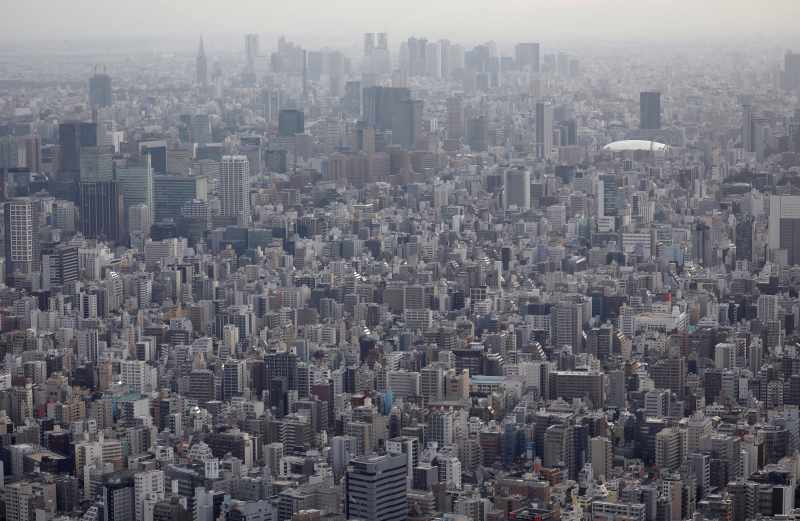
Office and residential buildings are seen from the observation deck of Tokyo Skytree in June 2019.
13:10 JST, December 23, 2023
TOKYO (Jiji Press) — People aged 65 or older will comprise over 40% of the population in 25 out of 47 prefectures in 2050, according to estimates released by the National Institute of Population and Social Security Research on Friday.
Akita Prefecture is projected to have the highest proportion of elderly individuals nationwide, reaching 49.9%.
Population projections for 2050 revealed declines from 2020 for all prefectures except Tokyo, emphasizing the accelerating trend of population concentration in the capital.
The estimates, based on the 2020 census, track changes in population at five-year intervals for 30 years through 2050, categorized by prefecture, city, ward, town and village.
In 2050, Japan’s total population is estimated at 104,686,000, down 17.0% from 2020. The decline is smaller than in the previous estimate, released in 2018, due to an anticipated increase in the number of non-Japanese residents.
Still, in every five-year period from 2020 to 2050, population decreases are projected for all prefectures except Tokyo. Even in the capital, declines are forecast in the 2040-2045 and 2045-2050 periods.
Substantial drops of 30% or more from 2020 to 2050 are predicted in 11 prefectures, with Akita experiencing the most significant decrease at 41.6%, followed by Aomori Prefecture with 39.0%, and Iwate Prefecture with 35.3%, according to the institute.
In 2050, the proportion of residents aged 65 or older is expected to exceed 40% in 25 prefectures, including Akita. Tokyo is projected to have the lowest share at 29.6%.
Additionally, in the same year, the proportion of individuals aged 75 or older is seen surpassing 20% in all prefectures except Tokyo.
Regarding population distribution, Tokyo is projected to represent 13.8% of the national total in 2050, up from 11.1% in 2020. With population shares also rising for Kanagawa Prefecture and other areas, the concentration of people in the Tokyo metropolitan area is expected to intensify further.
The institute also said that by 2050, the population is expected to decrease by over 50% from 2020 in about 20% of all cities, wards, towns, and villages.
The most significant population declines from 2020 to 2050 are projected for the village of Nanmoku, Gunma Prefecture, with 74.8%, the village of Kuma, Kumamoto Prefecture, with 73.3%, and the village of Nosegawa, Nara Prefecture, with 72.5%.








Most Read
Popular articles in the past 24 hours
-

SoftBank Launches AI Service for Call Centers That Converts Harsh...
-

Tokyo, Many Regions across Japan Hit with Heavy Snow
-

High Chocolate Prices Shake Up Valentine's Lineup at Japan's Depa...
-

Milano Cortina 2026: Japan’s Maruyama Wins Bronze Medal in Women’...
-

Milano Cortina 2026: Japan's Kimura, Kimata Dazzle in Big Air To ...
-

6 Injured, Taken to Hospital After Snow-related Car Collisions in...
-

Avg. Voter Turnout in Japan at 16.05% Nationwide as of 2:00 P.M. ...
-
Heavy Snow Affects Polling Stations in Japan’s Chugoku Region
Popular articles in the past week
-

Man Infected with Measles May Have Come in Contact with Many Peop...
-

BTS to Hold Comeback Concert in Seoul on March 21; Popular Boy Ba...
-

Israeli Ambassador to Japan Speaks about Japan’s Role in the Reco...
-

Milano Cortina 2026: Japan’s Athletes Arrive in Italy for Milano ...
-
Tokyo Had 65,000 More People Move In Than Out In 2025; Osaka Area...
-

Green Tea Exports Hit Record High in 2025 Amid Growing Demand, Li...
-

Sapporo Snow Festival Opens with 210 Snow and Ice Sculptures at 3...
-

U.N. Plans to Set Safety Regulation Standards on Automated Drivin...
Popular articles in the past month
-

Univ. in Japan, Tokyo-Based Startup to Develop Satellite for Disa...
-

Japan Institute to Use Domestic Commercial Optical Lattice Clock ...
-
JAL, ANA Cancel Flights During 3-day Holiday Weekend due to Blizz...
-

China Eyes Rare Earth Foothold in Malaysia to Maintain Dominance,...
-
Man Infected with Measles May Have Come in Contact with Many Peop...
-

Japan, Qatar Ministers Agree on Need for Stable Energy Supplies; ...
-
Australian Woman Dies After Mishap on Ski Lift in Nagano Prefectu...
-

Japan, Italy to Boost LNG Cooperation; Aimed at Diversifying Japa...
Top Articles in Society
-
Man Infected with Measles May Have Come in Contact with Many People in Tokyo, Went to Store, Restaurant Around When Symptoms Emerged
-
Australian Woman Dies After Mishap on Ski Lift in Nagano Prefecture
-
Foreign Snowboarder in Serious Condition After Hanging in Midair from Chairlift in Nagano Prefecture
-
Record-Breaking Snow Cripples Public Transport in Hokkaido; 7,000 People Stay Overnight at New Chitose Airport
-
Train Services in Tokyo Resume Following Power Outage That Suspended Yamanote, Keihin-Tohoku Lines (Update 4)
JN ACCESS RANKING
-
Japan Institute to Use Domestic Commercial Optical Lattice Clock to Set Japan Standard Time
-
China Eyes Rare Earth Foothold in Malaysia to Maintain Dominance, Counter Japan, U.S.
-
Man Infected with Measles May Have Come in Contact with Many People in Tokyo, Went to Store, Restaurant Around When Symptoms Emerged
-
Japan, Qatar Ministers Agree on Need for Stable Energy Supplies; Motegi, Qatari Prime Minister Al-Thani Affirm Commitment to Cooperation
-
Australian Woman Dies After Mishap on Ski Lift in Nagano Prefecture