
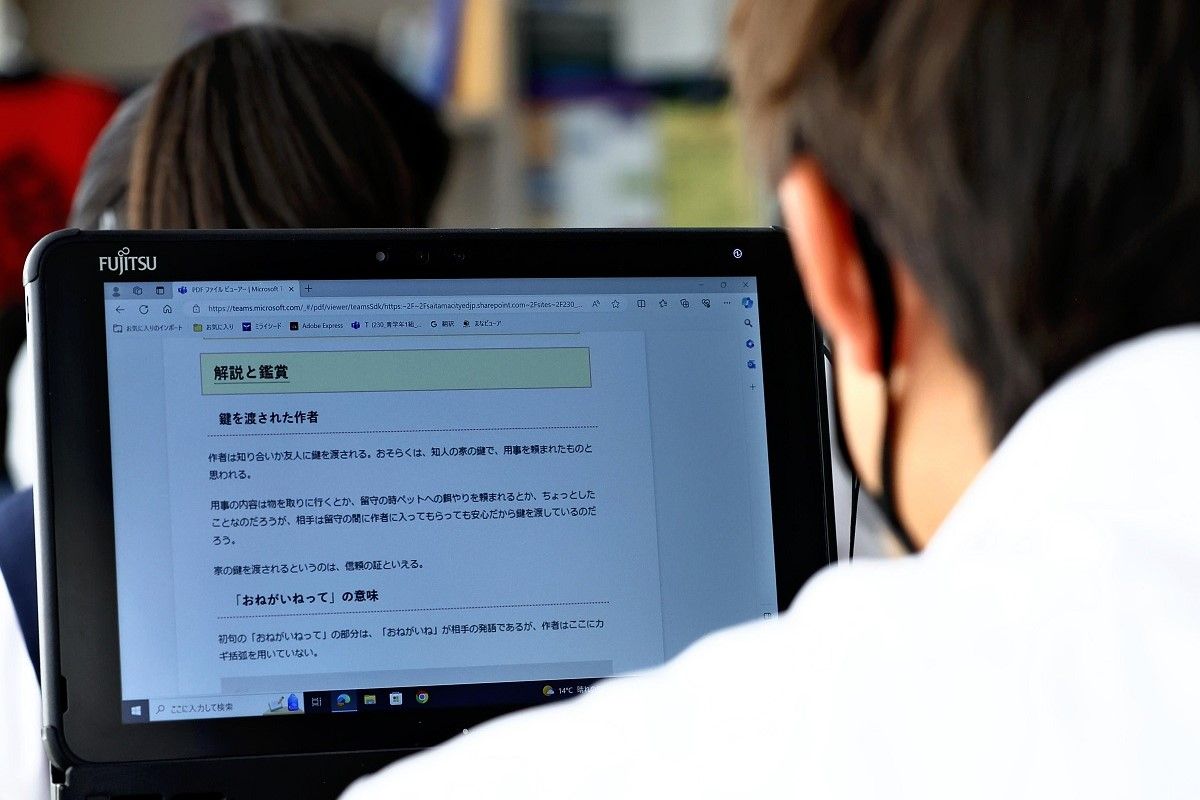
A student uses a tablet during a lesson at a junior high school in Saitama on Nov. 27.
2:00 JST, December 7, 2023
The Organization for Economic Cooperation and Development (OECD) indicated that school closures caused by the COVID-19 pandemic may have caused a decline in global student academic performance.
The OECD conducted the Program for International Student Assessment (PISA) for the first time since the outbreak of the novel coronavirus.
The average scores across OECD countries declined from the previous 2018 survey in all three areas of reading, mathematics and science.
The OECD analyzed the relationship between pandemic-induced school closures and math performance.
Countries and regions with a lower percentage of students reporting that they experienced “more than three months of closures” tended to have higher scores than those with a higher percentage, according to the OECD survey.
Taiwan, which ranked third in mathematics, had a low percentage of students experiencing “closures for more than three months” at 9.8%. South Korea, which ranked sixth, also had a low percentage of such students at 20.8%, both well below the OECD average of 50.3%.
On the other hand, Germany, ranked 25th in mathematics, went down five places from the previous survey, with a high percentage of 71.3% of its students experiencing school closures for more than three months.
Andreas Schleicher, the OECD’s director for the directorate of education and skills, acknowledged that there is a correlation between school closures and declining academic performances.
However, he also said some countries mitigated the damage by creating an environment that complements learning, such as distance learning and teacher support, even when schools were closed.
“In Japan, the school closures were short, and students’ academic performance was supported by shortened summer vacations and other factors. However, compared to other countries, Japan was unable to respond adequately to children from needy families and those who are truant from school,” said Prof. Daisuke Sonoyama of Osaka University, an expert on the state of schools around the world.
“Long-term monitoring of students is important, not just in terms of academic performance, but also in terms of how the school’s handling of the closures affected the students,” he said.






Most Read
Popular articles in the past 24 hours
-

Tokyo Stocks Dive amid Crude Surge; Nikkei Down Over 4,000 Points
-

Foreign Influence Operations: This Issue Is No Longer Someone Els...
-

Japan's Lower House Holds Public Hearings on Budget Over Weekend ...
-

Tokyo’s Classic ‘Pointed Hat’ Intake Tower Cameos in Films, Anime...
-
World's Oldest Bio-Business Is Japan's Seed Koji Retailing, Mold ...
-

Former Unification Church Files Special Appeal to Supreme Court t...
-
208 Japanese Nationals Who Evacuated Qatar Arrive in Saudi Arabia
-

Man Attacked by Bear in Iwate Pref.; Injuries Not Life-Threatenin...
Popular articles in the past week
-

Ibaraki Pref.'s 1st Foreign Bus Driver Hired in Tsukuba
-

Amid Strait of Hormuz Blockade, Shipping Companies Scramble to Ge...
-

Strait of Hormuz Closure Shakes Markets; Prolonged Closure Could ...
-
2 Unpublished Early Novellas by Japan's Kenzaburo Oe Discovered, ...
-

Japan's 2nd Round of U.S. Investments May Be Worth Over $100 Bill...
-
Japan Govt Survey Finds Just 10% of Workers Want Working Hours to...
-
Iran Situation: Japan Must Exert Diplomatic Efforts without Merel...
-

Imperial Family Watches World Baseball Classic Game Against Austr...
Popular articles in the past month
-

Producer Behind Pop Group XG Arrested for Cocaine Possession
-

Japan PM Takaichi’s Cabinet Resigns en Masse
-

Man Infected with Measles Reportedly Dined at Restaurant in Tokyo...
-

Videos Plagiarized, Reposted with False Subtitles Claiming ‘Ryuky...
-

Prudential Life Insurance Plans to Fully Compensate for Damages C...
-

iPS Treatments Pass Key Milestone, but Broader Applications Far f...
-

Sanae Takaichi Elected Prime Minister of Japan; Keeps All Cabinet...
-

Nepal Bus Crash Kills 19 People, Injures 25 Including One Japanes...
Top Articles in Society
-
Producer Behind Pop Group XG Arrested for Cocaine Possession
-
Man Infected with Measles Reportedly Dined at Restaurant in Tokyo Station
-

Bus Carrying 40 Passengers Catches Fire on Chuo Expressway; All Evacuate Safely
-

Tokyo Skytree’s Elevator Stops, Trapping 20 People; All Rescued (Update 1)
-

U.S. Firm to Build Training Hub in Fukushima N-plant for Debris Removal; Plans to Establish Training Center by 2029
JN ACCESS RANKING
-
Producer Behind Pop Group XG Arrested for Cocaine Possession
-
Japan PM Takaichi’s Cabinet Resigns en Masse
-
Man Infected with Measles Reportedly Dined at Restaurant in Tokyo Station
-
Videos Plagiarized, Reposted with False Subtitles Claiming ‘Ryukyu Belongs to China’; Anti-China False Information Also Posted in Japan
-
Prudential Life Insurance Plans to Fully Compensate for Damages Caused by Fraudulent Actions Without Waiting for Third-Party Committee Review