
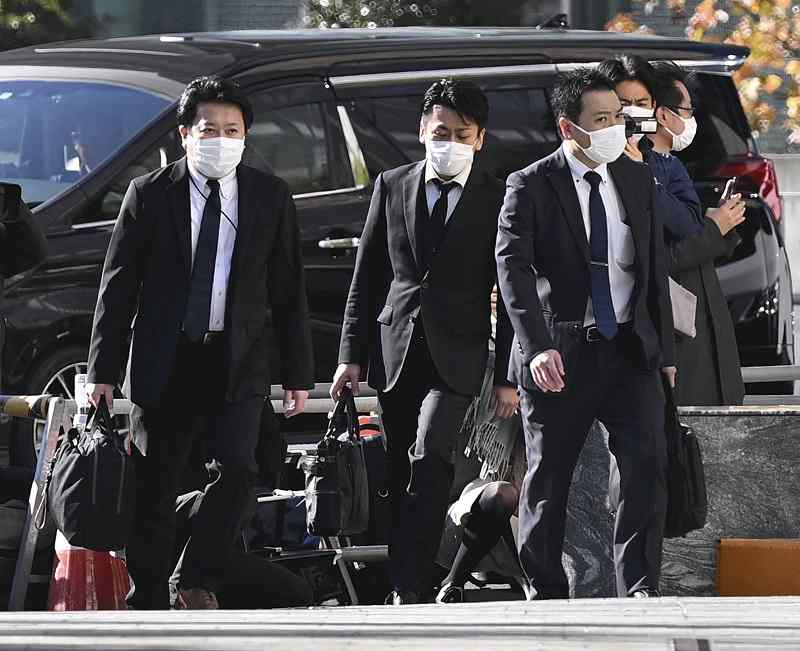
Investigators of the Tokyo District Public Prosecutors Office arrive at the head office of Dentsu Inc. in Minato Ward, Tokyo, on Friday.
17:44 JST, November 25, 2022
Prosecutors and the Japan Fair Trade Commission searched locations including the head office of major advertising company Dentsu Inc. in Minato Ward, Tokyo, on suspicion of violation of the Antimonopoly Law on Friday in connection with alleged bid-rigging involving test events for the Tokyo Olympics and Paralympics.
In the bidding conducted by the Tokyo Games organizing committee for contractors to plan and operate the test events of various sports, multiple companies, including Dentsu, are suspected to have coordinated in advance to agree on which company would win which bid. The special investigation squad of the Tokyo District Public Prosecutors Office and the JFTC are investigating the case as they suspect the possibility of the involvement of the organizing committee in the bid-rigging.
The investigation squad also searched the office of Cerespo Co., an event company based in Toshima Ward, Tokyo, on Friday.
Regarding the test events, major advertising company ADK Holdings Inc., which participated in the bidding, voluntarily reported its own violations to the JFTC under the Antimonopoly Law’s Leniency Program, which reduces or eliminates possible penalty fees. However, the investigative authorities apparently found it necessary to conduct a criminal investigation to clarify the facts.
In 2018, the Tokyo Games organizing committee conducted competitive bidding for a total of 26 contracts, each covering one or two venues.Nine companies, including Dentsu and Asatsu-DK Inc., now ADK Marketing Solutions Inc., plus one consortium, made successful bids. The amount of each contract ranged from about ¥4 million to about ¥60 million, totaling over ¥500 million.
According to sources, ADK voluntarily reported to the JFTC that there was prior coordination to agree on winners for the bids. The successful nine companies and one consortium are believed to have signed negotiated contracts with the organizing committee, which amounted to several tens of billions of yen in total, to run the test events and the actual Games events. The investigation squad and the JFTC strongly suspect that Dentsu and several other companies participating in the bidding rigged the bids with an eye on the possibility of administering actual Game events and other operations.
The Antimonopoly Law prohibits businesses from coordinating in advance to decide a bid winner and forming cartels to agree on setting prices, among other actions that fall under unreasonable restraint of trade.
While investigating corruption cases related to the Tokyo Games, the investigation squad learned of the suspected bid-rigging regarding the test events. Based on evidence and information that they have obtained so far, the investigators believe that multiple companies, such as Dentsu, rigged the bids by coordinating decisions on bid winners for respective venues for the test events in advance.


Most Read
Popular articles in the past 24 hours
-

Japanese Watermelon Shipments Starts in Leading Production Distri...
-

Takeshima Day: Persistently Demanding Resolution from South Korea...
-
Tokyo Skytree Observation Deck Remains Closed for Inspection afte...
-

Impact on Japanese Economy Unclear with Trump’s New Tariffs, Shif...
-
CARTOON OF THE DAY (February 25)
-
Hanzomon Line Service Suspended between Kudanshita, Oshiage Stati...
-
Hanzomon Line Service Resumes
-

Approval for iPS Cell Treatments: One More Step toward Awaited Pr...
Popular articles in the past week
-

Producer Behind Pop Group XG Arrested for Cocaine Possession
-

iPS Treatments Pass Key Milestone, but Broader Applications Far f...
-

Japan, U.S. Name 3 Inaugural Investment Projects; Reached Agreeme...
-
Tokyo Skytree's Elevator Stops, Trapping 20 People; All Rescued (...
-

Japan’s Major Real Estate Firms Expanding Overseas Businesses to ...
-

Baby Monkey Punch Captures Hearts at Chiba Pref. Zoo, on Social M...
-
Milano Cortina 2026: Japanese Figure Skater Kaori Sakamoto’...
-
Reciprocal Tariffs Ruled Illegal: Judiciary Would Not Tolerate Pr...
Popular articles in the past month
-
Producer Behind Pop Group XG Arrested for Cocaine Possession
-

Japan PM Takaichi’s Cabinet Resigns en Masse
-

Japan Institute to Use Domestic Commercial Optical Lattice Clock ...
-

Man Infected with Measles Reportedly Dined at Restaurant in Tokyo...
-

Israeli Ambassador to Japan Speaks about Japan’s Role in the Reco...
-

Videos Plagiarized, Reposted with False Subtitles Claiming ‘Ryuky...
-

Man Infected with Measles May Have Come in Contact with Many Peop...
-

Prudential Life Insurance Plans to Fully Compensate for Damages C...
Top Articles in Society
-
Producer Behind Pop Group XG Arrested for Cocaine Possession
-
Man Infected with Measles Reportedly Dined at Restaurant in Tokyo Station
-
Man Infected with Measles May Have Come in Contact with Many People in Tokyo, Went to Store, Restaurant Around When Symptoms Emerged
-

Woman with Measles Visited Hospital in Tokyo Multiple Times Before Being Diagnosed with Disease
-
Australian Woman Dies After Mishap on Ski Lift in Nagano Prefecture
JN ACCESS RANKING
-
Producer Behind Pop Group XG Arrested for Cocaine Possession
-
Japan PM Takaichi’s Cabinet Resigns en Masse
-
Man Infected with Measles Reportedly Dined at Restaurant in Tokyo Station
-
Israeli Ambassador to Japan Speaks about Japan’s Role in the Reconstruction of Gaza
-
Videos Plagiarized, Reposted with False Subtitles Claiming ‘Ryukyu Belongs to China’; Anti-China False Information Also Posted in Japan