
Letter from Sengoku period warlord Nobunaga authenticated, tracing advance into western Japan
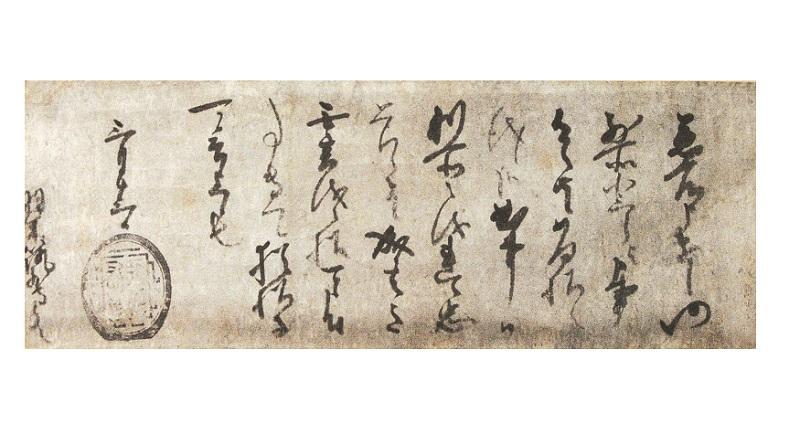
A letter from Nobunaga to Hideyoshi in a collection from the Taigan Historical Museum in Machida, Tokyo.
12:19 JST, November 18, 2022
A letter from the famous feudal warlord Oda Nobunaga (1534-1582) to warlord Hashiba Hideyoshi (1537-1598), later known as Toyotomi Hideyoshi, asking him to address disturbing moves by warlord Bessho Nagaharu (unknown-1580) has recently been verified as authentic.
Nobunaga sent the letter after he had dispatched Hideyoshi as general-in-chief to “pacify” western Japan. In the letter, Nobunaga asked Hideyoshi to deal with disturbing moves made by Nagaharu, a warlord from Harima Province (in what is now southwestern Hyogo Prefecture), who later disobeyed Nobunaga and killed himself.
The letter is a valuable historical document that traces events that occurred in the course of Nobunaga’s advance into western Japan.
Dated March 13, the letter is believed to have been sent to Hideyoshi after his arrival in Harima Province on Feb. 23, 1578. The Taiyo Collection Foundation, an organization that collects historical documents from the Sengoku warring states period in the 15th and 16th centuries, obtained the letter.
Hiraku Kaneko, an associate professor at the Historiographical Institute of the University of Tokyo and an expert in Nobunaga studies, recently verified the letter as authentic based on its content, including the black seal of Nobunaga, which reads “Tenka fubu,” as well as the handwriting of the warlord’s secretary, which is similar to that seen in Nobunaga’s letters from the same period.
Nobunaga started the letter by saying he had learned that there was trouble between Hideyoshi and Nagaharu. Nobunaga then described Nagaharu as a man who has always been loyal to him and told Hideyoshi to address the trouble and report back to him on how it went.
However, in an existing document sent to Kuroda Kanbei that is dated March 22 of the same year, asking Kanbei to cooperate with Hideyoshi to defeat Nagaharu, Nobunaga described him as an enemy.
“Hideyoshi began his two-year siege of Miki Castle [in current Hyogo Prefecture] in late March. This letter with Nobunaga’s black seal was issued just before that moment,” said Ryosuke Nakamura, curator at the Taigan Historical Museum in Machida, Tokyo, which exhibits historical documents from the Taiyo Collection.
“[The letter] shows Nobunaga trying to resolve the situation peacefully at the stage [when the letter was written],” Nakamura, an expert in Japanese medieval history, added.
Only a few original documents sent from Nobunaga to Hideyoshi are known to exist, including those that remain with the Hosokawa and Kuroda families and other feudal lords who served Nobunaga or Hideyoshi, according to Kaneko.
“Even though he had heard of trouble between Hideyoshi and [Nagaharu], Nobunaga had praised Nagaharu as a loyal and faithful man. The letter is an important historical document that shows Nobunaga changing his mind, leading to the defeat of Nagaharu,” said Kaneko.
The letter is on display for the first time at a special exhibition featuring the collections of the Taigan Historical Museum held at the Fujieda City Folk Museum and Literature Museum through Dec. 18.




Most Read
Popular articles in the past 24 hours
-

Japanese Watermelon Shipments Starts in Leading Production Distri...
-

Takeshima Day: Persistently Demanding Resolution from South Korea...
-
Tokyo Skytree Observation Deck Remains Closed for Inspection afte...
-

Impact on Japanese Economy Unclear with Trump’s New Tariffs, Shif...
-

CARTOON OF THE DAY (February 25)
-

Hanzomon Line Service Suspended between Kudanshita, Oshiage Stati...
-
Hanzomon Line Service Resumes
-
Japan GSDF, Indian Army Begin Joint Antiterror Drills
Popular articles in the past week
-

Producer Behind Pop Group XG Arrested for Cocaine Possession
-

iPS Treatments Pass Key Milestone, but Broader Applications Far f...
-

Japan, U.S. Name 3 Inaugural Investment Projects; Reached Agreeme...
-
Tokyo Skytree's Elevator Stops, Trapping 20 People; All Rescued (...
-

Japan’s Major Real Estate Firms Expanding Overseas Businesses to ...
-

Baby Monkey Punch Captures Hearts at Chiba Pref. Zoo, on Social M...
-

Milano Cortina 2026: Japanese Figure Skater Kaori Sakamoto’...
-
Reciprocal Tariffs Ruled Illegal: Judiciary Would Not Tolerate Pr...
Popular articles in the past month
-
Producer Behind Pop Group XG Arrested for Cocaine Possession
-

Japan PM Takaichi’s Cabinet Resigns en Masse
-

Japan Institute to Use Domestic Commercial Optical Lattice Clock ...
-

Man Infected with Measles Reportedly Dined at Restaurant in Tokyo...
-

Israeli Ambassador to Japan Speaks about Japan’s Role in the Reco...
-

Videos Plagiarized, Reposted with False Subtitles Claiming ‘Ryuky...
-

Man Infected with Measles May Have Come in Contact with Many Peop...
-

Prudential Life Insurance Plans to Fully Compensate for Damages C...
Top Articles in Society
-
Producer Behind Pop Group XG Arrested for Cocaine Possession
-
Man Infected with Measles Reportedly Dined at Restaurant in Tokyo Station
-
Man Infected with Measles May Have Come in Contact with Many People in Tokyo, Went to Store, Restaurant Around When Symptoms Emerged
-

Woman with Measles Visited Hospital in Tokyo Multiple Times Before Being Diagnosed with Disease
-

Australian Woman Dies After Mishap on Ski Lift in Nagano Prefecture
JN ACCESS RANKING
-
Producer Behind Pop Group XG Arrested for Cocaine Possession
-
Japan PM Takaichi’s Cabinet Resigns en Masse
-
Man Infected with Measles Reportedly Dined at Restaurant in Tokyo Station
-
Israeli Ambassador to Japan Speaks about Japan’s Role in the Reconstruction of Gaza
-
Videos Plagiarized, Reposted with False Subtitles Claiming ‘Ryukyu Belongs to China’; Anti-China False Information Also Posted in Japan