
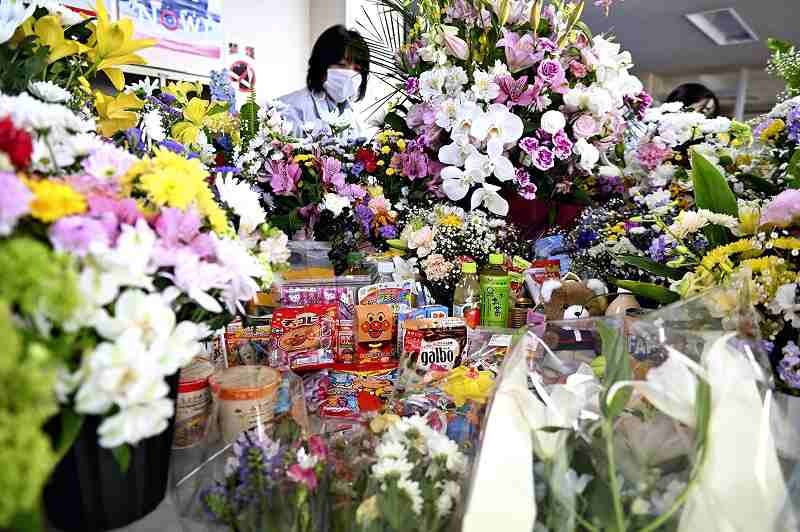
Offerings of flowers and sweets are seen Tuesday at a sports facility that served as a temporary morgue for bodies recovered after the sinking of the Kazu I tour boat.
21:30 JST, May 10, 2022
The company that operated the Kazu I sightseeing boat that sank off the Shiretoko Peninsula in Hokkaido with 26 people aboard was using a ham radio — instead of a professional radio as called for by its own safety manual — to communicate with the ship, and the operator had received administrative directives from the transport ministry in the past, it was learned Monday.
It was also found that a satellite phone, intended for use as another means of communication, was out of order at the time of the accident.
The operator, Shiretoko Pleasure Boat, had submitted its safety management manual under the Maritime Transportation Law, stipulating that three different communication methods — satellite phone, mobile phone and professional radio — were to be used for communications mainly between a ship captain and an onshore operation manager.
The mobile phone was said to have been out of range for most of its route.
According to a Land, Infrastructure, Transport and Tourism Ministry source, the Kazu I suffered two accidents in May and June last year, and the ministry conducted a special audit in June. At that time, the ministry confirmed that the ship was using a ham radio, which is vulnerable to interference in the form of cross-talk. The Ship Safety Law does not allow the use of a ham radio as a communication tool for small passenger ships, and the ministry instructed the company to use a satellite phone instead.
However, Shiretoko Pleasure Boat President Seiichi Katsurada has said that the satellite phone was out of order before the accident. It seems highly likely that a satellite phone was not even on board the Kazu I on the day of the accident.
A vessel inspection on April 20, three days before the accident, found that Kazu I’s communication method had changed from a satellite phone to a mobile phone.
But most of its route was not covered by mobile phone communications service, and an emergency call from Kazu I on the day of the accident was made from the mobile phone number of one of the passengers.
As a result, it is highly likely that none of the three communication methods stipulated by Shiretoko Pleasure Boat in its manual functioned at the time of the accident. The ministry is investigating in a special audit conducted after the accident.
Flower offerings
Meanwhile on Tuesday, people were seen offering flowers at a sports facility that had served as a temporary morgue in the Hokkaido town of Shari, where the Kazu I set sail from the Utoro Fishing Port.
“I came to offer flowers, feeling that an accident like this should never happen again,” a 68-year-old Hokkaido resident said.
According to the town, 585 bouquets of flowers and offerings of sweets had been placed there by Monday. “We cherish the feelings of those who come to offer flowers,” a town official said.






Most Read
Popular articles in the past 24 hours
-

Voters Using AI to Choose Candidates in Japan's Upcoming General ...
-

Japan's Snow-Clad Beauty: Camellia Flowers Seen in Winter Bloom a...
-
Monkey Strikes Junior High School Girl from Behind in Japan's Yam...
-
Genichiro Inokuma's Mural in Ueno Station That Gave Hope in Postw...
-

Senior Japanese Citizens Return to University to Gain Knowledge, ...
-
Heavy Snow Linked to 30 Deaths across Japan since Late Jan.; JMA ...
-

Tokyo Police Arrest Head of Resignation Assistance Firm
-

Foreign and Security Policy: Political Parties Must Discuss How T...
Popular articles in the past week
-

Japan Institute to Use Domestic Commercial Optical Lattice Clock ...
-
Australian Woman Dies After Mishap on Ski Lift in Nagano Prefectu...
-
Foreign Snowboarder in Serious Condition After Hanging in Midair ...
-
Chinese Embassy in Japan Reiterates Call for Chinese People to Re...
-
Narita Airport, Startup in Japan Demonstrate Machine to Compress ...
-

Toyota Motor Group Firm to Sell Clean Energy Greenhouses for Stra...
-

Sakie Yokota, Last Surviving Parent of a North Korea Abductee, Ur...
-

Beer Yeast Helps Save Labor, Water Use in Growing Rice; Govt Hope...
Popular articles in the past month
-
Univ. in Japan, Tokyo-Based Startup to Develop Satellite for Disa...
-
JAL, ANA Cancel Flights During 3-day Holiday Weekend due to Blizz...
-
China Confirmed to Be Operating Drilling Vessel Near Japan-China ...
-

China Eyes Rare Earth Foothold in Malaysia to Maintain Dominance,...
-
M6.2 Earthquake Hits Japan's Tottori, Shimane Prefectures; No Tsu...
-
Japan Institute to Use Domestic Commercial Optical Lattice Clock ...
-
Japan, Qatar Ministers Agree on Need for Stable Energy Supplies; ...
-

Japan, Italy to Boost LNG Cooperation; Aimed at Diversifying Japa...
Top Articles in Society
-
JAL, ANA Cancel Flights During 3-day Holiday Weekend due to Blizzard
-
Record-Breaking Snow Cripples Public Transport in Hokkaido; 7,000 People Stay Overnight at New Chitose Airport
-
Australian Woman Dies After Mishap on Ski Lift in Nagano Prefecture
-
Foreign Snowboarder in Serious Condition After Hanging in Midair from Chairlift in Nagano Prefecture
-
Train Services in Tokyo Resume Following Power Outage That Suspended Yamanote, Keihin-Tohoku Lines (Update 4)
JN ACCESS RANKING
-
Univ. in Japan, Tokyo-Based Startup to Develop Satellite for Disaster Prevention Measures, Bears
-
JAL, ANA Cancel Flights During 3-day Holiday Weekend due to Blizzard
-
China Confirmed to Be Operating Drilling Vessel Near Japan-China Median Line
-
China Eyes Rare Earth Foothold in Malaysia to Maintain Dominance, Counter Japan, U.S.
-
Japan Institute to Use Domestic Commercial Optical Lattice Clock to Set Japan Standard Time