
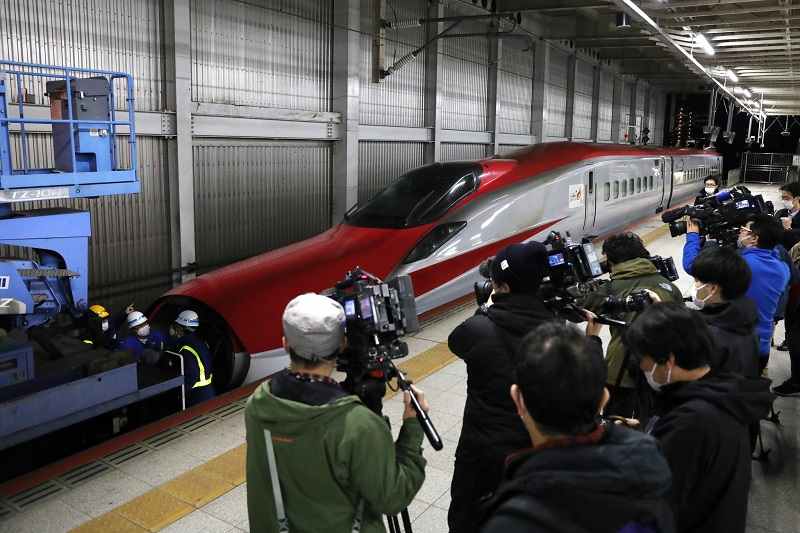
Tohoku Shinkansen cars are seen at JR Sendai Station on March 31.
17:34 JST, April 6, 2022
TOKYO (Jiji Press) — East Japan Railway Co., or JR East, said Tuesday that it will resume services on all sections of its Tohoku Shinkansen bullet train line on April 14.
The line is currently closed between Fukushima Station in Fukushima Prefecture and Sendai Station in neighboring Miyagi Prefecture due to damage from last month’s strong earthquake that mainly hit the Tohoku northeastern Japan region, including the two prefectures.
Even after the reopening of all sections, however, the number of services will be around 80-90 pct of that of full operations as trains must slow down between Koriyama Station in Fukushima and Ichinoseki Station in Iwate Prefecture, north of Miyagi, JR East President Yuji Fukasawa said at a press conference.
The company is expected to release a detailed timetable soon. Services are projected to fully return to normal during or after the Golden Week holiday period between late this month and early May, according to the railway operator.
The March 16 quake led to the derailment of 16 of the 17 cars of the Yamabiko No. 223 train, which was traveling between Fukushima Station and Shiroishizao Station in Miyagi on the Shinkansen line at the time. The temblor also caused damage to around 1,000 areas in Tohoku Shinkansen facilities, including utility poles and elevated tracks. Recovery work is expected to cost around ¥15 billion to ¥20 billion.
The Tohoku Shinkansen Line connects Tokyo Station and Shin-Aomori Station in Aomori Prefecture, located in the northernmost part of Honshu, the biggest of Japan’s four main islands.
Services are now offered at around 50 pct to 60 pct of full capacity on the sections between Tokyo and Fukushima, and between Sendai and Shin-Aomori.
JR East initially planned to resume services on all sections around April 20, but now expects to be able to move up the schedule thanks to smooth progress in the recovery work, such as removing the derailed cars.
Fukasawa apologized for the derailment, which caused “huge trouble.”
But he said that JR East’s measures to protect its Shinkansen services from earthquakes, such as devices to prevent major derailments, “fulfilled their functions” in the March 16 quake, while noting that the company hopes to “make use of lessons learned from the latest incident, including analysis by the Japan Transport Safety Board (of the Japanese transport ministry), in the future.”
The earthquake measured upper 6, the second-highest level on Japan’s seismic intensity scale, in some areas of Fukushima and Miyagi prefectures.





Most Read
Popular articles in the past 24 hours
-

Milano Cortina 2026: Sakamoto Serves as Flag Bearer; Japan Earns ...
-

Milano Cortina 2026: There Were Cheers across the Country, after ...
-

Emperor Turns 66 Ahead of Disaster Milestones
-

Luna Sea Drummer Shinya Dies at 56; Powerful Drummer Behind ‘Desi...
-

Milano Cortina 2026: ‘Magical’ Italian Games Close wi...
-

Milano Cortina 2026: Riku-Ryu Duo Stick Together During Closing C...
-

1.2 Mil. Rapeseed Flowers Attract Cute Birds, People in Aichi Pre...
-

Mexican Army Kills Leader of Powerful Jalisco New Generation Cart...
Popular articles in the past week
-

Japan PM Takaichi’s Cabinet Resigns en Masse
-

Man Infected with Measles Reportedly Dined at Restaurant in Tokyo...
-

Sanae Takaichi Elected Prime Minister of Japan; Keeps All Cabinet...
-

Japan's Govt to Submit Road Map for Growth Strategy in March, PM ...
-

Bus Carrying 40 Passengers Catches Fire on Chuo Expressway; All E...
-

Milano Cortina 2026: Figure Skaters Riku Miura, Ryuichi Kihara Pa...
-

U.S. Firm to Build Training Hub in Fukushima N-plant for Debris R...
-

Japan, U.S. Name 3 Inaugural Investment Projects; Reached Agreeme...
Popular articles in the past month
-
Japan PM Takaichi’s Cabinet Resigns en Masse
-

Japan Institute to Use Domestic Commercial Optical Lattice Clock ...
-

Israeli Ambassador to Japan Speaks about Japan’s Role in the Reco...
-
Man Infected with Measles Reportedly Dined at Restaurant in Tokyo...
-

Videos Plagiarized, Reposted with False Subtitles Claiming ‘Ryuky...
-

Man Infected with Measles May Have Come in Contact with Many Peop...
-

Prudential Life Insurance Plans to Fully Compensate for Damages C...
-

Woman with Measles Visited Hospital in Tokyo Multiple Times Befor...
Top Articles in Society
-

Producer Behind Girls Group XG Arrested for Cocaine Possession
-
Man Infected with Measles Reportedly Dined at Restaurant in Tokyo Station
-
Man Infected with Measles May Have Come in Contact with Many People in Tokyo, Went to Store, Restaurant Around When Symptoms Emerged
-
Woman with Measles Visited Hospital in Tokyo Multiple Times Before Being Diagnosed with Disease
-
Australian Woman Dies After Mishap on Ski Lift in Nagano Prefecture
JN ACCESS RANKING
-
Japan PM Takaichi’s Cabinet Resigns en Masse
-
Japan Institute to Use Domestic Commercial Optical Lattice Clock to Set Japan Standard Time
-
Israeli Ambassador to Japan Speaks about Japan’s Role in the Reconstruction of Gaza
-
Man Infected with Measles Reportedly Dined at Restaurant in Tokyo Station
-
Videos Plagiarized, Reposted with False Subtitles Claiming ‘Ryukyu Belongs to China’; Anti-China False Information Also Posted in Japan