
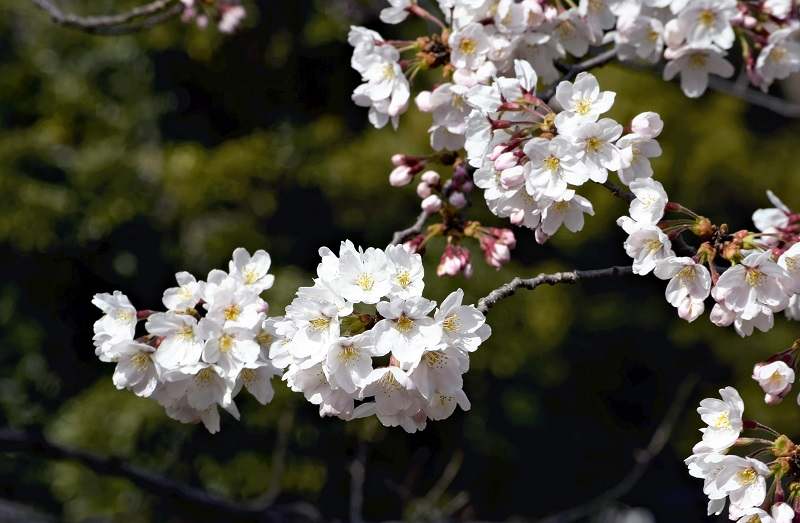
Blossoms of a possibly first-generation somei-yoshino tree
12:25 JST, March 29, 2022
A research team says all somei-yoshino cherry trees in Japan likely originated from four trees in a corner of Ueno Park in Taito Ward, Tokyo.
The team, led by Kazusa DNA Research Institute in Kisarazu, Chiba Prefecture, presented the find at a Japanese Society of Breeding conference in March.
The species does not reproduce through seed propagation, but rather via grafting and cuttings. As such, every somei-yoshino tree in Japan is likely a clone with the same genome, except for slight variations. This also explain why the flowers of such trees bloom and fall at the same time if in similar climatic conditions.
The circumstances behind the genesis of the species are not known. Some experts believe it was a result of natural hybridization of wild species, while others posit it came about through crossbreeding by a gardener in Somei-mura (present-day Toshima Ward, Tokyo) during the Edo period (1603-1867).
The location of the original tree is also unknown, but in 2015, Chiba University researchers analyzed the genes of somei-yoshino trees in Ueno Park and reported that one of the four trees in a corner near the center of the park was a possible candidate.
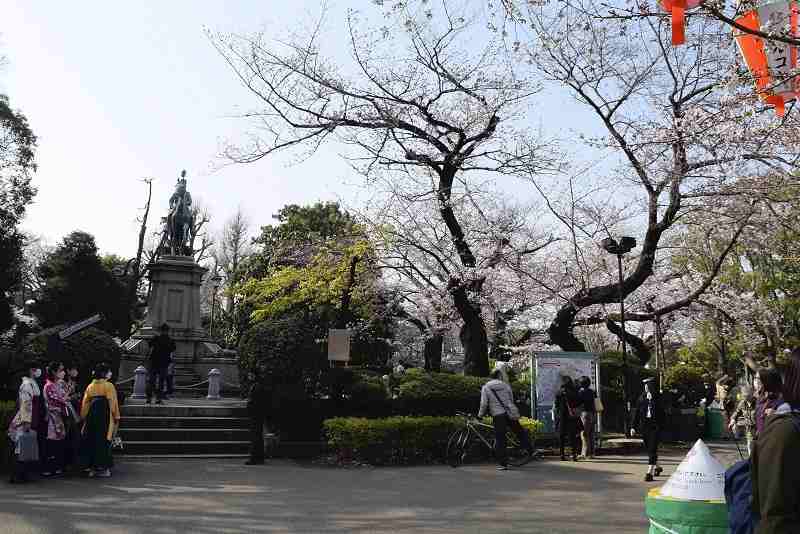
Two of four somei-yoshino trees identified as being the likely ancestor of all such trees in Japan are seen Ueno Park in Taito Ward, Tokyo, on Friday.
Kenta Shirasawa, a senior researcher at the institute who specializes in plant genetics and breeding, worked with his team to analyze 46 trees in 19 prefectures across Japan — from Aomori to Miyazaki — including the four in Ueno Park. Genomes were compared by examining subtle variances.
Based on these variances, the 46 trees were divided into six groups — each of the Ueno Park trees fell within a different group. It is unlikely that the four trees were planted side by side in Ueno Park by chance, leading researchers to presume that the differently grouped trees all originated from the Ueno quartet and spread throughout the country.
Ikuo Nakamura, a professor of plant genetics at Chiba University who reported the original tree candidates in 2015 and was not part of the current team, said: “The detailed genome analysis reinforces some of our reported findings. It would be even more interesting if we could identify the original trees by discerning their age.”




Most Read
Popular articles in the past 24 hours
-

Lady Bess: Iroha Okuda, Mayuko Kominami Discuss Performing Elizab...
-

Japan Considering Taking Part in U.S. ‘Golden Dome’ Defense Syste...
-

Japan's TEPCO Releases Footage from Fukushima N-Plant Reactor
-

Oil Reserve Releases: G7 Members Unite against Growing Threat
-
46 Evacuated from UAE, Oman on Japanese Govt-chartered Flight
-

Japan's Sanyo Shinkansen Suspended Again; Between Okayama, Aioi S...
-

Driver Dies in Collision with Express Train at Crossing in Mito; ...
-

Paw Patrol: Larry Marks 15 Years at 10 Downing Street
Popular articles in the past week
-
Japan Figure Skating Legend Yuzuru Hanyu Is Proud Disaster Surviv...
-

Nippon Life Insurance's U.S. Arm Sues OpenAI Over Legal Assistanc...
-
Govt to Utilize ODA for Ensuring Economic Security; Securing Ener...
-
15 Measles Patients Confirmed in Tokyo in Past 6 Days; 1 May Have...
-
Massive Sewer Pipe Found Jutting Out of Highway in Osaka
-
Japan Govt to Tighten Requirements to Receive Permanent Residency...
-
Beckoning Cats Get Makeover to Fit Modern Lifestyles with Sleek D...
-
Japan's 2nd Round of U.S. Investments May Be Worth Over $100 Bill...
Popular articles in the past month
-

Producer Behind Pop Group XG Arrested for Cocaine Possession
-

Japan PM Takaichi’s Cabinet Resigns en Masse
-

Man Infected with Measles Reportedly Dined at Restaurant in Tokyo...
-

Videos Plagiarized, Reposted with False Subtitles Claiming ‘Ryuky...
-
Japan Figure Skating Legend Yuzuru Hanyu Is Proud Disaster Surviv...
-

iPS Treatments Pass Key Milestone, but Broader Applications Far f...
-

Sanae Takaichi Elected Prime Minister of Japan; Keeps All Cabinet...
-

Nepal Bus Crash Kills 19 People, Injures 25 Including One Japanes...
Top Articles in Society
-
Producer Behind Pop Group XG Arrested for Cocaine Possession
-
Man Infected with Measles Reportedly Dined at Restaurant in Tokyo Station
-

Bus Carrying 40 Passengers Catches Fire on Chuo Expressway; All Evacuate Safely
-
15 Measles Patients Confirmed in Tokyo in Past 6 Days; 1 May Have Come into Contact with Many in Shibuya
-

Ibaraki Pref.’s 1st Foreign Bus Driver Hired in Tsukuba
JN ACCESS RANKING
-
Producer Behind Pop Group XG Arrested for Cocaine Possession
-
Japan PM Takaichi’s Cabinet Resigns en Masse
-
Man Infected with Measles Reportedly Dined at Restaurant in Tokyo Station
-
Videos Plagiarized, Reposted with False Subtitles Claiming ‘Ryukyu Belongs to China’; Anti-China False Information Also Posted in Japan
-
Japan Figure Skating Legend Yuzuru Hanyu Is Proud Disaster Survivor and Gold Medalist, Vows to Continue Support Efforts