
Council Submits Proposals for Revising Retrial System; Some Legal Experts Say Changes Do Not Go Far Enough
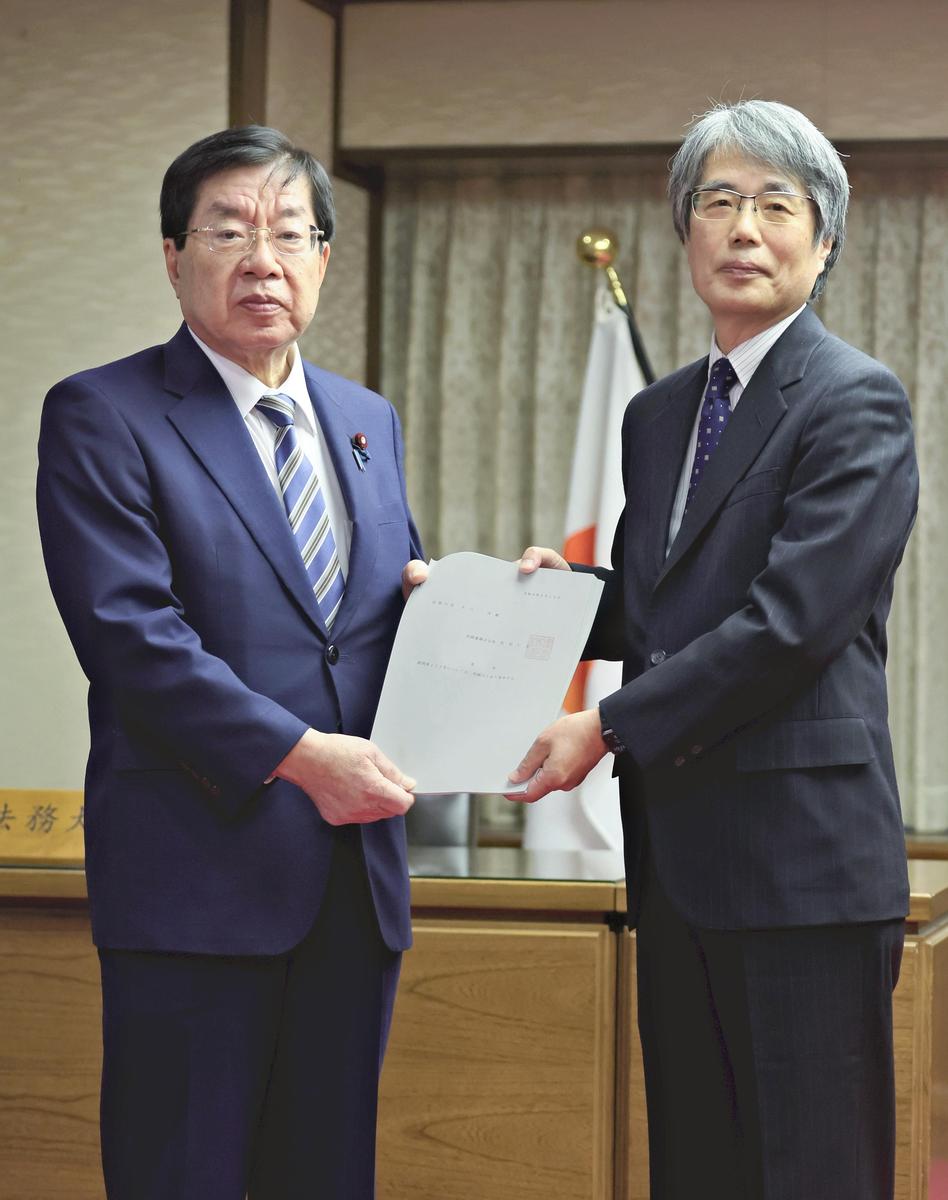
Justice Minister Hiroshi Hiraguchi, left, receives a report on proposals for revising the retrial system from Hitoshi Saeki, head of the Justice Ministry’s Legislative Council, in Chiyoda Ward, Tokyo, on Thursday.
7:00 JST, February 14, 2026
An advisory body to Justice Minister Hiroshi Hiraguchi has sent the minister a report outlining a set of proposals for revising the nation’s retrial system.
The proposals include establishing a legal provision stipulating an obligation to disclose evidence, though they would not ban prosecutors from appealing against a court’s order to commence a retrial.
The Justice Ministry plans to submit a bill to revise the Criminal Procedure Code in accordance with the proposals during this year’s ordinary Diet session.
The Legislative Council adopted the proposals Thursday at a general meeting held behind closed doors. According to the ministry, 12 council members agreed with the proposed revisions, four members opposed them and one did not indicate their position.
“I want to prepare quickly so we can submit [the proposals] to the Diet as soon as possible,” Hiraguchi said after receiving the report.
The Japan Federation of Bar Associations has come out against the proposed changes. “Relief for victims of wrongful convictions takes such a long time. Appeals [by prosecutors] should be prohibited,” a council member from the federation said at a press conference in Tokyo after the meeting.
The retrial system is a procedure for rehearing a criminal trial in cases where there has been some issue such as an erroneous fact-finding that led to a finalized guilty ruling. The Criminal Procedure Code currently has few provisions stipulating how retrials should proceed, and there are no explicit provisions on the disclosure of evidence.
The council’s proposals would create a provision under which courts would have a duty to order prosecutors to disclose “evidence relevant to the reasons given for requesting a retrial.”
The proposals also clearly stipulate that disclosed evidence would be prohibited from being used “for any other purpose,” and that doing so would be subject to a penalty. Providing or displaying copies of evidence to third parties for purposes other than use for retrial request procedures also would be banned. However, some observers have raised concerns that these rules could restrict the ability of media organizations to cover cases, infringing on the public’s right to know.
The council proposes that a court that receives a request for a retrial should promptly look into the case. In cases such as those in which there is clearly no grounds for a retrial, the application is to be dismissed even before detailed proceedings start. If the court can not determine with certainty that the retrial request is groundless, full-scale proceedings are to begin, including the disclosure of evidence.
The proposals do not include a provision banning appeals by prosecutors, which have been criticized as inviting protracted hearings. Instead, the proposals adopted the views of prosecutors and scholars who insisted that appeals were necessary to correct erroneous decisions to start a retrial.
2 high-profile cases dragged on for years
Appeals have been cited as a factor in hearings dragging on in previous retrial cases.
For example, Iwao Hakamata, now 89, was convicted of the 1966 murder of a family of four in Shizuoka Prefecture and spent decades in prison before the Shizuoka District Court decided in 2014 that he should have a retrial. However, prosecutors appealed this decision, and the retrial, in which Hakamata was finally acquitted, did not actually begin until 2023 – nine years after the district court’s decision.
In another case, involving the murder of a junior high school girl in Fukui, 14 years passed between the court ordering a retrial and the proceedings actually getting underway.
Discussions on reviewing the retrial system were prompted by lessons learned from the sheer length of time it took to reverse Hakamata’s wrongful conviction. If his case had moved to a retrial as soon as the district court had made its decision, he could have been saved much more quickly. At a council subcommittee meeting held before the general meeting, a member of the Japan Federation of Bar Associations used this argument to demand that appeals by prosecutors be prohibited.
Prosecutors and scholars pushed back fiercely against that idea. They argued that if such a ban were implemented, a guilty ruling finalized under the three-tiered judicial system could be overturned by just a single decision, destabilizing “legal certainty.”
The fact that there are multiple cases of one court ordering a case to be retried, only for that ruling to be reversed, is also significant. According to the Justice Ministry, there have been 11 cases – including the Shizuoka and Fukui cases – in which requests for a retrial have been granted since 2008. Prosecutors filed appeals in eight of those cases, and four were ultimately reversed.
The ministry and prosecutors strongly believe that all such appeals are thoroughly and carefully considered and are never lodged to intentionally prolong trials.
The council’s proposals specified that any request for a retrial with no clear grounds is to be dismissed before detailed proceedings start. The federation strongly opposed this. “It’s possible that even cases that deserve to be heard could be promptly thrown out,” a federation official said.





Most Read
Popular articles in the past 24 hours
-

Ibaraki Pref.'s 1st Foreign Bus Driver Hired in Tsukuba
-

Trump Fires Homeland Security Secretary Noem after Mounting Criti...
-

Japanese Nationals in 4 Gulf Countries to Be Evacuated with Chart...
-

China’s National People’s Congress Opens: Military Expansion Cont...
-

Hanamaruki to Sell Liquid 'Shio-Koji' Seasoning to U.S. Consumers
-

Strawberry Prince’s Rinu Discusses His Dream of Voice Acting, Suc...
-

Japan Foreign Minister Confirms Two Japanese Detained in Iran
-

CARTOON OF THE DAY (March 6)
Popular articles in the past week
-

South Korea Tightens Rules on Foreigners Buying Homes in Seoul Me...
-

2 Unpublished Early Novellas by Japan's Kenzaburo Oe Discovered, ...
-

Strait of Hormuz Closure Shakes Markets; Prolonged Closure Could ...
-

Tourists Ignore Safety Barriers Near Famous Zao ‘Snow Monsters’ i...
-

Iran Situation: Japan Must Exert Diplomatic Efforts without Merel...
-

Amid Strait of Hormuz Blockade, Shipping Companies Scramble to Ge...
-
Measles Patient Visited Hospital in Bunkyo Ward, Tokyo, Metropoli...
-
Ibaraki Pref.'s 1st Foreign Bus Driver Hired in Tsukuba
Popular articles in the past month
-

Producer Behind Pop Group XG Arrested for Cocaine Possession
-

Japan PM Takaichi’s Cabinet Resigns en Masse
-

Man Infected with Measles Reportedly Dined at Restaurant in Tokyo...
-

Videos Plagiarized, Reposted with False Subtitles Claiming ‘Ryuky...
-

Prudential Life Insurance Plans to Fully Compensate for Damages C...
-

Woman with Measles Visited Hospital in Tokyo Multiple Times Befor...
-

iPS Treatments Pass Key Milestone, but Broader Applications Far f...
-

Sanae Takaichi Elected Prime Minister of Japan; Keeps All Cabinet...
Top Articles in Society
-
Producer Behind Pop Group XG Arrested for Cocaine Possession
-
Man Infected with Measles Reportedly Dined at Restaurant in Tokyo Station
-
Woman with Measles Visited Hospital in Tokyo Multiple Times Before Being Diagnosed with Disease
-

Bus Carrying 40 Passengers Catches Fire on Chuo Expressway; All Evacuate Safely
-

Tokyo Skytree’s Elevator Stops, Trapping 20 People; All Rescued (Update 1)
JN ACCESS RANKING
-
Producer Behind Pop Group XG Arrested for Cocaine Possession
-
Japan PM Takaichi’s Cabinet Resigns en Masse
-
Man Infected with Measles Reportedly Dined at Restaurant in Tokyo Station
-
Videos Plagiarized, Reposted with False Subtitles Claiming ‘Ryukyu Belongs to China’; Anti-China False Information Also Posted in Japan
-
Prudential Life Insurance Plans to Fully Compensate for Damages Caused by Fraudulent Actions Without Waiting for Third-Party Committee Review