
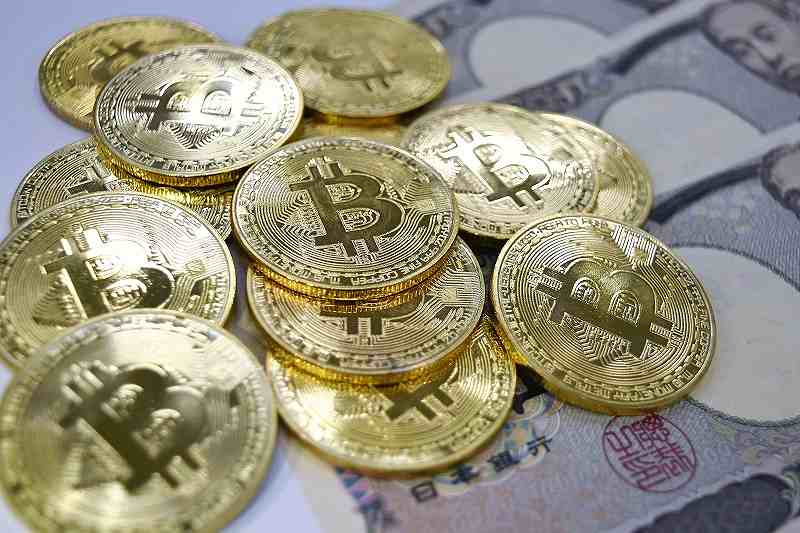
An image of bitcoin crypto-assets
1:00 JST, June 8, 2022
The Justice Ministry is planning legal revisions to ensure the confiscation of crypto-assets illegally obtained by crime groups and others.
Crypto-assets are sometimes targeted in cyber-attacks or used for money laundering, but current laws do not clearly stipulate whether they are included in the proceeds that can be confiscated by judicial authorities.
“This may obstruct the confiscation of the profits from crimes,” a ministry official said.
The Law on Punishment of Organized Crimes and Control of Proceeds of Crime is used to crack down on organized crimes by gangs and money laundering. The law allows the confiscation of real estate, such as land plots and buildings; movables such as cash and precious metals; and pecuniary claims such as savings.
However, crypto-assets are not guaranteed by governments or central banks unlike yen, dollars and other currencies, and the entities that issue the assets are not always clear. The general interpretation is therefore that crypto-assets do not constitute real estate, movables nor pecuniary claims.
If the owner of crypto-assets deposits them with dealer companies called exchanges, it is possible to regard the crypto-assets as a pecuniary claim, but the distinction is ambiguous.
Even if police or other judicial authorities find crypto-assets that were stolen in cyber-attacks or swapped with illegally obtained money, those crypto-assets might remain in the hands of criminals.
“Necessary legislative action should be taken to make sure they can be confiscated,” a source with the prosecutorial authorities said.
International organizations have deemed it problematic that Japan’s legal penalties are lenient regarding money laundering.
In February, the Legislative Council, an advisory panel for the justice minister, submitted a report that said penalties need to be strengthened regarding the concealment of proceeds from crime and other violations.
To clarify that crypto-assets can be confiscated, the ministry will decide on the details of the revisions to the Law on Punishment of Organized Crimes and Control of Proceeds of Crime by the end of this fiscal year at the earliest, after the Legislative Council discusses the issue.
Secret keys that are equivalent to PIN codes are necessary for trading crypto-assets. The ministry will likely consider how to deal with these systems, to more effectively confiscate assets.
According to the Japan Virtual and Crypto assets Exchange Association, the total trading value of crypto-assets in Japan rose to about ¥117.97 trillion in fiscal 2020. That figure was 33 times the level in fiscal 2016.
However, in 2018, there was an incident in which about ¥58 billion worth of crypto-assets were stolen from an exchange company hit by cyberattacks. There have also been an increasing number of cases in which exchange companies contacted relevant authorities about transactions that might be money laundering.
Crypto-assets are virtual money that is traded on the internet. A revision of the Payment Services Law in 2019 changed the naming from virtual currencies to crypto-assets.
Generally, people can purchase crypto-assets by opening accounts in exchange companies and depositing money.
More than 6,000 kinds of crypto-assets were estimated to be circulating in the market as of the end of March 2021, with the most famous being bitcoin.





Most Read
Popular articles in the past 24 hours
-

Japan Defense Agency to Develop AI Intelligence Analysis System f...
-

Moai Statue Shows Lasting Bond Between Miyagi Pref. Town, Easter ...
-

Milano Cortina 2026: Japan’s Oguri Wins Para Snowboard Silver at ...
-
Japan's Defense Ministry: North Korea Appears to Have Fired Balli...
-

Aichi Fisheries Cooperatives Use Smart Tech to Farm Triploid Oyst...
-

National Intelligence Council: Proposed Body Must Be Utilized To ...
-
Teachers Support Students’ Inquiry Learning behind the Scenes
-
Japan's Lower House Passes Budget Proposal; Could Be Delayed in U...
Popular articles in the past week
-

Japan Figure Skating Legend Yuzuru Hanyu Is Proud Disaster Surviv...
-
Govt to Utilize ODA for Ensuring Economic Security; Securing Ener...
-
15 Measles Patients Confirmed in Tokyo in Past 6 Days; 1 May Have...
-
Massive Sewer Pipe Found Jutting Out of Highway in Osaka
-
Japan Govt to Tighten Requirements to Receive Permanent Residency...
-
JR Tokai Breaks Ground on Yamanashi Maglev Station; Will Be Part ...
-
Power Outage Forces About 980 Passengers in Yokohama to Walk to T...
-

Beckoning Cats Get Makeover to Fit Modern Lifestyles with Sleek D...
Popular articles in the past month
-

Producer Behind Pop Group XG Arrested for Cocaine Possession
-

Japan PM Takaichi’s Cabinet Resigns en Masse
-

Man Infected with Measles Reportedly Dined at Restaurant in Tokyo...
-

Videos Plagiarized, Reposted with False Subtitles Claiming ‘Ryuky...
-
Japan Figure Skating Legend Yuzuru Hanyu Is Proud Disaster Surviv...
-

iPS Treatments Pass Key Milestone, but Broader Applications Far f...
-

Sanae Takaichi Elected Prime Minister of Japan; Keeps All Cabinet...
-

Nepal Bus Crash Kills 19 People, Injures 25 Including One Japanes...
Top Articles in Society
-
Producer Behind Pop Group XG Arrested for Cocaine Possession
-
Man Infected with Measles Reportedly Dined at Restaurant in Tokyo Station
-
15 Measles Patients Confirmed in Tokyo in Past 6 Days; 1 May Have Come into Contact with Many in Shibuya
-

Bus Carrying 40 Passengers Catches Fire on Chuo Expressway; All Evacuate Safely
-

Ibaraki Pref.’s 1st Foreign Bus Driver Hired in Tsukuba
JN ACCESS RANKING
-
Producer Behind Pop Group XG Arrested for Cocaine Possession
-
Japan PM Takaichi’s Cabinet Resigns en Masse
-
Man Infected with Measles Reportedly Dined at Restaurant in Tokyo Station
-
Videos Plagiarized, Reposted with False Subtitles Claiming ‘Ryukyu Belongs to China’; Anti-China False Information Also Posted in Japan
-
Japan Figure Skating Legend Yuzuru Hanyu Is Proud Disaster Survivor and Gold Medalist, Vows to Continue Support Efforts