
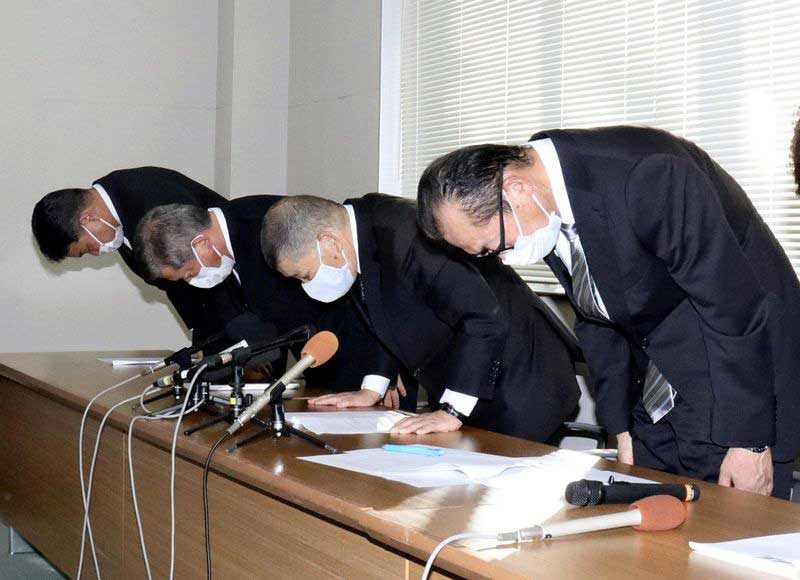
Yaizu Fisheries Cooperative Association Chairman Kakujiro Nishikawa, third from left, and other executives bow during a press conference on Monday in Yaizu, Shizuoka Prefecture.
December 1, 2021
SHIZUOKA — Fisheries cooperative employees in Yaizu, Shizuoka Prefecture, were found to have sold bonito landed at a port in the city through illegal channels for decades, a local fishing co-op announced.
Yaizu Fisheries Cooperative Association Chairman Kakujiro Nishikawa submitted an inquest report to the prefecture and apologized for the trouble at a press conference Monday.
“It shouldn’t have occurred at a fish market that deals with important catches,” Nishikawa said. “I apologize for causing trouble to fishermen throughout the country.”
According to the Yaizu city government, the value of marine products landed at Yaizu Port is the highest in Japan, and the port also boasts the largest bonito catch in the country.
On Nov. 16, the Shizuoka District Public Prosecutors Office indicted five people on charges of pilfering 4.4 tons of frozen bonito worth ¥1.04 million owned by local fish wholesaler Kyokuyo-suisan Co. The five are: two former executives of a local fish processing company, two employees of a local shipping firm and a co-op employee.
The co-op employee allegedly instructed the shipping firm’s workers to carry away a portion of the bonito without weighing it, and the fish processing company falsely claimed that it owned the bonito.
The association set up an investigation committee comprising six lawyers and questioned all 116 co-op employees and eight retirees, while conducting an independent survey through an anonymous questionnaire.
According to its inquest report, in addition to the case in which the five have been indicted, thefts involving co-op employees have been rampant for decades.
Up until about 10 years ago, co-op employees received cash in return for selling fish on the black market, and the money was spent on year-end and New Year parties as well as trips paid for by the co-op.
However, the exact time period during which the illegal activities were carried out, the number of people involved and the amount of damage are unknown.
“We didn’t have compulsory investigative authority and the investigation was conducted based on interviewees’ memories, so we had limitations,” an association member said at the press conference.
Kyokuyo-suisan’s attorney Masashi Kawamura told The Yomiuri Shimbun, “We won’t be able to know [from the report] who was involved and how much damage was caused, so we urge the co-op to clarify matters.”





Most Read
Popular articles in the past 24 hours
-

Japan Defense Agency to Develop AI Intelligence Analysis System f...
-

Moai Statue Shows Lasting Bond Between Miyagi Pref. Town, Easter ...
-

Milano Cortina 2026: Japan’s Oguri Wins Para Snowboard Silver at ...
-
Japan's Defense Ministry: North Korea Appears to Have Fired Balli...
-
Aichi Fisheries Cooperatives Use Smart Tech to Farm Triploid Oyst...
-
Teachers Support Students’ Inquiry Learning behind the Scenes
-

Japan's Lower House Passes Budget Proposal; Could Be Delayed in U...
-

National Intelligence Council: Proposed Body Must Be Utilized To ...
Popular articles in the past week
-

Japan Figure Skating Legend Yuzuru Hanyu Is Proud Disaster Surviv...
-
Govt to Utilize ODA for Ensuring Economic Security; Securing Ener...
-
15 Measles Patients Confirmed in Tokyo in Past 6 Days; 1 May Have...
-
Massive Sewer Pipe Found Jutting Out of Highway in Osaka
-
Japan Govt to Tighten Requirements to Receive Permanent Residency...
-
JR Tokai Breaks Ground on Yamanashi Maglev Station; Will Be Part ...
-

Beckoning Cats Get Makeover to Fit Modern Lifestyles with Sleek D...
-
Power Outage Forces About 980 Passengers in Yokohama to Walk to T...
Popular articles in the past month
-

Producer Behind Pop Group XG Arrested for Cocaine Possession
-

Japan PM Takaichi’s Cabinet Resigns en Masse
-

Man Infected with Measles Reportedly Dined at Restaurant in Tokyo...
-

Videos Plagiarized, Reposted with False Subtitles Claiming ‘Ryuky...
-
Japan Figure Skating Legend Yuzuru Hanyu Is Proud Disaster Surviv...
-

iPS Treatments Pass Key Milestone, but Broader Applications Far f...
-

Sanae Takaichi Elected Prime Minister of Japan; Keeps All Cabinet...
-

Nepal Bus Crash Kills 19 People, Injures 25 Including One Japanes...
Top Articles in Society
-
Producer Behind Pop Group XG Arrested for Cocaine Possession
-
Man Infected with Measles Reportedly Dined at Restaurant in Tokyo Station
-
15 Measles Patients Confirmed in Tokyo in Past 6 Days; 1 May Have Come into Contact with Many in Shibuya
-

Bus Carrying 40 Passengers Catches Fire on Chuo Expressway; All Evacuate Safely
-

Ibaraki Pref.’s 1st Foreign Bus Driver Hired in Tsukuba
JN ACCESS RANKING
-
Producer Behind Pop Group XG Arrested for Cocaine Possession
-
Japan PM Takaichi’s Cabinet Resigns en Masse
-
Man Infected with Measles Reportedly Dined at Restaurant in Tokyo Station
-
Videos Plagiarized, Reposted with False Subtitles Claiming ‘Ryukyu Belongs to China’; Anti-China False Information Also Posted in Japan
-
Japan Figure Skating Legend Yuzuru Hanyu Is Proud Disaster Survivor and Gold Medalist, Vows to Continue Support Efforts