
With Heatstroke a Threat in Japan Even in September, Professionals Urge Keeping Hydrated, Using Air Conditioning
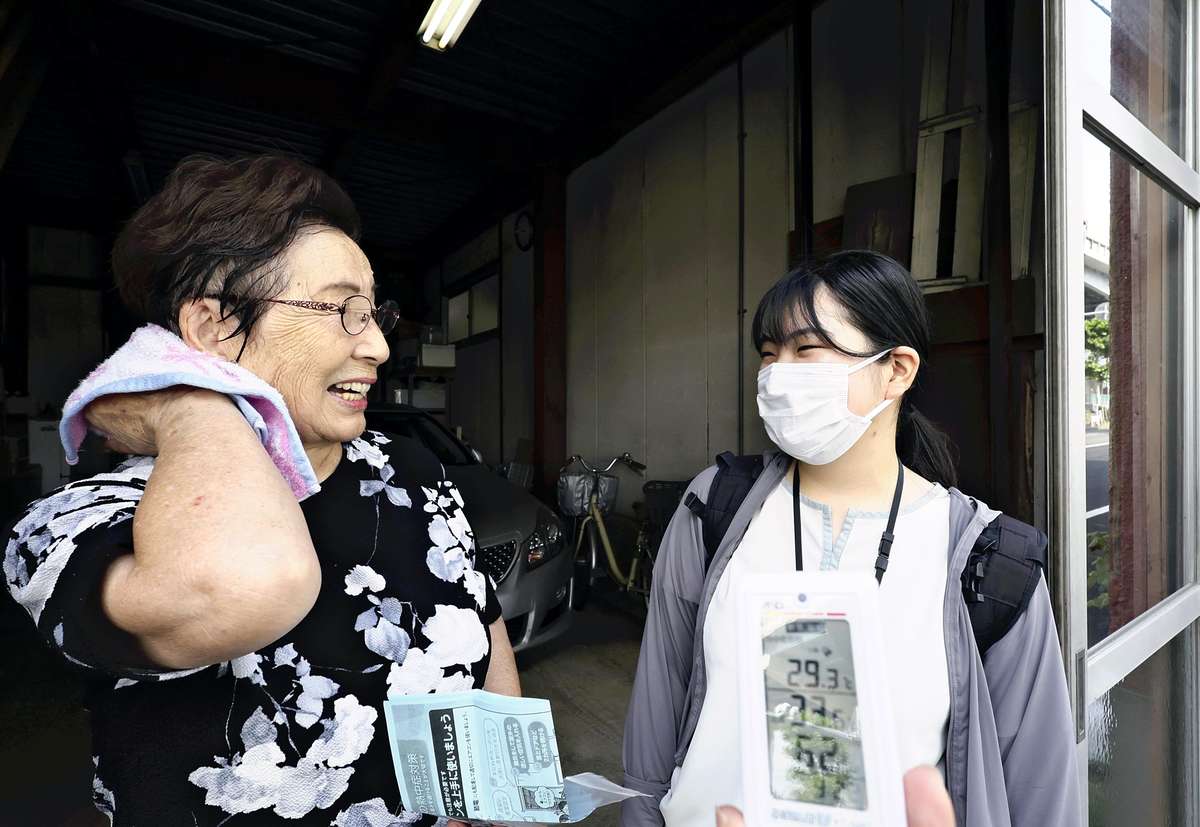
Consultation center staffer Mio Kobayashi, right, urges an elderly resident in Sumida Ward, Tokyo, to take precautions against heatstroke on Tuesday.
20:00 JST, August 30, 2025
August is drawing to a close, but the risk of heatstroke will remain high as sweltering heat continues to bake the nation after a summer that smashed temperature records.
The number of people hospitalized due to heatstroke this summer is on track to eclipse the record-high figure set last summer. The Tokyo metropolitan area recently recorded 10 consecutive days on which the temperature reached 35 C or higher, and intense heat is forecast in many regions for September. Taking precautions against heatstroke will remain essential in the weeks ahead.
On Tuesday morning, Mio Kobayashi, 26, a staffer at a consultation and counseling center for elderly people in Sumida Ward, Tokyo, visited the home of 85-year-old Eiko Toshida, who lives alone in the ward. “It’s still very hot, so don’t let your guard down,” said Kobayashi, as she urged Toshida to take steps to prevent heatstroke.
Kobayashi visits the homes of people aged 85 and older on her rounds, which she does by bicycle. She carries a device called a “heatstroke index monitor” that displayed a “severe warning” about the risk posed by the heat that day. “Are you using your air conditioner?” Kobayashi asked as she handed Toshida some salt replenishment tablets.
“It would be terrible if I collapsed while I was by myself,” Toshida said, wiping sweat from her face. “I use my cooler at night, too.”
Sumida Ward has eight such consultation and counseling centers for elderly residents. From May to September last year, staffers from these centers visited a total of 4,259 households of elderly people to check whether they were taking precautions against heatstroke. The people they visited included one who turned off the air conditioner because the air blowing from the machine made their “knees ache,” and others who were reluctant to drink more water because it made them go to the toilet more frequently.
In the past, there was a case of an elderly man who was rushed to a hospital after he was found collapsed in a room where the air conditioner was not working. “I’ll tenaciously keep telling residents that these precautions could help save their lives,” Kobayashi said.
Stifling heat has continued across the archipelago since before this year’s rainy season ended. Both June and July set new records for the nation’s highest monthly average temperature, which the Japan Meteorological Agency described as “abnormal temperatures.”
In August, the city of Isesaki, Gunma Prefecture, sizzled in the nation’s highest-ever temperature of 41.8 C. The mercury also soared to 41.4 C in the town of Hatoyama, Saitama Prefecture, and in Shizuoka City, and to 41.2 C in Kiryu, Gunma Prefecture. All these temperatures topped the previous national record, which until last year had been 41.1 C. According to the Fire and Disaster Management Agency’s preliminary figures, 84,521 people across Japan were hospitalized due to heatstroke from May to Aug. 24. This figure is on track to exceed the record set in 2024.
According to the Tokyo Metropolitan Medical Examiner’s Office, 95 of the 98 people who had died from heatstroke in Tokyo’s 23 wards this year as of Tuesday were aged 60 or older. Forty-two were in their 70s and 32 were in their 80s. According to the office, 93 of these people died indoors, and 80% of them either did not have air conditioners or had not been using them.
The Japan Meteorological Agency forecasts that a high-pressure system over the Pacific Ocean will cover the archipelago in September as well, resulting in many days that are at least as hot as in an average year. More than 10,000 people across Japan were taken hospitalized due to heatstroke in September 2024 — the first time that level was reached in a September — so vigilance against the heat will be required in the weeks to come.
Koichi Inukai, an emergency physician and representative of a group formed by doctors and others to help prevent and raise awareness of heatstroke, pointed out that it was “dangerous” to conclude summer had finished based solely on the calendar. Inukai warned that damage to the body caused by the relentless heat could accumulate, and that people needed to be mindful of this.
“If you keep straining your body, there is a heightened risk that chronic diseases could get worse, such as diabetics having elevated blood sugar levels,” Inukai said. “I urge people to thoroughly follow basic precautions such as using the air conditioner and staying hydrated, and to be sure to maintain a well-regulated life.”





Most Read
Popular articles in the past 24 hours
-

National Intelligence Council: Proposed Body Must Be Utilized To ...
-

North Korea Fires about 10 Missiles toward Sea in Show of Force, ...
-
Japan's Defense Ministry: North Korea Appears to Have Fired Balli...
-

Milano Cortina 2026: Japan’s Daichi Oguri Wins Silver in Pa...
-

‘Kokuho’ Wins Record 10 Awards at Japan Academy Film Prize; Demon...
-

Aichi Fisheries Cooperatives Use Smart Tech to Farm Triploid Oyst...
-

CARTOON OF THE DAY (March 14)
-

Japan's Lower House Passes Budget Proposal; Could Be Delayed in U...
Popular articles in the past week
-

Japan Figure Skating Legend Yuzuru Hanyu Is Proud Disaster Surviv...
-
Govt to Utilize ODA for Ensuring Economic Security; Securing Ener...
-
15 Measles Patients Confirmed in Tokyo in Past 6 Days; 1 May Have...
-
Massive Sewer Pipe Found Jutting Out of Highway in Osaka
-
Japan Govt to Tighten Requirements to Receive Permanent Residency...
-

JR Tokai Breaks Ground on Yamanashi Maglev Station; Will Be Part ...
-
Power Outage Forces About 980 Passengers in Yokohama to Walk to T...
-

Beckoning Cats Get Makeover to Fit Modern Lifestyles with Sleek D...
Popular articles in the past month
-

Producer Behind Pop Group XG Arrested for Cocaine Possession
-

Japan PM Takaichi’s Cabinet Resigns en Masse
-

Man Infected with Measles Reportedly Dined at Restaurant in Tokyo...
-
Japan Figure Skating Legend Yuzuru Hanyu Is Proud Disaster Surviv...
-

iPS Treatments Pass Key Milestone, but Broader Applications Far f...
-

Sanae Takaichi Elected Prime Minister of Japan; Keeps All Cabinet...
-

South Korea Tightens Rules on Foreigners Buying Homes in Seoul Me...
-

Nepal Bus Crash Kills 19 People, Injures 25 Including One Japanes...
Top Articles in Society
-
Producer Behind Pop Group XG Arrested for Cocaine Possession
-
Man Infected with Measles Reportedly Dined at Restaurant in Tokyo Station
-
15 Measles Patients Confirmed in Tokyo in Past 6 Days; 1 May Have Come into Contact with Many in Shibuya
-

Bus Carrying 40 Passengers Catches Fire on Chuo Expressway; All Evacuate Safely
-

Ibaraki Pref.’s 1st Foreign Bus Driver Hired in Tsukuba
JN ACCESS RANKING
-
Producer Behind Pop Group XG Arrested for Cocaine Possession
-
Japan PM Takaichi’s Cabinet Resigns en Masse
-
Man Infected with Measles Reportedly Dined at Restaurant in Tokyo Station
-
Japan Figure Skating Legend Yuzuru Hanyu Is Proud Disaster Survivor and Gold Medalist, Vows to Continue Support Efforts
-
iPS Treatments Pass Key Milestone, but Broader Applications Far from Guaranteed