
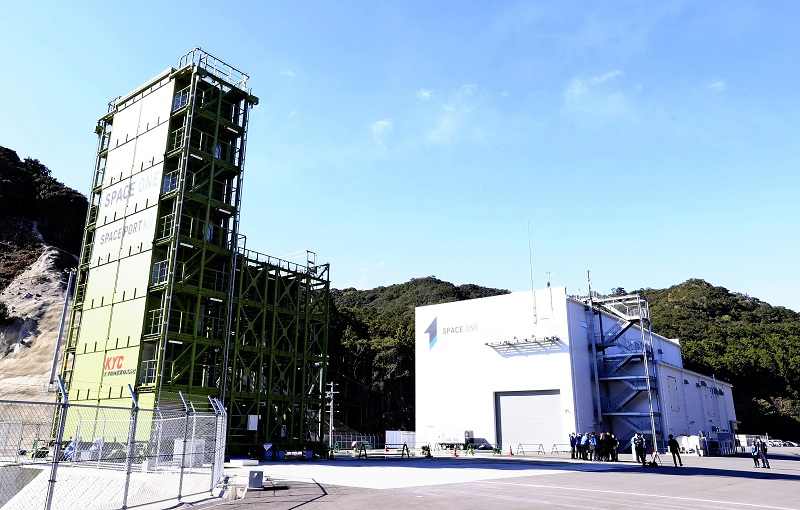
Japan’s first civilian rocket launch site, Space Port Kii in Kushimoto, Wakayama Prefecture, is seen Thursday.
13:55 JST, December 23, 2022
KUSHIMOTO, Wakayama — The nation’s first civilian rocket launch site, located in the town of Kushimoto, Wakayama Prefecture, was unveiled to the press on Thursday.
Space Port Kii was constructed by Tokyo-based startup Space One Co., which is planning to launch its first rocket at the end of February.
The company developed the launch facility with the aim to start providing commercial space transportation services, such as sending small satellites into orbit.
A rocket launch was originally scheduled for fiscal year 2021 but was postponed twice due to logistical problems caused by the COVID-19 pandemic and Russia’s invasion of Ukraine, both of which hindered the procurement of necessary parts.
Space One gave the press a look at its facilities, including the main command building, which controls launches, and a service tower built on a rocket launch pad. The tower moves on rails to accommodate the placement of rockets to be launched.
“We‘re approaching the most significant point [of the project]. We want to make sure of carrying out every step involved,” the company official said.





Most Read
Popular articles in the past 24 hours
-

78% Interested in Reconstruction from 2011 Disaster; Concern High...
-

Japan’s Nikkei Stock Average Rise Lifted by AI Stocks, Easing Con...
-
2 Mt. Fuji Hikers Identified as Police Warn People Not to Climb i...
-

15 Years since Great East Japan Earthquake: How Can Affected Area...
-

Parents in Japan to Get Instagram Notifications When Teens Repeat...
-

Italy Shocks U.S. in World Baseball Classic Pool Game
-
Tokyo Conference 2026 Opens, Discusses Rebuilding Multilateralism...
-

Samurai Japan Routs Perky Czech Republic Team After Shuto, Muraka...
Popular articles in the past week
-

Ibaraki Pref.'s 1st Foreign Bus Driver Hired in Tsukuba
-

Nippon Life Insurance's U.S. Arm Sues OpenAI Over Legal Assistanc...
-
Govt to Utilize ODA for Ensuring Economic Security; Securing Ener...
-

Amid Strait of Hormuz Blockade, Shipping Companies Scramble to Ge...
-
Japan Govt Survey Finds Just 10% of Workers Want Working Hours to...
-
Japan's 2nd Round of U.S. Investments May Be Worth Over $100 Bill...
-

Beckoning Cats Get Makeover to Fit Modern Lifestyles with Sleek D...
-

Imperial Family Watches World Baseball Classic Game Against Austr...
Popular articles in the past month
-

Producer Behind Pop Group XG Arrested for Cocaine Possession
-

Japan PM Takaichi’s Cabinet Resigns en Masse
-

Man Infected with Measles Reportedly Dined at Restaurant in Tokyo...
-

Videos Plagiarized, Reposted with False Subtitles Claiming ‘Ryuky...
-

iPS Treatments Pass Key Milestone, but Broader Applications Far f...
-

Sanae Takaichi Elected Prime Minister of Japan; Keeps All Cabinet...
-

Nepal Bus Crash Kills 19 People, Injures 25 Including One Japanes...
-

South Korea Tightens Rules on Foreigners Buying Homes in Seoul Me...
Top Articles in Science & Nature
-
iPS Treatments Pass Key Milestone, but Broader Applications Far from Guaranteed
-
Record 700 Startups to Gather at SusHi Tech Tokyo in April; Event Will Center on Themes Like Artificial Intelligence and Robotics
-
iPS Cell Products for Parkinson’s, Heart Disease OK’d for Commercialization by Japan Health Ministry Panel
-
Japan to Ban Use of Power Banks on Airplanes
-

Mt. Meakan in Japan’s Hokkaido Erupts, Plume Reaches 100 Meters
JN ACCESS RANKING
-
Producer Behind Pop Group XG Arrested for Cocaine Possession
-
Japan PM Takaichi’s Cabinet Resigns en Masse
-
Man Infected with Measles Reportedly Dined at Restaurant in Tokyo Station
-
Videos Plagiarized, Reposted with False Subtitles Claiming ‘Ryukyu Belongs to China’; Anti-China False Information Also Posted in Japan
-
iPS Treatments Pass Key Milestone, but Broader Applications Far from Guaranteed