
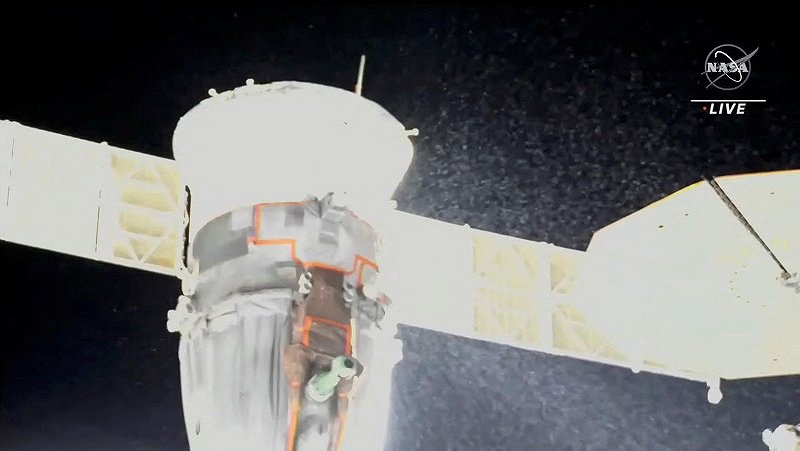
A stream of particles, which NASA says appears to be liquid and possibly coolant, sprays out of the Soyuz spacecraft on the International Space Station, forcing a delay of a routine planned spacewalk by two Russian cosmonauts on Dec. 14.
13:56 JST, December 21, 2022
A routine spacewalk by two Russian cosmonauts aboard the International Space Station (ISS) was called off as it was about to begin after flight controllers noticed a stream of liquid spewing from a docked Soyuz spacecraft, a NASA webcast showed.
The spray of fluid, which was visible in NASA’s live video feed as a torrent of snowflake-like particles emanating from the rear section of the Soyuz MS-22 capsule, was described by a NASA commentator as a coolant leak.
NASA said none of the seven members of the current International Space Station (ISS) crew — three Russian cosmonauts, three U.S. NASA astronauts and a Japanese astronaut — was ever in any danger.
The mishap occurred just as two of the cosmonauts, crew commander Sergey Prokopyev and flight engineer Dimitri Petelin, were suited and preparing for a planned spacewalk to move a radiator from one module to another on the Russian segment of the ISS.
An official for Russia’s mission control operations near Moscow was heard telling Prokopyev and Petelin in a radio transmission that their spacewalk was being canceled while engineers worked to determine the nature and origin of the leak.
The NASA commentator on the livestream, Rob Navias, broadcasting from NASA’s Johnson Space Center in Houston, also said the spacewalk was called off because of the leak, which he said began about 7:45 p.m. EST.
Navias said the Soyuz craft arrived at the space station in September, bringing Prokopyev, Petelin and U.S. astronaut Frank Rubio to the ISS, and has remained attached to the Earth-facing side of the orbital laboratory.
The spacewalk planned for Dec. 14 was postponed once before, in late November, because of faulty cooling pumps in the cosmonauts’ spacesuits, Navias said.
The spacewalk was to be the 12th this year at the ISS and the 257th in the history of the 22-year-old platform for assembly, maintenance and upgrade work, according to NASA.
Navias said it was too soon to know what implications the leak might have for the integrity of that spacecraft, and whether it might pose any difficulties for returning crew to Earth at the end of their mission.




Most Read
Popular articles in the past 24 hours
-

Young People in Japan Grapple with Social Media Addiction
-
Ruling Coalition Calls for Opposition Participation in ‘National ...
-

Japan’s Updated ‘Free and Open Indo-Pacific’ Initiative to Streng...
-

Myaku-Myaku Fan Event Held in Osaka; ‘Its Butt is so Cute!’ Says ...
-

Takaichi Chats with Tunku Tunku, Interactive Mascot for Internati...
-

Milano Cortina 2026: Riku Miura and Ryuichi Kihara Win Japan̵...
-

Ginza West Confectionery Store Staying True to Its Roots
-

Robert Duvall, Oscar-Winning Actor and 'Godfather' Mainstay, Dead...
Popular articles in the past week
-

Videos Plagiarized, Reposted with False Subtitles Claiming ‘Ryuky...
-

Woman with No Overseas Travel History Infected with Measles in Na...
-

Milano Cortina 2026: Kokomo Murase Comes Out on Top After Overcom...
-
CRA Leadership Election Will Center on Party Rebuilding; Lower Ho...
-

Tokyo’s New Record-Breaking Fountain Named ‘Tokyo Aqua Symphony’
-

Crime in Japan Ticks Up for 4th Straight Year
-

Japanese Constitutional Revision Debate Expected to be Revived Af...
-
Chemical Tanker Collides with Fishing Boat off Kobe with No Fuel ...
Popular articles in the past month
-

Japan Institute to Use Domestic Commercial Optical Lattice Clock ...
-

Israeli Ambassador to Japan Speaks about Japan’s Role in the Reco...
-

Man Infected with Measles May Have Come in Contact with Many Peop...
-

China Eyes Rare Earth Foothold in Malaysia to Maintain Dominance,...
-

Prudential Life Insurance Plans to Fully Compensate for Damages C...
-
Woman with Measles Visited Hospital in Tokyo Multiple Times Befor...
-
Australian Woman Dies After Mishap on Ski Lift in Nagano Prefectu...
-
Foreign Snowboarder in Serious Condition After Hanging in Midair ...
Top Articles in Science & Nature
-
Japan Institute to Use Domestic Commercial Optical Lattice Clock to Set Japan Standard Time
-

Space Mission Demonstrates Importance of International Cooperation, Astronaut Kimiya Yui Says
-
Japan to Face Shortfall of 3.39 Million Workers in AI, Robotics in 2040; Clerical Workers Seen to Be in Surplus
-

Record 700 Startups to Gather at SusHi Tech Tokyo in April; Event Will Center on Themes Like Artificial Intelligence and Robotics
JN ACCESS RANKING
-
Japan Institute to Use Domestic Commercial Optical Lattice Clock to Set Japan Standard Time
-
Israeli Ambassador to Japan Speaks about Japan’s Role in the Reconstruction of Gaza
-
Man Infected with Measles May Have Come in Contact with Many People in Tokyo, Went to Store, Restaurant Around When Symptoms Emerged
-
Prudential Life Insurance Plans to Fully Compensate for Damages Caused by Fraudulent Actions Without Waiting for Third-Party Committee Review
-
Woman with Measles Visited Hospital in Tokyo Multiple Times Before Being Diagnosed with Disease