
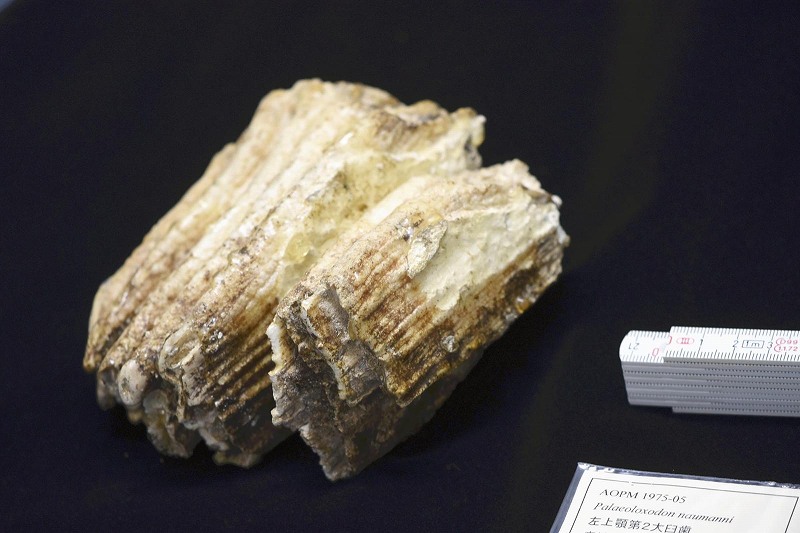
A fossilized molar of a Naumann’s elephant excavated in Aomori Prefecture
16:21 JST, January 6, 2026
A Japanese-led research team announced that it has conducted the first successful DNA analysis of Naumann’s elephant, an extinct species which once roamed Japan.
Naumann’s elephant belongs to Palaeoloxodon, an extinct genus of straight-tusked elephants that originated in Africa and dispersed across Eurasia. The team consisting of members from the University of Yamanashi, the National Museum of Nature and Science and other institutions found that the species diverged from its African ancestors at an early date, estimated at as much as 1.05 million years ago.
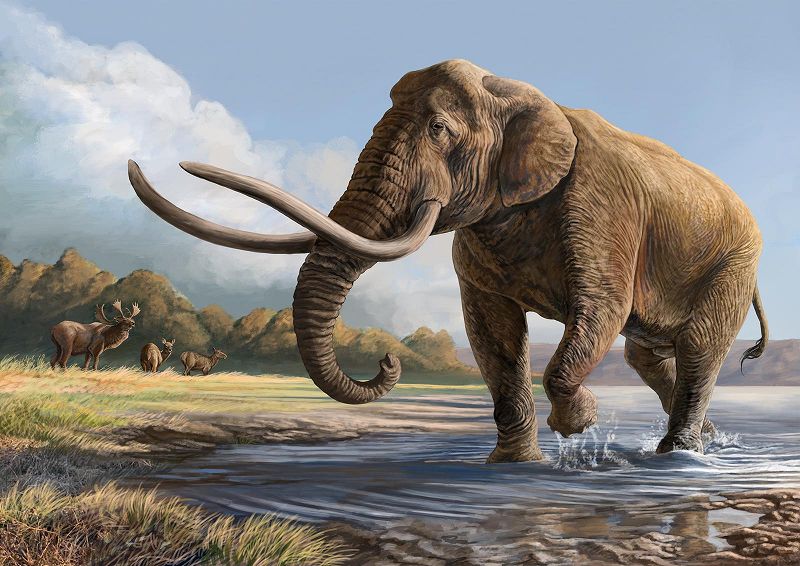
Reconstruction of a Naumann’s elephant
The findings were published in the scientific journal iScience.
Some species within Palaeoloxodon exceeded 4 meters in height at the shoulder. By comparison, Naumann’s elephant was relatively small, standing about 2 meters to 3 meters at the shoulder. Its ancestors migrated to Japan when the landmass was connected to the continent during a glacial period hundreds of thousands of years ago, when sea levels were lower.
You may also like to read
Oldest ‘Head-Butting’ Dinosaur Fossil Found in Mongolia; Team Includes Scientists From Okayama University of Science, Fukushima MuseumNaumann’s elephant is believed to have gone extinct in Japan between 20,000 and 30,000 years ago. While fossils have been discovered at about 300 sites nationwide, its genetic lineage had remained unknown.
The team successfully extracted and sequenced mitochondrial DNA — inherited from mother to offspring — from molar fossils of Naumann’s elephants dating from 49,000 and 34,000 years ago that were excavated in the village of Higashidori, Aomori Prefecture. The team compared these sequences with those from Palaeoloxodon fossils found in Germany and elsewhere.
Through the analysis, it was found that Naumann’s elephant represents an ancient lineage that diverged about 1.05 million years ago. It was previously thought that elephants from a more recent lineage gradually evolved smaller in Japan to become the Naumann’s elephant, but the latest findings strongly suggest that an early group migrating from Africa was its direct ancestor.
“It was found to be a living fossil that retained primitive characteristics lost on the continent,” said the team’s Naoki Kohno, director of the National Museum of Nature and Science’s Paleontology and Anthropology Department.
“This is an important achievement that allows us to infer details of its evolutionary history. Analysis of fossils from India and China, which are close to Japan, is also necessary,” said Keiichi Takahashi, Lake Biwa Museum honorary director and expert in paleontology.






Most Read
Popular articles in the past 24 hours
-

Milano Cortina 2026: Ceremony for Winter Paralympic Torch Relay T...
-

WBC to Begin: All the Pieces are in Place for Japan’s Second Stra...
-

How Trump Assassination Attempts Played into His Decision to Atta...
-

Tokyo High Court Upholds Unification Church Dissolution Order
-

CARTOON OF THE DAY (March 4)
-

PM Sanae Takaichi: Iran Situation Won’t Immediately Affect Electr...
-

Trump's Asian Allies Fear Iran War Will Sap Defenses against Chin...
-

Japanese Speedskater Takagi Announces Retirement
Popular articles in the past week
-

Tokyo Spends Big on Children, Wins Over Parents
-

Japan’s Miura, Kihara Announce Withdrawal from Figure Skating Wor...
-

South Korea Tightens Rules on Foreigners Buying Homes in Seoul Me...
-

BOJ Keeping Eye on Economy and Takaichi's ‘Proactive Fiscal Polic...
-

Tokyo Measles Patient Traveled to Fukuoka Aboard JAL Planes; Susp...
-

Nidec Chairman Resigns Amid Accounting Scandal at Major Japanese ...
-

Strait of Hormuz Closure Shakes Markets; Prolonged Closure Could ...
-

Tourists Ignore Safety Barriers Near Famous Zao ‘Snow Monsters’ i...
Popular articles in the past month
-

Producer Behind Pop Group XG Arrested for Cocaine Possession
-

Japan PM Takaichi’s Cabinet Resigns en Masse
-

Man Infected with Measles Reportedly Dined at Restaurant in Tokyo...
-

Israeli Ambassador to Japan Speaks about Japan’s Role in the Reco...
-

Videos Plagiarized, Reposted with False Subtitles Claiming ‘Ryuky...
-

Prudential Life Insurance Plans to Fully Compensate for Damages C...
-

Woman with Measles Visited Hospital in Tokyo Multiple Times Befor...
-

iPS Treatments Pass Key Milestone, but Broader Applications Far f...
Top Articles in Science & Nature
-
iPS Treatments Pass Key Milestone, but Broader Applications Far from Guaranteed
-

Record 700 Startups to Gather at SusHi Tech Tokyo in April; Event Will Center on Themes Like Artificial Intelligence and Robotics
-

iPS Cell Products for Parkinson’s, Heart Disease OK’d for Commercialization by Japan Health Ministry Panel
-

Japan to Ban Use of Power Banks on Airplanes
-

Total Lunar Eclipse Visible for Some in Japan, While Clouds Block View in Tokyo
JN ACCESS RANKING
-
Producer Behind Pop Group XG Arrested for Cocaine Possession
-
Japan PM Takaichi’s Cabinet Resigns en Masse
-
Man Infected with Measles Reportedly Dined at Restaurant in Tokyo Station
-
Israeli Ambassador to Japan Speaks about Japan’s Role in the Reconstruction of Gaza
-
Videos Plagiarized, Reposted with False Subtitles Claiming ‘Ryukyu Belongs to China’; Anti-China False Information Also Posted in Japan