
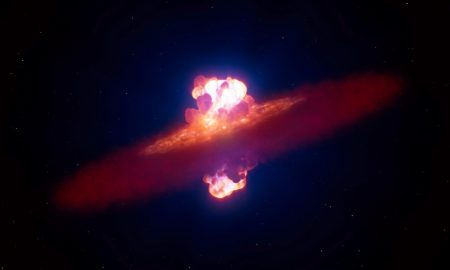
An artist’s impression shows a star exploding at the end of its lifecycle, in this image released by the European Southern Observatory on Nov. 12.
11:03 JST, December 3, 2025
WASHINGTON (Reuters) — The explosive death of a star — a supernova — is among the most violent cosmic events, but precisely how this cataclysm looks as it unfolds has remained mysterious. Scientists now have observed for the first time the very early stages of a supernova, with a massive star exploding in a distinctive olive-like shape.
The researchers used the European Southern Observatory’s Chile-based Very Large Telescope, or VLT, to observe the supernova, which involved a star roughly 15 times the mass of our sun residing in a galaxy called NGC 3621 about 22 million light-years from Earth in the direction of the constellation Hydra.
The shape of such explosions has been hard to nail down until now because of how rapidly they take place, so it took quick action with this supernova. The explosion was detected on April 10, 2024, around the time astrophysicist Yi Yang of Tsinghua University in China had landed on a long flight to San Francisco. Yang’s formal request just hours later to aim the VLT at the supernova was granted.
The researchers thus were able to observe the explosion just 26 hours after the initial detection and 29 hours after material from inside the star first broke through the stellar surface.
What they saw was the doomed star surrounded at its equator by a preexisting disk of gas and dust, with the explosion pushing material outward from the stellar core to distort the star’s shape into one resembling a vertical-standing olive. The explosion notably did not blow the star apart in a spherical shape. Instead, the explosion pushed violently outward at opposite sides of the star.
“The geometry of a supernova explosion provides fundamental information on stellar evolution and the physical processes leading to these cosmic fireworks,” said Yang, lead author of the study published on Nov. 12 in the journal Science Advances.
“The exact mechanisms behind supernova explosions of massive stars, those with more than eight times the mass of the sun, are still debated and are one of the fundamental questions scientists want to address,” Yang said.
Big stars like those live relatively short lives. This one, a type called a red supergiant, was about 25 million years old at the time of its demise. In comparison, the sun is more than 4.5 billion years old and has a few more billion years to go.
At the time it exploded, this star’s diameter was 600 times greater than the sun. Some of the star’s mass was blown into space in the explosion. The remainder is believed to have become a neutron star, a highly compact stellar remnant, according to study coauthor Dietrich Baade, a Germany-based astrophysicist at the European Southern Observatory.
“The first VLT observations captured the phase during which matter accelerated by the explosion near the center of the star shot through the star’s surface, the photosphere,” Yang said.
“Once the shock breaks through the surface, it unleashes immense amounts of energy. The supernova then brightens dramatically and becomes observable. During a short-lived phase, the supernova’s initial ‘breakout’ shape can be studied before the explosion interacts with the material surrounding the dying star,” Yang said.
This shape, Yang said, offers clues about how the explosion was triggered at the heart of the star. The observations seem to rule out some current scientific models of the explosion process, Yang said, as scientists refine their understanding of the deaths of massive stars.






Most Read
Popular articles in the past 24 hours
-

Lady Bess: Iroha Okuda, Mayuko Kominami Discuss Performing Elizab...
-

Japan Considering Taking Part in U.S. ‘Golden Dome’ Defense Syste...
-

Japan's TEPCO Releases Footage from Fukushima N-Plant Reactor
-

Oil Reserve Releases: G7 Members Unite against Growing Threat
-
46 Evacuated from UAE, Oman on Japanese Govt-chartered Flight
-

Japan's Sanyo Shinkansen Suspended Again; Between Okayama, Aioi S...
-

Driver Dies in Collision with Express Train at Crossing in Mito; ...
-

Raise Interest Rate, Stop Yen’s Fall to Stabilize Prices
Popular articles in the past week
-

Japan Figure Skating Legend Yuzuru Hanyu Is Proud Disaster Surviv...
-

Nippon Life Insurance's U.S. Arm Sues OpenAI Over Legal Assistanc...
-

Govt to Utilize ODA for Ensuring Economic Security; Securing Ener...
-
15 Measles Patients Confirmed in Tokyo in Past 6 Days; 1 May Have...
-
Massive Sewer Pipe Found Jutting Out of Highway in Osaka
-

Japan Govt to Tighten Requirements to Receive Permanent Residency...
-

Beckoning Cats Get Makeover to Fit Modern Lifestyles with Sleek D...
-

Japan's 2nd Round of U.S. Investments May Be Worth Over $100 Bill...
Popular articles in the past month
-

Producer Behind Pop Group XG Arrested for Cocaine Possession
-

Japan PM Takaichi’s Cabinet Resigns en Masse
-

Man Infected with Measles Reportedly Dined at Restaurant in Tokyo...
-

Videos Plagiarized, Reposted with False Subtitles Claiming ‘Ryuky...
-
Japan Figure Skating Legend Yuzuru Hanyu Is Proud Disaster Surviv...
-

iPS Treatments Pass Key Milestone, but Broader Applications Far f...
-

Sanae Takaichi Elected Prime Minister of Japan; Keeps All Cabinet...
-

Nepal Bus Crash Kills 19 People, Injures 25 Including One Japanes...
Top Articles in Science & Nature
-
iPS Treatments Pass Key Milestone, but Broader Applications Far from Guaranteed
-

Record 700 Startups to Gather at SusHi Tech Tokyo in April; Event Will Center on Themes Like Artificial Intelligence and Robotics
-

iPS Cell Products for Parkinson’s, Heart Disease OK’d for Commercialization by Japan Health Ministry Panel
-

Japan to Ban Use of Power Banks on Airplanes
-

Parents in Japan to Get Instagram Notifications When Teens Repeatedly Search for Suicide Content
JN ACCESS RANKING
-
Producer Behind Pop Group XG Arrested for Cocaine Possession
-
Japan PM Takaichi’s Cabinet Resigns en Masse
-
Man Infected with Measles Reportedly Dined at Restaurant in Tokyo Station
-
Videos Plagiarized, Reposted with False Subtitles Claiming ‘Ryukyu Belongs to China’; Anti-China False Information Also Posted in Japan
-
Japan Figure Skating Legend Yuzuru Hanyu Is Proud Disaster Survivor and Gold Medalist, Vows to Continue Support Efforts