
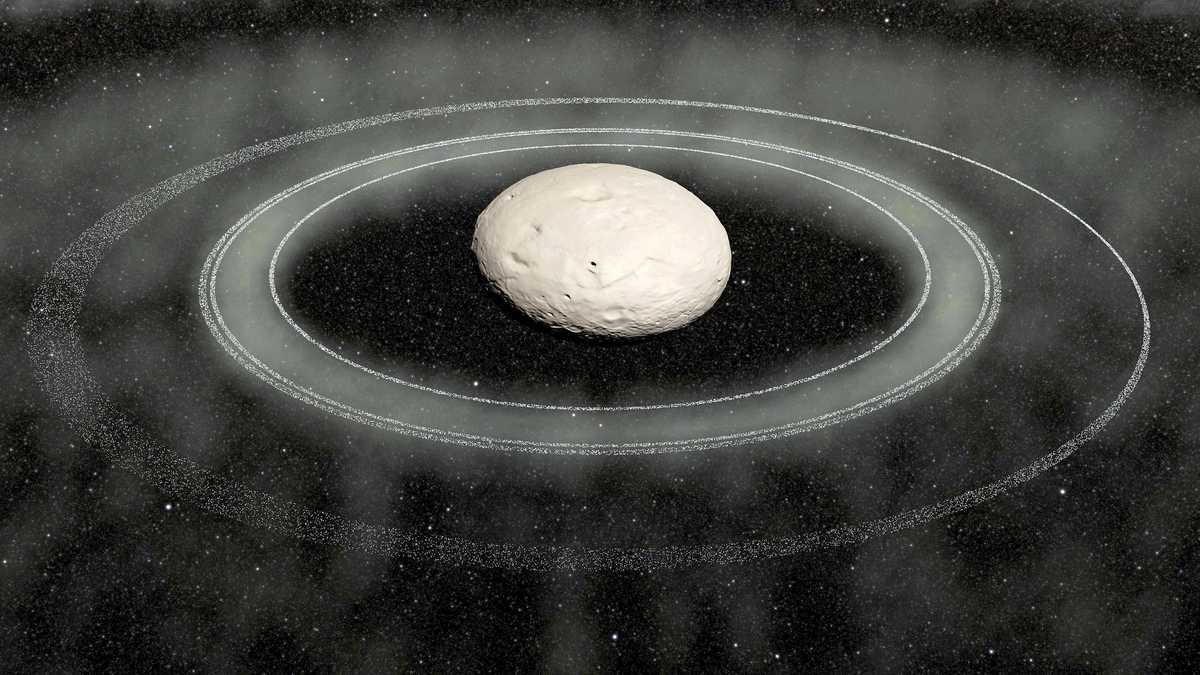
A reconstruction of the centaur object (2060) Chiron and its ring system is seen in this image released on Oct. 14.
13:39 JST, November 12, 2025
WASHINGTON (Reuters) — The rings of Saturn are among the wonders of our solar system, with a diameter of roughly 280,000 kilometers as they encircle the giant planet. But smaller celestial bodies in the solar system also boast ring systems that are impressive in their own right, even if their scale is not as grand.
Scientists said they have observed for the first time a ring system in the process of formation and evolution, consisting of four rings and diffuse material, surrounding a small icy body called Chiron that orbits the sun in the expanse between Saturn and Uranus.
Chiron is part of a class of objects called centaurs that populate the outer solar system between Jupiter and Neptune, displaying characteristics of both asteroids and comets. Formally called “(2060) Chiron,” it has a diameter of about 200 kilometers and takes about 50 years to complete one orbit around the sun. Centaurs are composed mainly of rock, water ice and complex organic compounds.
Since its discovery in 1977, astronomers have observed Chiron off and on, and for years had known it was surrounded by material of some sort. In the research, scientists obtained their best data on Chiron in 2023 using a telescope at the Pico dos Dias Observatory in Brazil to go along with data from 2011, 2018 and 2022.
The researchers said these observations clearly showed that it is surrounded by well-defined rings — three dense ones about 273 kilometers, 325 kilometers and 438 kilometers from Chiron’s center, and a fourth one, approximately 1,400 kilometers from its center. This outer feature, detected for the first time, lies unusually far from Chiron and, they said, requires further observations to confirm its stability as a ring. The three inner rings are embedded within dust swirling around in a disk-like shape.
Comparing data from the various observations of Chiron, the researchers detected significant changes in the ring system, clear evidence that its rings are evolving in real time, according to Chrystian Luciano Pereira, a postdoctoral researcher at the National Observatory in Brazil and lead author of the study published in the Astrophysical Journal Letters.
“This provides a rare glimpse into how such structures originate and change,” Pereira said.
Chiron’s rings, Pereira added, are likely composed mainly of water ice mixed with small amounts of rocky material, like those of Saturn. Water ice may play a key role in the stability of ring systems because its physical properties allow particles to remain separated instead of coalescing into a moon.
Chiron exhibits occasional comet-like activity — ejecting gas and dust into space. In 1993, Chiron even displayed a small tail of material, as comets do.
The researchers said its rings may be made of leftover material from a possible collision that destroyed a small moon of Chiron or from some other crashes of space debris, or could be from the stuff ejected from Chiron itself — or perhaps some combination of these factors.
“It is an evolving system that will help us understand the dynamical mechanisms governing the creation of rings and satellites around small bodies, with potential implications for various types of disk dynamics in the universe,” said astronomer and study coauthor Braga Ribas of the Federal University of Technology-Parana and the Interinstitutional Laboratory of e-Astronomy in Brazil.
All four of the solar system’s big outer planets — Jupiter, Saturn, Uranus and Neptune — have rings, with Saturn’s being the largest. But astronomers since 2014 have discovered that some of its smaller bodies have them, too. Chiron brings that number to four, joining fellow centaur Chariklo and two icy worlds beyond Neptune — Haumea and Quaoar.
“This diversity reminds us that ring formation is not exclusive to large planets. It’s a universal process that can occur wherever the right physical conditions exist,” Pereira said.
A method called stellar occultation was used by a team including Brazilian, French and Spanish researchers to observe the rings. The researchers watched as Chiron passed in front of a distant star, temporarily blocking its light. By measuring how the starlight dims from different locations on Earth, they were able to discern the environment around Chiron.
“We can reconstruct the shape and environment around the object with kilometer-scale precision,” Pereira said.





Most Read
Popular articles in the past 24 hours
-
Seeking Nuclear Waste Site, Japan Eyes Remote Island of Minami-To...
-
Total Lunar Eclipse Visible for Some in Japan, While Clouds Block...
-

Japan Ministry Asks to Conduct Nuclear Waste Disposal-related Sur...
-

WBC to Begin: All the Pieces are in Place for Japan’s Second Stra...
-

Japan's Nikkei Stock Average Slips to One-Month Low as Middle Eas...
-

Milano Cortina 2026: Ceremony for Winter Paralympic Torch Relay T...
-

Tokyo High Court Upholds Unification Church Dissolution Order; Li...
-

How Trump Assassination Attempts Played into His Decision to Atta...
Popular articles in the past week
-
Tokyo Spends Big on Children, Wins Over Parents
-

Japan’s Miura, Kihara Announce Withdrawal from Figure Skating Wor...
-

South Korea Tightens Rules on Foreigners Buying Homes in Seoul Me...
-

BOJ Keeping Eye on Economy and Takaichi's ‘Proactive Fiscal Polic...
-
Tokyo Measles Patient Traveled to Fukuoka Aboard JAL Planes; Susp...
-

Nidec Chairman Resigns Amid Accounting Scandal at Major Japanese ...
-

Strait of Hormuz Closure Shakes Markets; Prolonged Closure Could ...
-

Tourists Ignore Safety Barriers Near Famous Zao ‘Snow Monsters’ i...
Popular articles in the past month
-

Producer Behind Pop Group XG Arrested for Cocaine Possession
-

Japan PM Takaichi’s Cabinet Resigns en Masse
-

Man Infected with Measles Reportedly Dined at Restaurant in Tokyo...
-

Israeli Ambassador to Japan Speaks about Japan’s Role in the Reco...
-

Videos Plagiarized, Reposted with False Subtitles Claiming ‘Ryuky...
-

Prudential Life Insurance Plans to Fully Compensate for Damages C...
-

Woman with Measles Visited Hospital in Tokyo Multiple Times Befor...
-

iPS Treatments Pass Key Milestone, but Broader Applications Far f...
Top Articles in Science & Nature
-
iPS Treatments Pass Key Milestone, but Broader Applications Far from Guaranteed
-
Record 700 Startups to Gather at SusHi Tech Tokyo in April; Event Will Center on Themes Like Artificial Intelligence and Robotics
-
iPS Cell Products for Parkinson’s, Heart Disease OK’d for Commercialization by Japan Health Ministry Panel
-

Japan to Ban Use of Power Banks on Airplanes
-
Total Lunar Eclipse Visible for Some in Japan, While Clouds Block View in Tokyo
JN ACCESS RANKING
-
Producer Behind Pop Group XG Arrested for Cocaine Possession
-
Japan PM Takaichi’s Cabinet Resigns en Masse
-
Man Infected with Measles Reportedly Dined at Restaurant in Tokyo Station
-
Israeli Ambassador to Japan Speaks about Japan’s Role in the Reconstruction of Gaza
-
Videos Plagiarized, Reposted with False Subtitles Claiming ‘Ryukyu Belongs to China’; Anti-China False Information Also Posted in Japan