
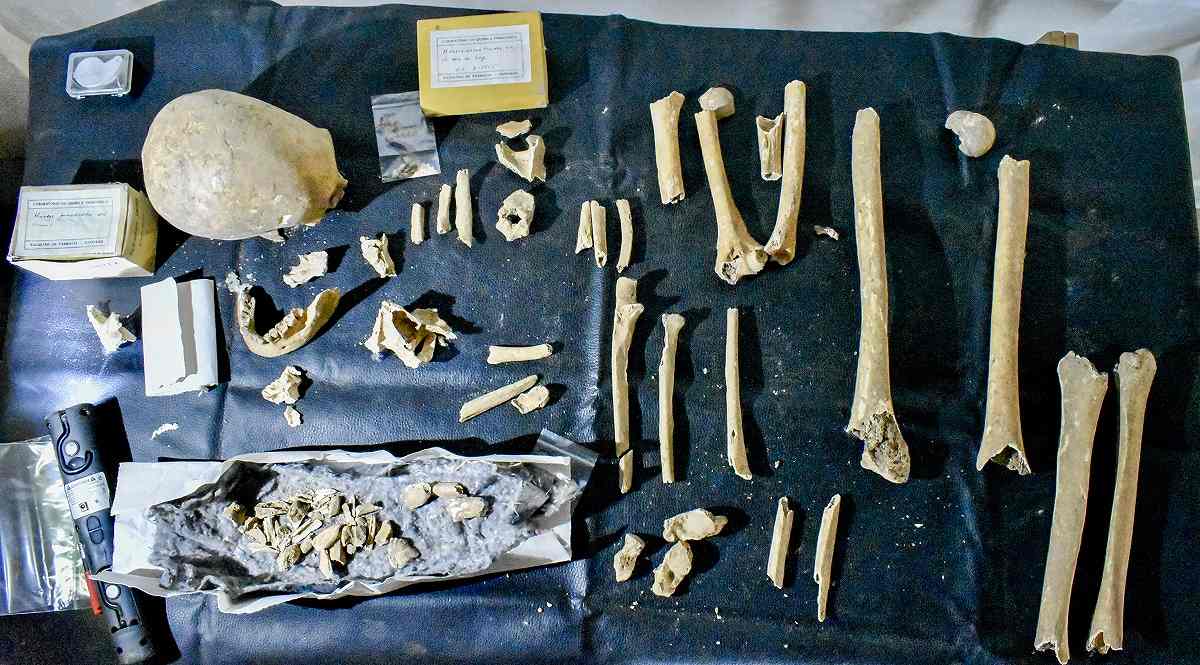
Human remains found in a tomb in northwestern Spain are seen in Santiago de Compostela, Spain in November 2019.
16:56 JST, August 29, 2024
MADRID (Reuters) — Remains found in a tomb in northwestern Spain are likely to belong to a ninth-century bishop believed to have helped create the Camino de Santiago, one of Christianity’s most popular pilgrimages, a new study has found.
A combination of bone analysis, carbon dating, stable isotope analysis and DNA testing yielded data that “supports the possibility” that the human bones found in 1955 are those of Bishop Thedomir, according to a paper published on Aug. 13 in the journal “Antiquity.”
Oral tradition, later written down, has it that Theodomir discovered the tomb of St. James the Apostle between 820 and 830 following a divine revelation in what is now Santiago de Compostela, the capital of the Galicia region.
News of the discovery reached King Alfonso II of the neighboring region of Asturias, who marched with his court from Oviedo to Santiago.
The 146 kilometer royal pilgrimage established what is today known as the “Primitive Way,” the oldest path used by pilgrims of the Camino, or Way of St. James.
Theodomir’s existence had been hotly debated until 1955, when Spanish archaeologist Manuel Chamoso Lamas discovered a tombstone underneath Santiago de Compostela’s cathedral inscribed with his name.
An initial study of the bones concluded that they probably came from an elderly adult male, but three decades later a new assessment based on photographs of the site proclaimed them to belong to a woman aged between 50 and 70.
The newest study, led by Patxi Perez-Ramallo of the Norwegian University of Science and Technology, combined different analytical methods in a bid to recreate the individual’s life story.
The carbon-14 dating shows the person died after the age of 45, and the bones’ features suggest they had a weak build and performed little physical work during their lifetime, which is consistent with the lifestyle of high clergy during the period.
Perez-Ramallo told El Pais newspaper that there was a “98% likelihood of it being Theodomir.”






Most Read
Popular articles in the past 24 hours
-
Moai Statue Shows Lasting Bond Between Miyagi Pref. Town, Easter ...
-

Milano Cortina 2026: Japan’s Oguri Wins Para Snowboard Silver at ...
-
Japan's Defense Ministry: North Korea Appears to Have Fired Balli...
-
Aichi Fisheries Cooperatives Use Smart Tech to Farm Triploid Oyst...
-

National Intelligence Council: Proposed Body Must Be Utilized To ...
-

Teachers Support Students’ Inquiry Learning behind the Scenes
-

Japan's Lower House Passes Budget Proposal; Could Be Delayed in U...
-

CARTOON OF THE DAY (March 14)
Popular articles in the past week
-

Japan Figure Skating Legend Yuzuru Hanyu Is Proud Disaster Surviv...
-

Govt to Utilize ODA for Ensuring Economic Security; Securing Ener...
-
15 Measles Patients Confirmed in Tokyo in Past 6 Days; 1 May Have...
-

Massive Sewer Pipe Found Jutting Out of Highway in Osaka
-

Japan Govt to Tighten Requirements to Receive Permanent Residency...
-

JR Tokai Breaks Ground on Yamanashi Maglev Station; Will Be Part ...
-

Power Outage Forces About 980 Passengers in Yokohama to Walk to T...
-

Beckoning Cats Get Makeover to Fit Modern Lifestyles with Sleek D...
Popular articles in the past month
-

Producer Behind Pop Group XG Arrested for Cocaine Possession
-

Japan PM Takaichi’s Cabinet Resigns en Masse
-

Man Infected with Measles Reportedly Dined at Restaurant in Tokyo...
-

Videos Plagiarized, Reposted with False Subtitles Claiming ‘Ryuky...
-
Japan Figure Skating Legend Yuzuru Hanyu Is Proud Disaster Surviv...
-

iPS Treatments Pass Key Milestone, but Broader Applications Far f...
-

Sanae Takaichi Elected Prime Minister of Japan; Keeps All Cabinet...
-

Nepal Bus Crash Kills 19 People, Injures 25 Including One Japanes...
Top Articles in Science & Nature
-
iPS Treatments Pass Key Milestone, but Broader Applications Far from Guaranteed
-

Record 700 Startups to Gather at SusHi Tech Tokyo in April; Event Will Center on Themes Like Artificial Intelligence and Robotics
-
iPS Cell Products for Parkinson’s, Heart Disease OK’d for Commercialization by Japan Health Ministry Panel
-

Parents in Japan to Get Instagram Notifications When Teens Repeatedly Search for Suicide Content
-

Japan to Ban Use of Power Banks on Airplanes
JN ACCESS RANKING
-
Producer Behind Pop Group XG Arrested for Cocaine Possession
-
Japan PM Takaichi’s Cabinet Resigns en Masse
-
Man Infected with Measles Reportedly Dined at Restaurant in Tokyo Station
-
Videos Plagiarized, Reposted with False Subtitles Claiming ‘Ryukyu Belongs to China’; Anti-China False Information Also Posted in Japan
-
Japan Figure Skating Legend Yuzuru Hanyu Is Proud Disaster Survivor and Gold Medalist, Vows to Continue Support Efforts