
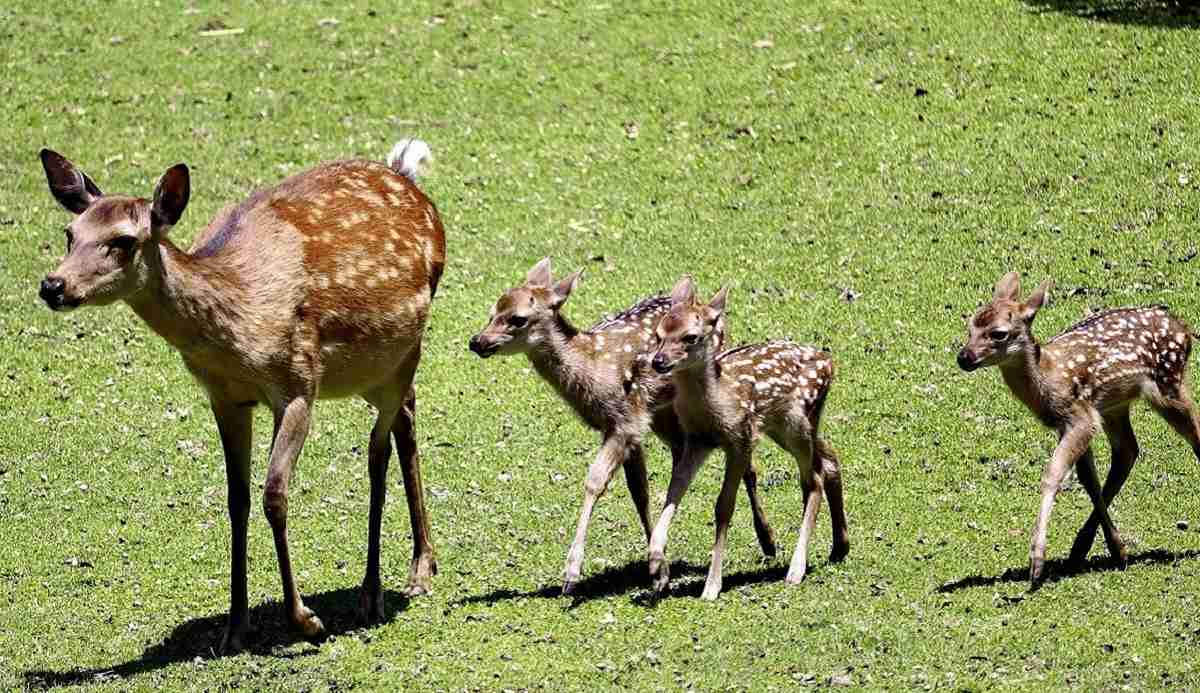
A family of Japanese deer walk in Nara Park in June 2022.
17:47 JST, February 8, 2023
TOKYO (Jiji Press) — A team of researchers from Japanese universities has found that a herd of Japanese deer inhabiting Nara Park has maintained a unique genotype for over 1,000 years.
Amid shrinking deer habitats caused by hunting and development, the herd in the park adjacent to Kasugataisha Shrine and local temples survived without mixing with other herds, as it was protected as sacred by humans, according to a paper released Jan. 31 by researchers at Fukushima University, Nara University of Education and Yamagata University.
The paper was published in the Journal of Mammalogy of the American Society of Mammalogists.
The team, including Toshihito Takagi, a graduate student at Fukushima University, collected muscle and blood samples from a total of 294 wild deer in 30 locations in the Kii Peninsula, including Nara Park, and analyzed their genetic structures.
The team found that deer in all locations had the same ancestors and could be divided into three groups — one in Nara Park, one in the western part of the Kii Peninsula and another in the eastern part of the peninsula.
The group from Nara Park had never mixed with the others after diverging from the ancestor group more than 1,000 years ago. The groups from the western and eastern parts of the Kii Peninsula diverged around the 16th century and mixed with each other in the central part of the peninsula.
The team said the outcome reflects the effects of human activities, noting that the overall number of deer has been decreasing due to the spread of rice cultivation, urbanization and hunting, while the worshiped herd of deer at Nara Park had been subject to protection.
It concluded that the unique genetic identity of the herd at the park has therefore been preserved for more than 1,000 years.
“Problems for people and the environment caused by deer overpopulation have become an issue. We hope the finding of our research will help people understand the origin of deer at Nara Park and devise new deer protection plans for the future,” Takagi said.








Most Read
Popular articles in the past 24 hours
-

Japan's Budget on Track for Quick Passage, but Ruling Parties to ...
-

Japan-Based USS Tripoli, Marine Unit to Be Sent to Middle East, U...
-

Ransomware Attacks Hitting Japan's Small, Midsize Firms
-

7 Men Arrested Over Robbery of ¥423 Mil. on Tokyo Street; Members...
-

North Korea Fires about 10 Missiles toward Sea in Show of Force, ...
-

German Journalist Traces Footsteps of Great-Grandfather Who Was P...
-

Hiroshima: Yamato Museum to Reopen on April 23 after Major Renova...
-

CARTOON OF THE DAY (March 14)
Popular articles in the past week
-

Japan Figure Skating Legend Yuzuru Hanyu Is Proud Disaster Surviv...
-
Govt to Utilize ODA for Ensuring Economic Security; Securing Ener...
-
15 Measles Patients Confirmed in Tokyo in Past 6 Days; 1 May Have...
-

Massive Sewer Pipe Found Jutting Out of Highway in Osaka
-

Japan Govt to Tighten Requirements to Receive Permanent Residency...
-

Power Outage Forces About 980 Passengers in Yokohama to Walk to T...
-
JR Tokai Breaks Ground on Yamanashi Maglev Station; Will Be Part ...
-

Beckoning Cats Get Makeover to Fit Modern Lifestyles with Sleek D...
Popular articles in the past month
-

Producer Behind Pop Group XG Arrested for Cocaine Possession
-

Japan PM Takaichi’s Cabinet Resigns en Masse
-

Man Infected with Measles Reportedly Dined at Restaurant in Tokyo...
-
Japan Figure Skating Legend Yuzuru Hanyu Is Proud Disaster Surviv...
-

iPS Treatments Pass Key Milestone, but Broader Applications Far f...
-

Sanae Takaichi Elected Prime Minister of Japan; Keeps All Cabinet...
-

South Korea Tightens Rules on Foreigners Buying Homes in Seoul Me...
-

Nepal Bus Crash Kills 19 People, Injures 25 Including One Japanes...
Top Articles in Science & Nature
-
iPS Treatments Pass Key Milestone, but Broader Applications Far from Guaranteed
-

Record 700 Startups to Gather at SusHi Tech Tokyo in April; Event Will Center on Themes Like Artificial Intelligence and Robotics
-

Parents in Japan to Get Instagram Notifications When Teens Repeatedly Search for Suicide Content
-
iPS Cell Products for Parkinson’s, Heart Disease OK’d for Commercialization by Japan Health Ministry Panel
-

Japan to Ban Use of Power Banks on Airplanes
JN ACCESS RANKING
-
Producer Behind Pop Group XG Arrested for Cocaine Possession
-
Japan PM Takaichi’s Cabinet Resigns en Masse
-
Man Infected with Measles Reportedly Dined at Restaurant in Tokyo Station
-
Japan Figure Skating Legend Yuzuru Hanyu Is Proud Disaster Survivor and Gold Medalist, Vows to Continue Support Efforts
-
iPS Treatments Pass Key Milestone, but Broader Applications Far from Guaranteed