
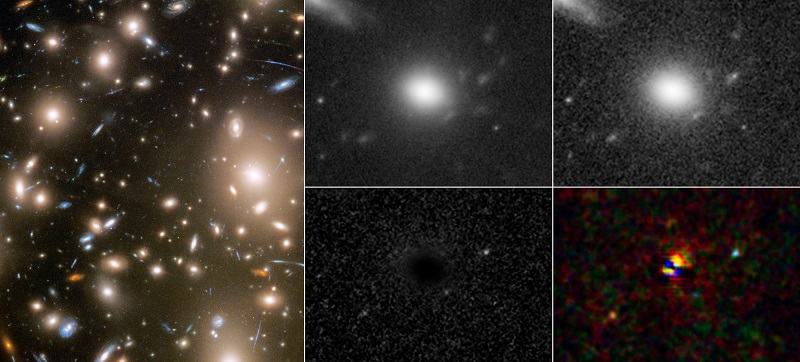
Clockwise from left: The portion of Abell 370 where the multiple images of the supernova appeared; the locations of the multiple-imaged host galaxy after the supernova faded in a composite of Hubble observations from 2011 to 2016; the images of the host galaxy and the supernova at different phases in its evolution in a Hubble picture from December 2010; the different colors of the cooling supernova at three different stages in its evolution; and three different faces of the evolving supernova.
5:05 JST, November 23, 2022
WASHINGTON (Reuters) — About 11.5 billion years ago, a distant star roughly 530 times larger than our sun died in a cataclysmic explosion that blew its outer layers of gas into the surrounding cosmos, a supernova documented by astronomers in blow-by-blow detail.
Researchers on Nov. 9 said NASA’s Hubble Space Telescope managed to capture three separate images spanning a period of eight days starting just hours after the detonation — an achievement even more noteworthy considering how long ago and far away it occurred.
The images were discovered in a review of Hubble observation archival data from 2010, according to astronomer Wenlei Chen, a University of Minnesota postdoctoral researcher and lead author of the study published in the journal Nature.
They offered the first glimpse of a supernova cooling rapidly after the initial explosion in a single set of images and the first in-depth look at a supernova so early in the universe’s history, when it was less than a fifth its current age.
“The supernova is expanding and cooling, so its color evolves from a hot blue to a cool red,” University of Minnesota astronomy professor and study coauthor Patrick Kelly said.
The doomed star, a type called a red supergiant, resided in a dwarf galaxy and exploded at the end of its relatively brief life span.
“Red supergiants are luminous, massive and large stars, but they are much cooler than most of the other massive stars — that is why they are red,” Chen said. “After a red supergiant exhausts the fusion energy in its core, a core collapse will occur and the supernova explosion will then blast away the star’s outer layers — its hydrogen envelope.”








Most Read
Popular articles in the past 24 hours
-

German Journalist Traces Footsteps of Great-Grandfather Who Was P...
-

10 Foreign Tourists Sustain Injuries After Fire at Capsule Hotel ...
-

World Baseball Classic: Venezuela Beats Japan in Nail-biting Back...
-

Rapid Services Resume on JR Chuo Line; Suspension Caused by Accid...
-

Zelenskiy Says Ukraine Wants Money, Technology in Return for Midd...
-

Rapid Services on JR Chuo Line Suspended; Accident at Kokubunji S...
-

World Baseball Classic: Venezuela Beats Japan in Back-and-Forth Q...
-

World Baseball Classic: Red Sox’s Abreu Hits 3-run Homer, Giving ...
Popular articles in the past week
-

Japan Figure Skating Legend Yuzuru Hanyu Is Proud Disaster Surviv...
-
15 Measles Patients Confirmed in Tokyo in Past 6 Days; 1 May Have...
-

Massive Sewer Pipe Found Jutting Out of Highway in Osaka
-

Japan Govt to Tighten Requirements to Receive Permanent Residency...
-

Power Outage Forces About 980 Passengers in Yokohama to Walk to T...
-

JR Tokai Breaks Ground on Yamanashi Maglev Station; Will Be Part ...
-

Parents in Japan to Get Instagram Notifications When Teens Repeat...
-

'World's Oldest Bio-Business' Is Japan's Seed Koji Retailing, Mol...
Popular articles in the past month
-

Producer Behind Pop Group XG Arrested for Cocaine Possession
-

Japan PM Takaichi’s Cabinet Resigns en Masse
-

Man Infected with Measles Reportedly Dined at Restaurant in Tokyo...
-
Japan Figure Skating Legend Yuzuru Hanyu Is Proud Disaster Surviv...
-

iPS Treatments Pass Key Milestone, but Broader Applications Far f...
-

Sanae Takaichi Elected Prime Minister of Japan; Keeps All Cabinet...
-

South Korea Tightens Rules on Foreigners Buying Homes in Seoul Me...
-

Nepal Bus Crash Kills 19 People, Injures 25 Including One Japanes...
Top Articles in Science & Nature
-
iPS Treatments Pass Key Milestone, but Broader Applications Far from Guaranteed
-

Record 700 Startups to Gather at SusHi Tech Tokyo in April; Event Will Center on Themes Like Artificial Intelligence and Robotics
-
Parents in Japan to Get Instagram Notifications When Teens Repeatedly Search for Suicide Content
-
iPS Cell Products for Parkinson’s, Heart Disease OK’d for Commercialization by Japan Health Ministry Panel
-

Japan to Ban Use of Power Banks on Airplanes
JN ACCESS RANKING
-
Producer Behind Pop Group XG Arrested for Cocaine Possession
-
Japan PM Takaichi’s Cabinet Resigns en Masse
-
Man Infected with Measles Reportedly Dined at Restaurant in Tokyo Station
-
Japan Figure Skating Legend Yuzuru Hanyu Is Proud Disaster Survivor and Gold Medalist, Vows to Continue Support Efforts
-
iPS Treatments Pass Key Milestone, but Broader Applications Far from Guaranteed