
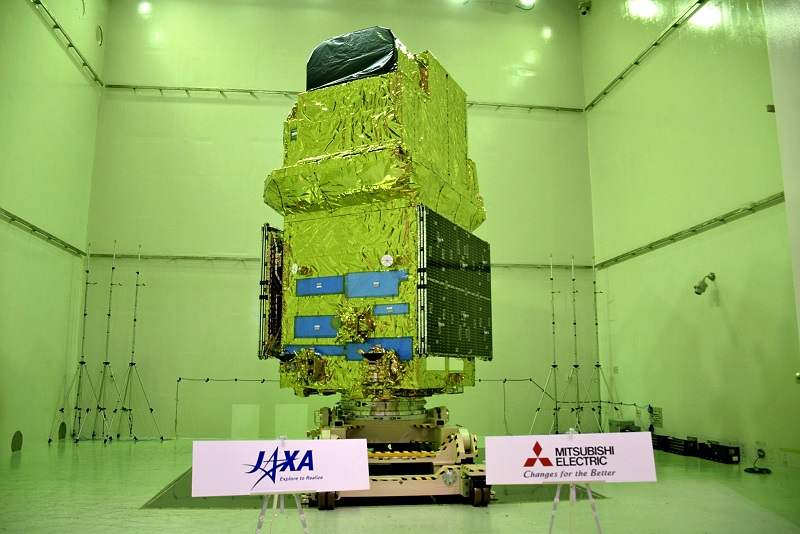
Mitsubishi Electric Corp.’s new Daichi-3 Earth-observation satellite is seen in Kamakura, Kanagawa Prefecture, on Thursday.
12:47 JST, September 24, 2022
Mitsubishi Electric Corp. unveiled its new Daichi-3 Earth-observation satellite to the press at its Kamakura Works facility in Kanagawa Prefecture on Thursday.
The new satellite will provide an upgrade of the resolution of images taken from space. It will be carried in the next flagship domestically manufactured H-3 rocket, which the Japan Aerospace Exploration Agency, or JAXA, aims to launch by March next year.
Daichi-3 is 5 meters high and 16.5 meters wide — with the solar panels unfolded — and weighs about 3 tons. It is the successor to the first-generation Daichi, which was retired in 2011.
Daichi-3 will produce images at a resolution three times higher than Daichi, and has the detail to identify individual automobiles on the ground from space.
It will be used to update Geospatial Information Authority-produced topographical maps at a scale of 1/25,000, as well as improve car navigation systems and disaster preparedness maps, meaning more detailed damage assessments can be expected in circumstances of emergency.






Most Read
Popular articles in the past 24 hours
-
Japan's Budget on Track for Quick Passage, but Ruling Parties to ...
-

Ransomware Attacks Hitting Japan's Small, Midsize Firms
-

Japan-Based USS Tripoli, Marine Unit to Be Sent to Middle East, U...
-

7 Men Arrested Over Robbery of ¥423 Mil. on Tokyo Street; Members...
-

German Journalist Traces Footsteps of Great-Grandfather Who Was P...
-

10 Foreign Tourists Sustain Injuries After Fire at Capsule Hotel ...
-

World Baseball Classic: Red Sox’s Abreu Hits 3-run Homer, Giving ...
-

Shohei Ohtani Homers in WBC Q’final Against Venezuela; Pitch by J...
Popular articles in the past week
-

Japan Figure Skating Legend Yuzuru Hanyu Is Proud Disaster Surviv...
-
Govt to Utilize ODA for Ensuring Economic Security; Securing Ener...
-
15 Measles Patients Confirmed in Tokyo in Past 6 Days; 1 May Have...
-
Massive Sewer Pipe Found Jutting Out of Highway in Osaka
-

Japan Govt to Tighten Requirements to Receive Permanent Residency...
-
Power Outage Forces About 980 Passengers in Yokohama to Walk to T...
-
JR Tokai Breaks Ground on Yamanashi Maglev Station; Will Be Part ...
-

Imperial Family Watches World Baseball Classic Game Against Austr...
Popular articles in the past month
-

Producer Behind Pop Group XG Arrested for Cocaine Possession
-

Japan PM Takaichi’s Cabinet Resigns en Masse
-

Man Infected with Measles Reportedly Dined at Restaurant in Tokyo...
-
Japan Figure Skating Legend Yuzuru Hanyu Is Proud Disaster Surviv...
-

iPS Treatments Pass Key Milestone, but Broader Applications Far f...
-

Sanae Takaichi Elected Prime Minister of Japan; Keeps All Cabinet...
-

South Korea Tightens Rules on Foreigners Buying Homes in Seoul Me...
-

Nepal Bus Crash Kills 19 People, Injures 25 Including One Japanes...
Top Articles in Science & Nature
-
iPS Treatments Pass Key Milestone, but Broader Applications Far from Guaranteed
-
Record 700 Startups to Gather at SusHi Tech Tokyo in April; Event Will Center on Themes Like Artificial Intelligence and Robotics
-

Parents in Japan to Get Instagram Notifications When Teens Repeatedly Search for Suicide Content
-
iPS Cell Products for Parkinson’s, Heart Disease OK’d for Commercialization by Japan Health Ministry Panel
-
Japan to Ban Use of Power Banks on Airplanes
JN ACCESS RANKING
-
Producer Behind Pop Group XG Arrested for Cocaine Possession
-
Japan PM Takaichi’s Cabinet Resigns en Masse
-
Man Infected with Measles Reportedly Dined at Restaurant in Tokyo Station
-
Japan Figure Skating Legend Yuzuru Hanyu Is Proud Disaster Survivor and Gold Medalist, Vows to Continue Support Efforts
-
iPS Treatments Pass Key Milestone, but Broader Applications Far from Guaranteed