
‘Fiercest, Most Damaging Invasive Weed’ Spreading in Rivers, Lakes in Japan, Alligator Weed Found in Numerous Locations
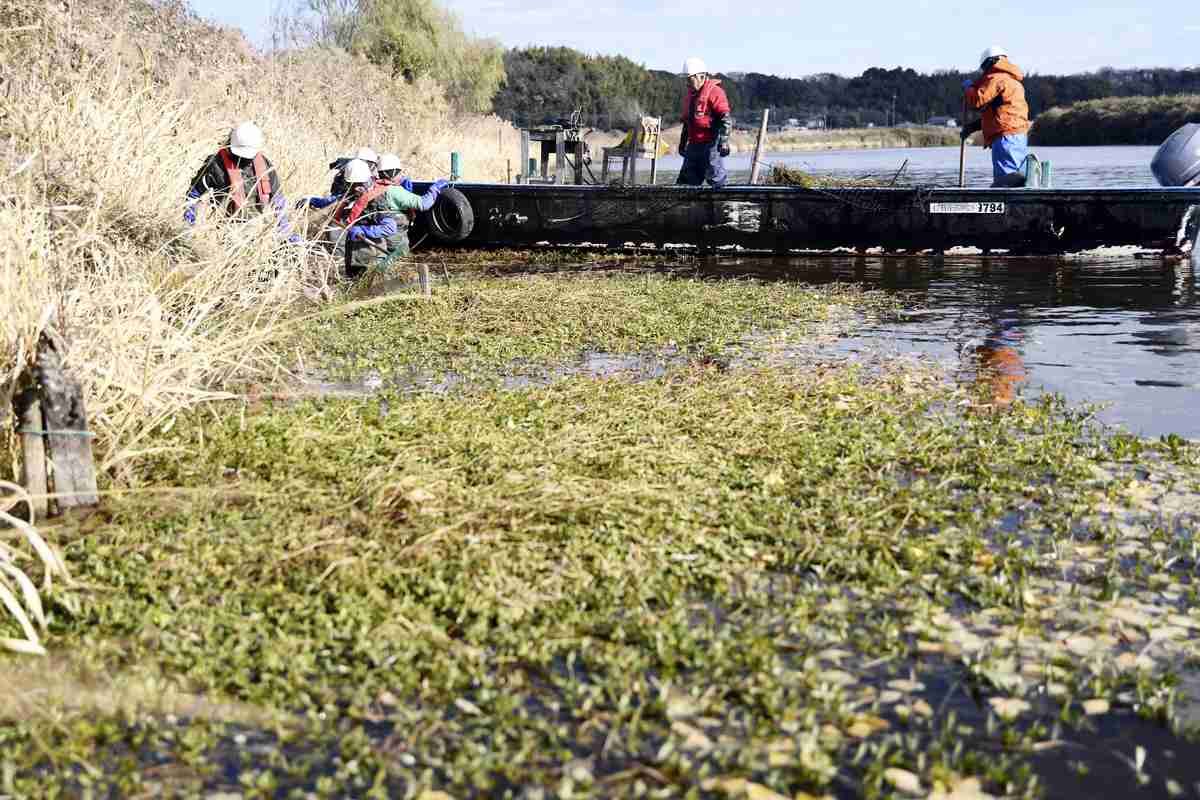
People remove alligator weed at Inbanuma lake in Sakura, Chiba Prefecture, on Dec 9.
14:19 JST, December 27, 2025
Alligator weed, an invasive plant species native to South America, is spreading in rivers and lakes in Japan. The aquatic plant is described as one of the fiercest and most damaging invasive species because of its high reproductivity. It is causing damage to agriculture such as by covering rice paddies, thereby preventing harvest.
Alligator weed has been confirmed to be growing in the wild in Tokyo and 30 prefectures.
Concerns also have been raised over the risks of their spread leading to disasters such as floods, and the government has begun strengthening countermeasures.
On Dec. 1, alligator weed was found growing along a path beside a rice paddy in Tatebayashi, Gunma Prefecture. It was the first instance of the plant being confirmed in the wild in the prefecture. “As we have feared, the invasive alien species has made an incursion [into the prefecture,]” said Tomoji Arai, section chief at the Gunma Agricultural Technology Center.
The plant was confirmed to be growing over an area of several square meters, and the technology center removed the plant using herbicide. They said they will continue monitoring the situation for some time to make sure it was completely eradicated.
According to the Environment Ministry, the weed was first found growing wild in Japan in Amagasaki, Hyogo Prefecture, in 1989. It is believed to have been brought from overseas first as ornamentals and was released into the wild.
It has gradually spread across western Japan since then. The plant can now be found in some areas in eastern Japan as far as a portion of southern Fukushima Prefecture.
According to people familiar with it, the species has very high reproductivity. The perennial and drought-resistant plant extends its stems both on land and in water while branching. It intertwines as it grows, forming mat-like clusters on the surface of water.
The stems grow to around 0.5 to 1 meter long and have the straw-like vascular system. They break easily, and even small pieces only a few centimeters long can take root. The plant can also spread in new locations after their pieces are carried there by sticking to other things such as farm machinery and shoes.
Alligator weed was designated an invasive alien species when the Invasive Alien Species Law went into effect in 2005 due to concerns over their detrimental effects on ecosystems and agriculture.
In southern Ibaraki Prefecture along the Shin-Tonegawa river, alligator weed has spread widely across watershed areas. They are found not only around rivers but also in agricultural irrigation canals that carry water from the river to fields.
In autumn last year, alligator weed spread over an entire rice field owned by Masahiro Kayanuma, 65, in Kawachi, Ibaraki Prefecture. Kayanuma was unable to harvest rice in an area of about 700 square meters, as he could not run farm equipment there. He had sprayed commercially available herbicide on the fields before planting rice seedlings. He had even placed a net over the water plug leading to an irrigation canal.
“Tiny parts of the stems may have slipped through the mesh of the net into the fields. The herbicide wasn’t effective, either,” Kayanuma said. “The plant has such high reproductivity that farmers can’t cope with them on their own.”
Disaster risk
The plant grows in clusters in rivers and waterways, clogging drainage systems and increasing disaster risks.
During a typhoon in September 2015, drainage systems at Inbanuma lake in northern Chiba Prefecture designed to divert water to a nearby river to prevent flooding became clogged, forcing an emergency shutdown. Although it did not lead to flooding, officials had to conduct an emergency removal of the plant.
Alligator weed also proliferates in Teganuma lake, part of the Tonegawa river system in Chiba Prefecture. The prefectural government has been leading the effort to remove the plant. But a local official involved in managing agricultural water said: “No matter how many times we remove them, they just grow again. It’s a game of cat and mouse.”
The Environment Ministry allocated ¥500 million in subsidies to municipalities working to eradicate the plant and other invasive species under the fiscal 2025 budget. For fiscal 2026, it requested ¥1.4 billion in the preliminary budget.
The Environment Ministry, in collaboration with the Agriculture, Forestry and Fisheries Ministry and others, is also advancing surveillance of the plant using artificial intelligence with image recognition capabilities and the study of more effective pesticides to ensure its eradication.
“Alligator weed poses a significant threat in various areas, including ecosystems and agriculture. We must prevent it from spreading,” an Environment Ministry official said.




Most Read
Popular articles in the past 24 hours
-

Milano Cortina 2026: Japanese Gold Medalist Figure Skater Miura S...
-

Japan’s Takaichi Speaks on New U.S. Tariff in Upper House, Says P...
-

Takeshima Day: Persistently Demanding Resolution from South Korea...
-
Japanese Watermelon Shipments Starts in Leading Production Distri...
-

Milano Cortina 2026: Team Japan Disbands at Ceremony in Tokyo as ...
-

Impact on Japanese Economy Unclear with Trump’s New Tariffs, Shif...
-

Japan Authorities Begin On-site Inspection of Japanese Microsoft ...
-

Nikkei Average Rewrites All-Time Closing High
Popular articles in the past week
-

Producer Behind Pop Group XG Arrested for Cocaine Possession
-

iPS Treatments Pass Key Milestone, but Broader Applications Far f...
-

Japan, U.S. Name 3 Inaugural Investment Projects; Reached Agreeme...
-

Tokyo Skytree's Elevator Stops, Trapping 20 People; All Rescued (...
-

Japan’s Major Real Estate Firms Expanding Overseas Businesses to ...
-

Baby Monkey Punch Captures Hearts at Chiba Pref. Zoo, on Social M...
-
Milano Cortina 2026: Japanese Gold Medalist Figure Skater Miura S...
-

Milano Cortina 2026: Japanese Figure Skater Kaori Sakamoto’...
Popular articles in the past month
-
Producer Behind Pop Group XG Arrested for Cocaine Possession
-

Japan PM Takaichi’s Cabinet Resigns en Masse
-

Japan Institute to Use Domestic Commercial Optical Lattice Clock ...
-

Man Infected with Measles Reportedly Dined at Restaurant in Tokyo...
-

Israeli Ambassador to Japan Speaks about Japan’s Role in the Reco...
-

Videos Plagiarized, Reposted with False Subtitles Claiming ‘Ryuky...
-

Man Infected with Measles May Have Come in Contact with Many Peop...
-

Prudential Life Insurance Plans to Fully Compensate for Damages C...
Top Articles in Science & Nature
-
iPS Treatments Pass Key Milestone, but Broader Applications Far from Guaranteed
-

Record 700 Startups to Gather at SusHi Tech Tokyo in April; Event Will Center on Themes Like Artificial Intelligence and Robotics
-
iPS Cell Products for Parkinson’s, Heart Disease OK’d for Commercialization by Japan Health Ministry Panel
-

Japan to Ban Use of Power Banks on Airplanes
JN ACCESS RANKING
-
Producer Behind Pop Group XG Arrested for Cocaine Possession
-
Japan PM Takaichi’s Cabinet Resigns en Masse
-
Man Infected with Measles Reportedly Dined at Restaurant in Tokyo Station
-
Israeli Ambassador to Japan Speaks about Japan’s Role in the Reconstruction of Gaza
-
Videos Plagiarized, Reposted with False Subtitles Claiming ‘Ryukyu Belongs to China’; Anti-China False Information Also Posted in Japan