
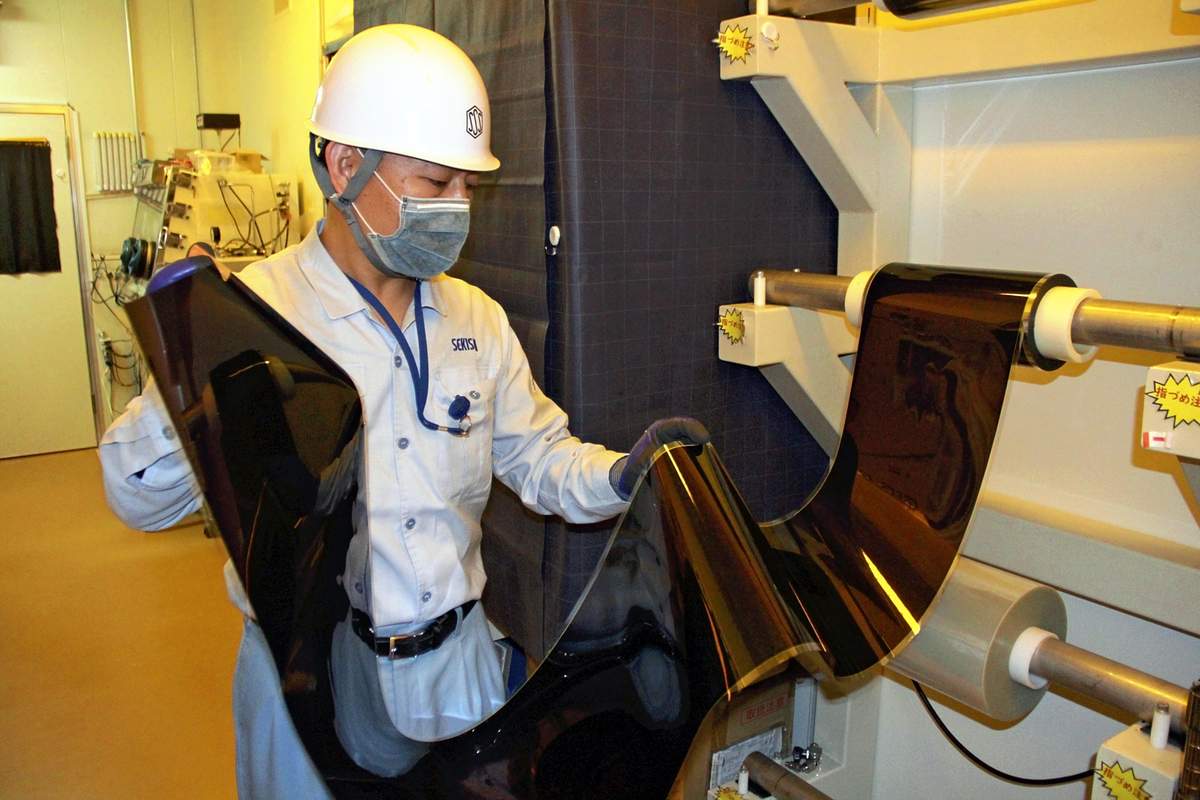
A researcher at Sekisui Chemical Co.’s laboratory in Shimamoto, Osaka Prefecture, holds a perovskite solar cell.
12:50 JST, September 22, 2025
Aiming to promote the introduction of next-generation perovskite solar cells, the Environment Ministry is set to launch a subsidy program for companies and municipalities that covers up to 75% of the costs needed for purchasing and installing them.
By leveraging the solar cells’ thin and lightweight features, the program aims to promote its use in buildings where traditional panel-type solar cells are difficult to install. Companies and local governments that want subsidy support can apply starting this month.
Developed in Japan, Perovskite solar cells use iodine as their main raw material, of which Japan accounts for about 30% of the global supply. Since the cells are flexible, they can be attached to dome-shaped roofs and other curved surfaces.
The subsidy program will utilize about ¥5 billion from the ministry’s current fiscal year budget. It will cover two-thirds of the costs required for purchasing the solar cell and their installation for facilities such as factories, warehouses and gymnasiums where heavy traditional panels cannot be installed, along with the requirement of a certain scale of installation. For facilities expected to serve as evacuation centers in times of disaster, the subsidy will cover three-quarters of such costs.
Japanese companies including Sekisui Chemical Co. and Panasonic Corp. are moving forward with commercializing perovskite solar cells. Sekisui Chemical has even established a new company and plans to bring products to market within this fiscal year. The ministry hopes the subsidy program will accelerate the adoption of these next-generation solar cells and expand the use of renewable energy.
According to research firm Fuji Keizai Co., the global market for perovskite solar cells is projected to reach around ¥4 trillion by 2040. China is also aiming for mass production, and by lowering installation costs through subsidies, the ministry seeks to support demand and enhance the competitiveness of Japanese industries.






Most Read
Popular articles in the past 24 hours
-
TEPCO's Rebuilding Still Far from Complete; Effects of 2011 Fukus...
-
78% Interested in Reconstruction from 2011 Disaster; Concern High...
-
2 Mt. Fuji Hikers Identified as Police Warn People Not to Climb i...
-
Japan’s Nikkei Stock Average Rise Lifted by AI Stocks, Easing Con...
-

Samurai Japan Routs Perky Czech Republic Team After Shuto, Muraka...
-

Italy Shocks U.S. in World Baseball Classic Pool Game
-

15 Years since Great East Japan Earthquake: How Can Affected Area...
-

Parents in Japan to Get Instagram Notifications When Teens Repeat...
Popular articles in the past week
-

Ibaraki Pref.'s 1st Foreign Bus Driver Hired in Tsukuba
-
Govt to Utilize ODA for Ensuring Economic Security; Securing Ener...
-

Nippon Life Insurance's U.S. Arm Sues OpenAI Over Legal Assistanc...
-

Amid Strait of Hormuz Blockade, Shipping Companies Scramble to Ge...
-
Japan Govt Survey Finds Just 10% of Workers Want Working Hours to...
-
Japan's 2nd Round of U.S. Investments May Be Worth Over $100 Bill...
-

Imperial Family Watches World Baseball Classic Game Against Austr...
-

Beckoning Cats Get Makeover to Fit Modern Lifestyles with Sleek D...
Popular articles in the past month
-

Producer Behind Pop Group XG Arrested for Cocaine Possession
-

Japan PM Takaichi’s Cabinet Resigns en Masse
-

Man Infected with Measles Reportedly Dined at Restaurant in Tokyo...
-

Videos Plagiarized, Reposted with False Subtitles Claiming ‘Ryuky...
-

iPS Treatments Pass Key Milestone, but Broader Applications Far f...
-

Sanae Takaichi Elected Prime Minister of Japan; Keeps All Cabinet...
-

Nepal Bus Crash Kills 19 People, Injures 25 Including One Japanes...
-

South Korea Tightens Rules on Foreigners Buying Homes in Seoul Me...
Top Articles in Science & Nature
-
iPS Treatments Pass Key Milestone, but Broader Applications Far from Guaranteed
-
Record 700 Startups to Gather at SusHi Tech Tokyo in April; Event Will Center on Themes Like Artificial Intelligence and Robotics
-
iPS Cell Products for Parkinson’s, Heart Disease OK’d for Commercialization by Japan Health Ministry Panel
-

Japan to Ban Use of Power Banks on Airplanes
-

Mt. Meakan in Japan’s Hokkaido Erupts, Plume Reaches 100 Meters
JN ACCESS RANKING
-
Producer Behind Pop Group XG Arrested for Cocaine Possession
-
Japan PM Takaichi’s Cabinet Resigns en Masse
-
Man Infected with Measles Reportedly Dined at Restaurant in Tokyo Station
-
Videos Plagiarized, Reposted with False Subtitles Claiming ‘Ryukyu Belongs to China’; Anti-China False Information Also Posted in Japan
-
iPS Treatments Pass Key Milestone, but Broader Applications Far from Guaranteed