
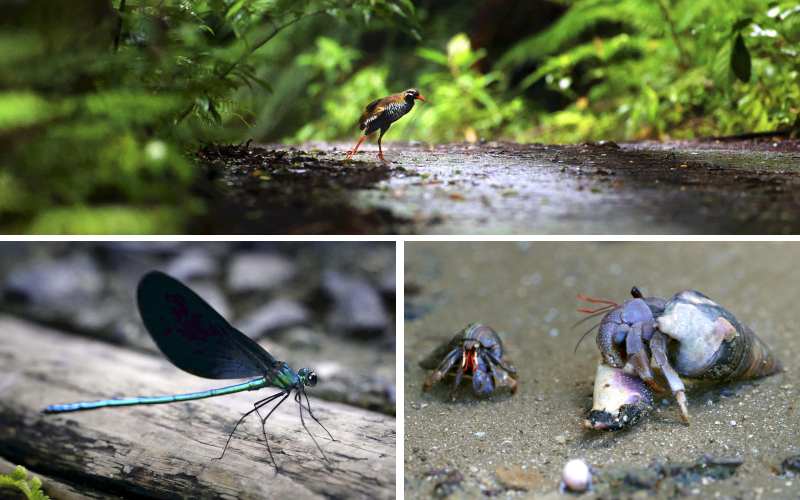
Top: An Okinawa rail is seen in a forest just before sunset in Kunigami, Okinawa Prefecture.
Left: Matrona basilaris japonica. Right: Land hermit crab.
19:51 JST, August 24, 2021
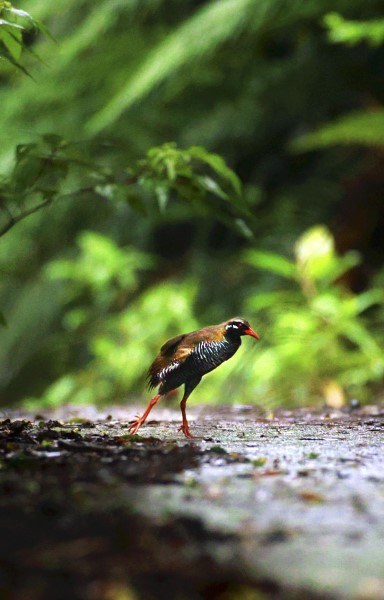
Okinawa rail
Just after it rained, loud birdcalls that sounded like “kyo, kyo, kyo” echoed through the deep-green forest. They were the calls of Okinawa rails, flightless birds found only in the northern part of Okinawa Island.
A rail we encountered pecked at some food under fallen leaves piled up on a forest path, and then disappeared into the depths of the forest.
The region stretching from Kagoshima Prefecture to Okinawa Prefecture is home to many rare animal species, such as Iriomote cats and Amami rabbits.
In July, the region was registered as a world natural heritage site, titled “Amami-Oshima Island, Tokunoshima Island, Northern part of Okinawa Island and Iriomote Island.”
Although the designated region accounts for a mere 0.1% of Japan’s total land area, the about 9,500 species of plants and animals that live there account for 25% of the national total of species.
However, the foundations of the region’s biodiversity are under threat. Some rare species there are at risk of extinction due to such factors as logging, traffic accidents and predation by mongooses and feral cats.
In each area of the region, local residents, administrative entities and private organizations are united to continue efforts to protect the wildlife and search for ways to coexist.
In June, three Okinawa rail chicks were hatched in artificial conditions at a breeding facility under the Environment Ministry’s Yambaru Wildlife Conservation Center in Kunigami, Okinawa Prefecture.
At the facility, staff research how to release individual animals which were artificially bred and raised into the wild.
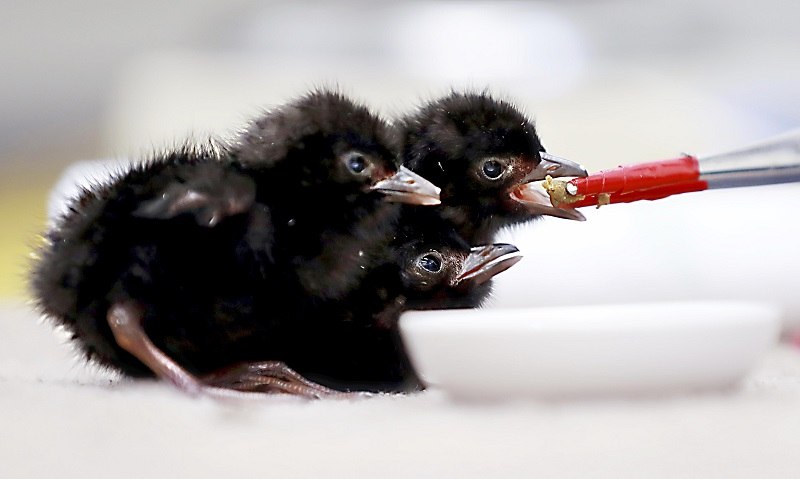
Okinawa rail chicks are fed at a breeding facility in Kunigami, Okinawa Prefecture.
On Amami-Oshima Island in February, an Amami rabbit that was injured in a traffic accident was brought into the Yuinoshima Animal Clinic in Amami, Kagoshima Prefecture. The rabbit had to have a part of its thighbone removed.
The clinic treats wild animals in cooperation with the ministry and other entities.
Kaho Sato, a 28-year-old veterinarian who operated on the rabbit, said, “Precisely because endangered animal species live very close to us, having an awareness about protecting them is important.”
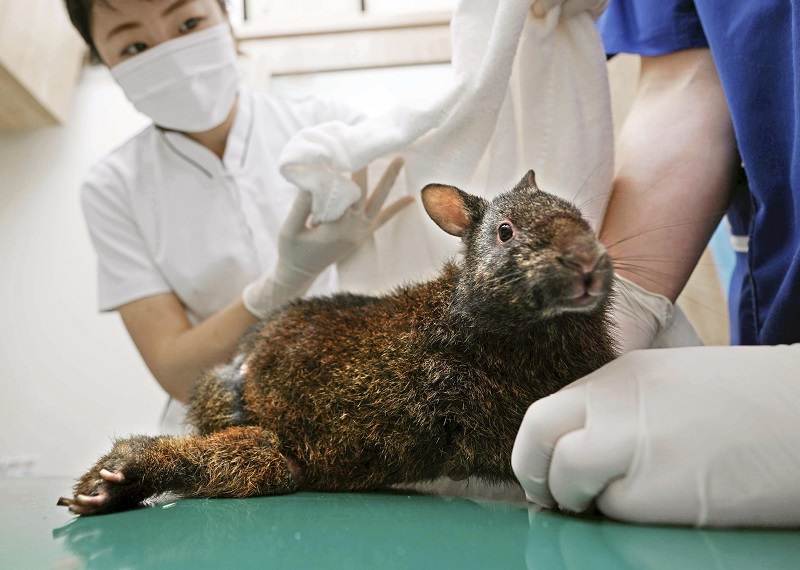
Veterinarian Kaho Sato tends to an Amami rabbit, held by an assistant.
Islanders in the region have protected their forests and wildlife, and bequeathed them to following generations. Such forests are going to be a world treasure.






Most Read
Popular articles in the past 24 hours
-

Japan's Budget on Track for Quick Passage, but Ruling Parties to ...
-

Ransomware Attacks Hitting Japan's Small, Midsize Firms
-

7 Men Arrested Over Robbery of ¥423 Mil. on Tokyo Street; Members...
-

German Journalist Traces Footsteps of Great-Grandfather Who Was P...
-

10 Foreign Tourists Sustain Injuries After Fire at Capsule Hotel ...
-

World Baseball Classic: Venezuela Beats Japan in Nail-biting Back...
-

World Baseball Classic: Red Sox’s Abreu Hits 3-run Homer, Giving ...
-

World Baseball Classic: Venezuela Beats Japan in Back-and-Forth Q...
Popular articles in the past week
-

Japan Figure Skating Legend Yuzuru Hanyu Is Proud Disaster Surviv...
-

Govt to Utilize ODA for Ensuring Economic Security; Securing Ener...
-
15 Measles Patients Confirmed in Tokyo in Past 6 Days; 1 May Have...
-

Massive Sewer Pipe Found Jutting Out of Highway in Osaka
-

Japan Govt to Tighten Requirements to Receive Permanent Residency...
-

Power Outage Forces About 980 Passengers in Yokohama to Walk to T...
-

JR Tokai Breaks Ground on Yamanashi Maglev Station; Will Be Part ...
-

Parents in Japan to Get Instagram Notifications When Teens Repeat...
Popular articles in the past month
-

Producer Behind Pop Group XG Arrested for Cocaine Possession
-

Japan PM Takaichi’s Cabinet Resigns en Masse
-

Man Infected with Measles Reportedly Dined at Restaurant in Tokyo...
-
Japan Figure Skating Legend Yuzuru Hanyu Is Proud Disaster Surviv...
-

iPS Treatments Pass Key Milestone, but Broader Applications Far f...
-

Sanae Takaichi Elected Prime Minister of Japan; Keeps All Cabinet...
-

South Korea Tightens Rules on Foreigners Buying Homes in Seoul Me...
-

Nepal Bus Crash Kills 19 People, Injures 25 Including One Japanes...
Top Articles in Science & Nature
-
iPS Treatments Pass Key Milestone, but Broader Applications Far from Guaranteed
-

Record 700 Startups to Gather at SusHi Tech Tokyo in April; Event Will Center on Themes Like Artificial Intelligence and Robotics
-
Parents in Japan to Get Instagram Notifications When Teens Repeatedly Search for Suicide Content
-

iPS Cell Products for Parkinson’s, Heart Disease OK’d for Commercialization by Japan Health Ministry Panel
-

Japan to Ban Use of Power Banks on Airplanes
JN ACCESS RANKING
-
Producer Behind Pop Group XG Arrested for Cocaine Possession
-
Japan PM Takaichi’s Cabinet Resigns en Masse
-
Man Infected with Measles Reportedly Dined at Restaurant in Tokyo Station
-
Japan Figure Skating Legend Yuzuru Hanyu Is Proud Disaster Survivor and Gold Medalist, Vows to Continue Support Efforts
-
iPS Treatments Pass Key Milestone, but Broader Applications Far from Guaranteed