
Japan Innovation Party’s Hirofumi Yoshimura Welcomes Possible Lower House Dissolution Amid Debate Over Legitimacy of Coalition with LDP
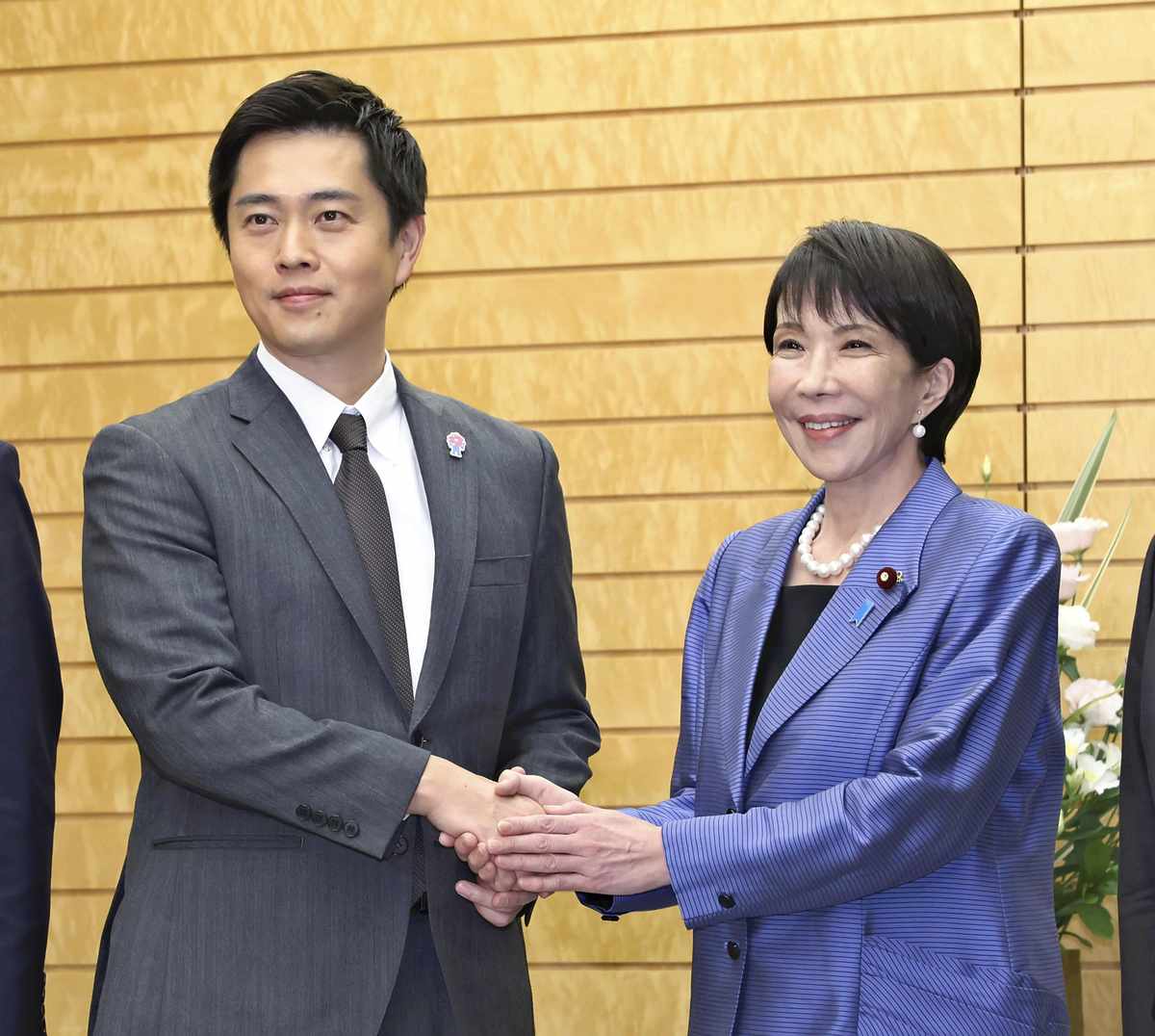
Japan Innovation Party leader Hirofumi Yoshimura, left, shakes hands with Prime Minister Sanae Takaichi in October.
14:01 JST, January 12, 2026
Regarding Prime Minister Sanae Takaichi considering dissolving the House of Representatives at the outset of the ordinary Diet session set to be convened on Jan. 23, Japan Innovation Party leader Hirofumi Yoshimura said on an NHK program on Sunday that he wants to “put it to the public head-on” about the coalition agreement his party made with the ruling Liberal Democratic Party.
Opposition leaders appearing on the program one after the other announced plans to speed up preparations.
The LDP and the JIP launched their coalition government in October last year without securing voter endorsement for the new governing framework. Yoshimura’s remarks signaled support for the prime minister’s consideration of a dissolution, arguing that both the coalition arrangement itself and coalition pledges — including reducing the number of seats in the lower house — would become central election issues.
Yoshimura also referred to a conversation he had with the prime minister after attending a government-ruling bloc liaison meeting on Friday. “We exchanged words to the effect that we’ve entered a different stage,” he said. He later told reporters that, based on discussion with the prime minister, he thought that “a dissolution is not far off.”
In an interview recorded Thursday, Takaichi said: “Without political stability, it’s impossible to pursue strong economic policy. It would also be difficult to realize strong diplomacy and security.” She did not mention dissolving the lower house, but added that she hoped to “create a form of political stability.”
Constitutional Democratic Party of Japan leader Yoshihiko Noda set his party’s goal for the lower house election. He stated: “In an era of increasing party fragmentation, winning a single-party majority is difficult. We aim to become the largest party.” On possible election cooperation with Komeito, he said, “There is a substantial area where we can agree on basic policies, and I hope we can work together.”
Yuichiro Tamaki, leader of the Democratic Party for the People — which, despite being in opposition, had pledged cooperation to ensure the fiscal 2026 budget is enacted within the fiscal year — criticized the prospect of an early dissolution, saying it would make passage within fiscal 2025 difficult and “break the promise.” Still, acknowledging that dissolution would be the prime minister’s decision, he stressed, “We want to accelerate the fielding of candidates.”
Komeito leader Tetsuo Saito questioned the move, asking whether it was appropriate to create a political vacuum.
Sanseito leader Sohei Kamiya declared, “We want to win seats in the lower house as well and reflect our policies.” Reiwa Shinsengumi co-leader Mari Kushibuchi said political leaders were failing to see “how hard life is for ordinary people.”
Japanese Communist Party chair Tomoko Tamura said she wanted to “talk about a political vision and move forward with preparations.” Conservative Party of Japan leader Naoki Hyakuta said that holding a national election for the third time in a year and a half would be “too much.”




Most Read
Popular articles in the past 24 hours
-

Kesennuma, Miyagi Pref., Locals Raise Carp Streamers as Symbol of...
-

Iran Situation: Significance of Rule of Law Must Be Conveyed
-

Toyota Advancing Plant-Based Biofuel Development in Fukushima Tow...
-

Trump Says Iran Had a New Site for Developing Nuclear Weapons
-

2 People Reportedly Found on Mt. Fuji; Hiking Trail Currently Clo...
-

CARTOON OF THE DAY (March 10)
-

Rapeseed Flowers Reach Peak Viewing Period at Tokyo's Showa Kinen...
-

Japan's TEPCO to Raise Electricity Rates for Corporations in Apri...
Popular articles in the past week
-

Ibaraki Pref.'s 1st Foreign Bus Driver Hired in Tsukuba
-

Amid Strait of Hormuz Blockade, Shipping Companies Scramble to Ge...
-
Govt to Utilize ODA for Ensuring Economic Security; Securing Ener...
-
Japan Govt Survey Finds Just 10% of Workers Want Working Hours to...
-

Japan's 2nd Round of U.S. Investments May Be Worth Over $100 Bill...
-

Imperial Family Watches World Baseball Classic Game Against Austr...
-

Nippon Life Insurance's U.S. Arm Sues OpenAI Over Legal Assistanc...
-
Donald Keene’s Drinking Buddy and Translator Yukio Kakuchi Pays T...
Popular articles in the past month
-

Producer Behind Pop Group XG Arrested for Cocaine Possession
-

Japan PM Takaichi’s Cabinet Resigns en Masse
-

Man Infected with Measles Reportedly Dined at Restaurant in Tokyo...
-

Videos Plagiarized, Reposted with False Subtitles Claiming ‘Ryuky...
-

iPS Treatments Pass Key Milestone, but Broader Applications Far f...
-

Sanae Takaichi Elected Prime Minister of Japan; Keeps All Cabinet...
-

Nepal Bus Crash Kills 19 People, Injures 25 Including One Japanes...
-

South Korea Tightens Rules on Foreigners Buying Homes in Seoul Me...
Top Articles in Politics
-
Japan PM Takaichi’s Cabinet Resigns en Masse
-
Sanae Takaichi Elected Prime Minister of Japan; Keeps All Cabinet Appointees from Previous Term
-

Japan’s Govt to Submit Road Map for Growth Strategy in March, PM Takaichi to Announce in Upcoming Policy Speech
-
CRA Leadership Election Will Center on Party Rebuilding; Lower House Defeat Leaves Divisions among Former CDPJ, Komeito Members
-
LDP Begins Training New Lawmakers to Avoid Scandal, Gaffes; Historic Victory in Latest Election Heightens Focus on Party
JN ACCESS RANKING
-
Producer Behind Pop Group XG Arrested for Cocaine Possession
-
Japan PM Takaichi’s Cabinet Resigns en Masse
-
Man Infected with Measles Reportedly Dined at Restaurant in Tokyo Station
-
Videos Plagiarized, Reposted with False Subtitles Claiming ‘Ryukyu Belongs to China’; Anti-China False Information Also Posted in Japan
-
iPS Treatments Pass Key Milestone, but Broader Applications Far from Guaranteed