
Ruling Parties Finalize Tax System Reform Outline, with Hike of Taxable Income Threshold to ¥1.78 Mil., Expanded Mortgage Tax Breaks
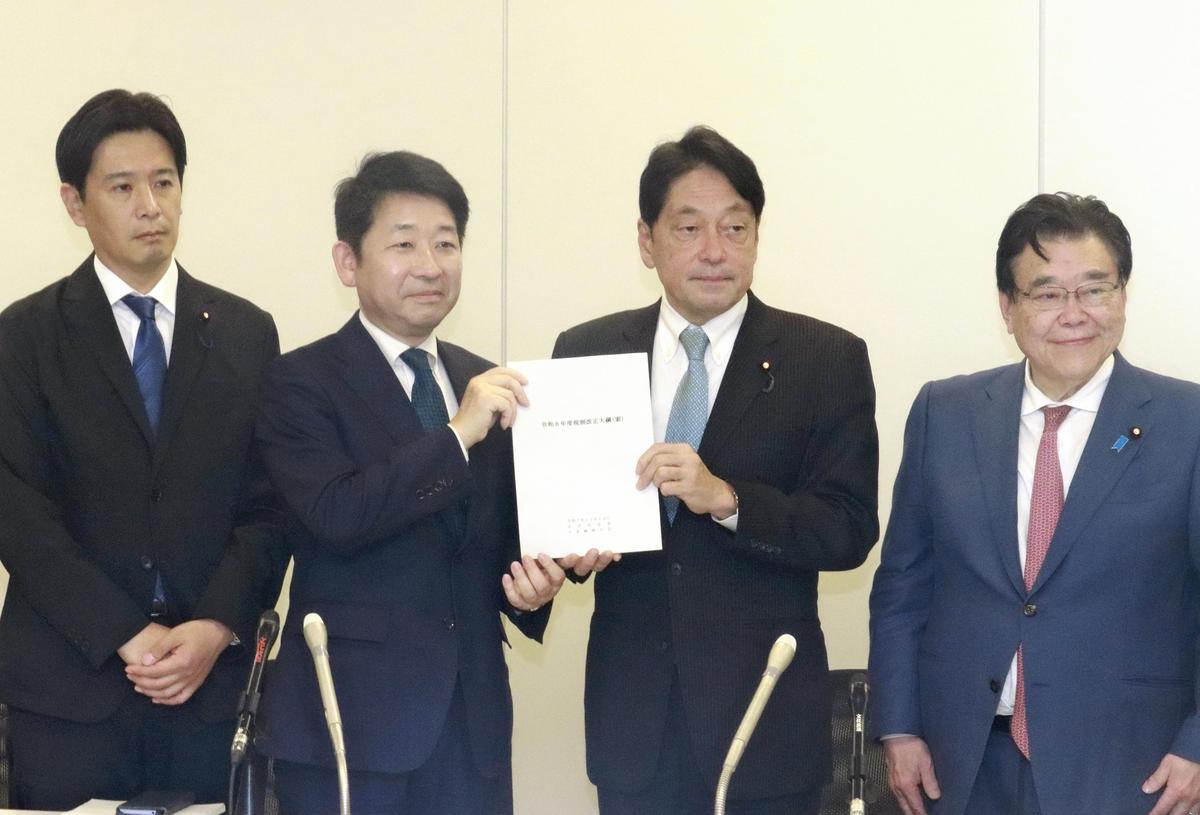
Itsunori Onodera, chairperson of the LDP’s Research Commission on the Tax System, second from right, and Satoshi Umemura, Onodera’s counterpart from the JIP, third from right, hold their tax reform outline in this photo taken at the Diet building on Friday.
16:46 JST, December 20, 2025
The Liberal Democratic Party and the Japan Innovation Party finalized their tax system reform outline for fiscal 2026 on Friday.
The outline provides details on a hike to the “annual income barrier” — the income threshold at which income tax is imposed — from the current ¥1.6 million to ¥1.78 million. It also includes an expanded mortgage tax break.
Both initiatives are aimed at supporting households increasingly burdened by rising prices.
This is the first tax reform outline finalized under the LDP-JIP coalition government.
The government will submit related tax reform bills based on the outline to the regular Diet session to convene early next year.
“This outline will enable us to solidly tackle important issues such as how to respond to price increases and realize a robust economy,” Itsunori Onodera, chairperson of the LDP’s Research Commission on the Tax System, said at a press conference on Friday.
In addition to raising the threshold, the government will expand the income bracket for those eligible for the full basic deduction from the current ¥2 million or less to ¥6.65 million or less.
About 80% of taxpayers will see a significant increase in the deduction amount, resulting in higher net incomes.
Additionally, a mortgage tax deduction due to expire at the end of 2025 will be extended by five years until the end of 2030. The period during which buyers of used homes can utilize the deduction will be extended from the current 10 years to a maximum of 13 years, while the maximum loan amount eligible for the deduction will be raised from the current ¥30 million to ¥45 million.
According to Real Estate Economic Institute Co., the average price of a new condominium in Tokyo’s 23 wards during the first half of 2025 was ¥130.64 million, up 20% from the same period the previous year. The wave of rising housing prices is also spreading to rural areas.
Data compiled by Tokyo Kantei Co., a real estate research firm, shows that the average price of a new condominium sold in Tokyo and 23 other prefectures in 2024 was more than ten times the average annual income of people living there.
While pre-owned homes are more affordable than new ones, their associated tax breaks are less favorable. As pre-owned homes make up less than 20% of all homes purchased in a given year, the government aims to revitalize the pre-owned home market by expanding support.
Replacement purchase
Tax breaks for automobiles have also become a major issue.
Car prices have risen due to soaring prices for parts and components, as well as releases of models with increased functionality, so more people are hesitant about replacing their current cars. The average ownership period for a car had grown from about 9 years in the 1990s to about 13 years in the 2020s.
The outline includes a plan to abolish the “environmental performance tax,” with which up to 3% of the purchase price of a new vehicle is levied based on such factors as fuel efficiency, by the end of fiscal 2025.
The “eco-car tax break,” which reduces or removes the tax paid on a new automobile’s weight at the time of registration, will be extended by two years, though stricter conditions will apply. By reducing the tax burden that comes with purchasing a new car, the government aims to encourage consumers to replace their current vehicles.
The Japanese automotive sector, which encompasses a wide range of firms and industries, has been hit hard by the high tariff policy of the administration of U.S. President Donald Trump.
If major automakers reduce their domestic production to avoid the adverse impacts of U.S. tariffs, there could be widespread effects on manufacturers of parts and components. By creating an environment in which consumers can purchase new vehicles to replace their old ones, the government aims to revitalize domestic industries.





Most Read
Popular articles in the past 24 hours
-

Kesennuma, Miyagi Pref., Locals Raise Carp Streamers as Symbol of...
-

Iran Situation: Significance of Rule of Law Must Be Conveyed
-

Toyota Advancing Plant-Based Biofuel Development in Fukushima Tow...
-

Trump Says Iran Had a New Site for Developing Nuclear Weapons
-

2 People Reportedly Found on Mt. Fuji; Hiking Trail Currently Clo...
-

CARTOON OF THE DAY (March 10)
-

Rapeseed Flowers Reach Peak Viewing Period at Tokyo's Showa Kinen...
-

Memorial Service Marks 81st Anniversary of Tokyo Air Raid; Crown ...
Popular articles in the past week
-

Ibaraki Pref.'s 1st Foreign Bus Driver Hired in Tsukuba
-

Amid Strait of Hormuz Blockade, Shipping Companies Scramble to Ge...
-
Govt to Utilize ODA for Ensuring Economic Security; Securing Ener...
-
Japan Govt Survey Finds Just 10% of Workers Want Working Hours to...
-

Japan's 2nd Round of U.S. Investments May Be Worth Over $100 Bill...
-

Nippon Life Insurance's U.S. Arm Sues OpenAI Over Legal Assistanc...
-

Imperial Family Watches World Baseball Classic Game Against Austr...
-

Beckoning Cats Get Makeover to Fit Modern Lifestyles with Sleek D...
Popular articles in the past month
-

Producer Behind Pop Group XG Arrested for Cocaine Possession
-

Japan PM Takaichi’s Cabinet Resigns en Masse
-

Man Infected with Measles Reportedly Dined at Restaurant in Tokyo...
-

Videos Plagiarized, Reposted with False Subtitles Claiming ‘Ryuky...
-

iPS Treatments Pass Key Milestone, but Broader Applications Far f...
-

Sanae Takaichi Elected Prime Minister of Japan; Keeps All Cabinet...
-

Nepal Bus Crash Kills 19 People, Injures 25 Including One Japanes...
-
South Korea Tightens Rules on Foreigners Buying Homes in Seoul Me...
Top Articles in Politics
-
Japan PM Takaichi’s Cabinet Resigns en Masse
-
Sanae Takaichi Elected Prime Minister of Japan; Keeps All Cabinet Appointees from Previous Term
-

Japan’s Govt to Submit Road Map for Growth Strategy in March, PM Takaichi to Announce in Upcoming Policy Speech
-
CRA Leadership Election Will Center on Party Rebuilding; Lower House Defeat Leaves Divisions among Former CDPJ, Komeito Members
-
LDP Begins Training New Lawmakers to Avoid Scandal, Gaffes; Historic Victory in Latest Election Heightens Focus on Party
JN ACCESS RANKING
-
Producer Behind Pop Group XG Arrested for Cocaine Possession
-
Japan PM Takaichi’s Cabinet Resigns en Masse
-
Man Infected with Measles Reportedly Dined at Restaurant in Tokyo Station
-
Videos Plagiarized, Reposted with False Subtitles Claiming ‘Ryukyu Belongs to China’; Anti-China False Information Also Posted in Japan
-
iPS Treatments Pass Key Milestone, but Broader Applications Far from Guaranteed