
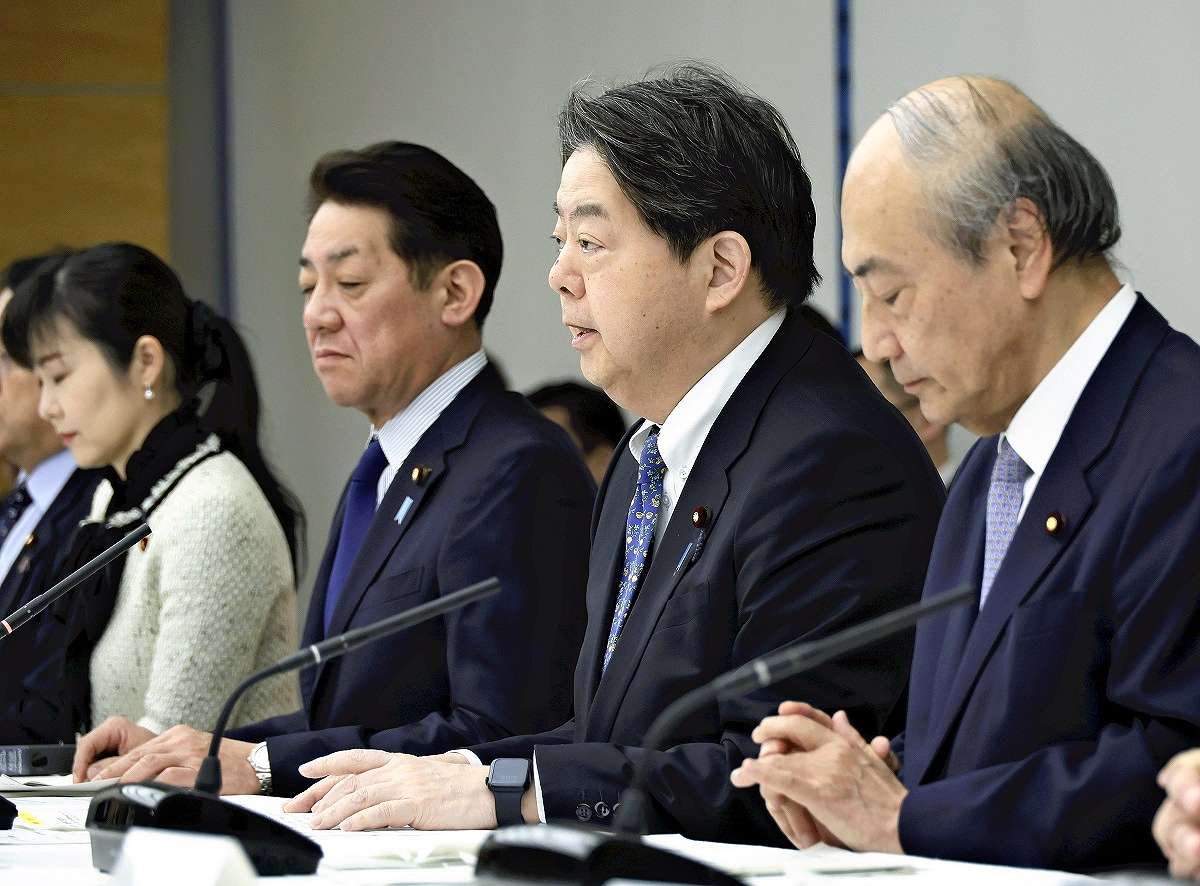
Foreign Minister Yoshimasa Hayashi speaks at a meeting of relevant ministers regarding foreign workers on Friday at the Prime Minister’s Office.
14:36 JST, March 29, 2024
Tokyo, March 29 (Jiji Press) — The Japanese government Friday decided to add four industries to the list of sectors covered by its program to grant medium- to long-term resident status to foreign workers with so-called specified skills.
The addition of the four sectors—automobile transportation, railways, forestry and lumber—will bring the total number of industries covered by the program to 16.
The government also set the maximum number of foreigners to be admitted under the program over the five years from fiscal 2024, which starts in April, to 820,000, up 2.4-fold from 345,150 set for the previous five years. As of the end of 2023, the number of foreigners staying in Japan under the program stood at 208,462.
The government sets an upper limit on the number of foreigners that can be admitted over five years by industry, in order to curb the impact of the program on the domestic employment situation.
After seeking public comments, the government will revise related ministerial ordinances and notices.
The government introduced the program in 2019 to tackle serious labor shortages in Japan.
Under the program, Type 1 workers with certain skill levels and experiences are allowed to work in Japan for up to five years, and Type 2 workers with higher skill levels can effectively work in the country permanently.
Foreign workers will be given only Type 1 status in the four new industries.
In the automobile transportation industry, foreigners under the program will be allowed to work as bus, taxi and truck drivers.
But they will be required to acquire a Class 2 driver’s license needed for passenger transportation and complete a legally required training program for those planning to work as bus or taxi drivers for the first time.
To foreigners hoping to work in the industry under the program, Japan will grant the so-called designated activities resident status to allow them to stay in the country for one year, so that they can acquire a driver’s license.
Japan faces a serious need to increase truck drivers as stricter overtime rules come into effect in April, worsening driver shortages further. The situation is called the 2024 problem.





Most Read
Popular articles in the past 24 hours
-

Voters Using AI to Choose Candidates in Japan's Upcoming General ...
-

Japan's Snow-Clad Beauty: Camellia Flowers Seen in Winter Bloom a...
-

Monkey Strikes Junior High School Girl from Behind in Japan's Yam...
-

Genichiro Inokuma's Mural in Ueno Station That Gave Hope in Postw...
-

Senior Japanese Citizens Return to University to Gain Knowledge, ...
-

Heavy Snow Linked to 30 Deaths across Japan since Late Jan.; JMA ...
-

Tokyo Police Arrest Head of Resignation Assistance Firm
-

Foreign and Security Policy: Political Parties Must Discuss How T...
Popular articles in the past week
-

Japan Institute to Use Domestic Commercial Optical Lattice Clock ...
-
Australian Woman Dies After Mishap on Ski Lift in Nagano Prefectu...
-
Foreign Snowboarder in Serious Condition After Hanging in Midair ...
-

Chinese Embassy in Japan Reiterates Call for Chinese People to Re...
-
Narita Airport, Startup in Japan Demonstrate Machine to Compress ...
-

Toyota Motor Group Firm to Sell Clean Energy Greenhouses for Stra...
-

Sakie Yokota, Last Surviving Parent of a North Korea Abductee, Ur...
-
Beer Yeast Helps Save Labor, Water Use in Growing Rice; Govt Hope...
Popular articles in the past month
-

Univ. in Japan, Tokyo-Based Startup to Develop Satellite for Disa...
-

JAL, ANA Cancel Flights During 3-day Holiday Weekend due to Blizz...
-
China Confirmed to Be Operating Drilling Vessel Near Japan-China ...
-

China Eyes Rare Earth Foothold in Malaysia to Maintain Dominance,...
-
M6.2 Earthquake Hits Japan's Tottori, Shimane Prefectures; No Tsu...
-
Japan Institute to Use Domestic Commercial Optical Lattice Clock ...
-

Japan, Qatar Ministers Agree on Need for Stable Energy Supplies; ...
-

Japan, Italy to Boost LNG Cooperation; Aimed at Diversifying Japa...
Top Articles in Politics
-

Japan Seeks to Enhance Defense Capabilities in Pacific as 3 National Security Documents to Be Revised
-

Japan Tourism Agency Calls for Strengthening Measures Against Overtourism
-

Japan’s Prime Minister: 2-Year Tax Cut on Food Possible Without Issuing Bonds
-

Japan-South Korea Leaders Meeting Focuses on Rare Earth Supply Chains, Cooperation Toward Regional Stability
-

Japanese Government Plans New License System Specific to VTOL Drones; Hopes to Encourage Proliferation through Relaxed Operating Requirements
JN ACCESS RANKING
-
Univ. in Japan, Tokyo-Based Startup to Develop Satellite for Disaster Prevention Measures, Bears
-
JAL, ANA Cancel Flights During 3-day Holiday Weekend due to Blizzard
-
China Confirmed to Be Operating Drilling Vessel Near Japan-China Median Line
-
China Eyes Rare Earth Foothold in Malaysia to Maintain Dominance, Counter Japan, U.S.
-
Japan Institute to Use Domestic Commercial Optical Lattice Clock to Set Japan Standard Time