
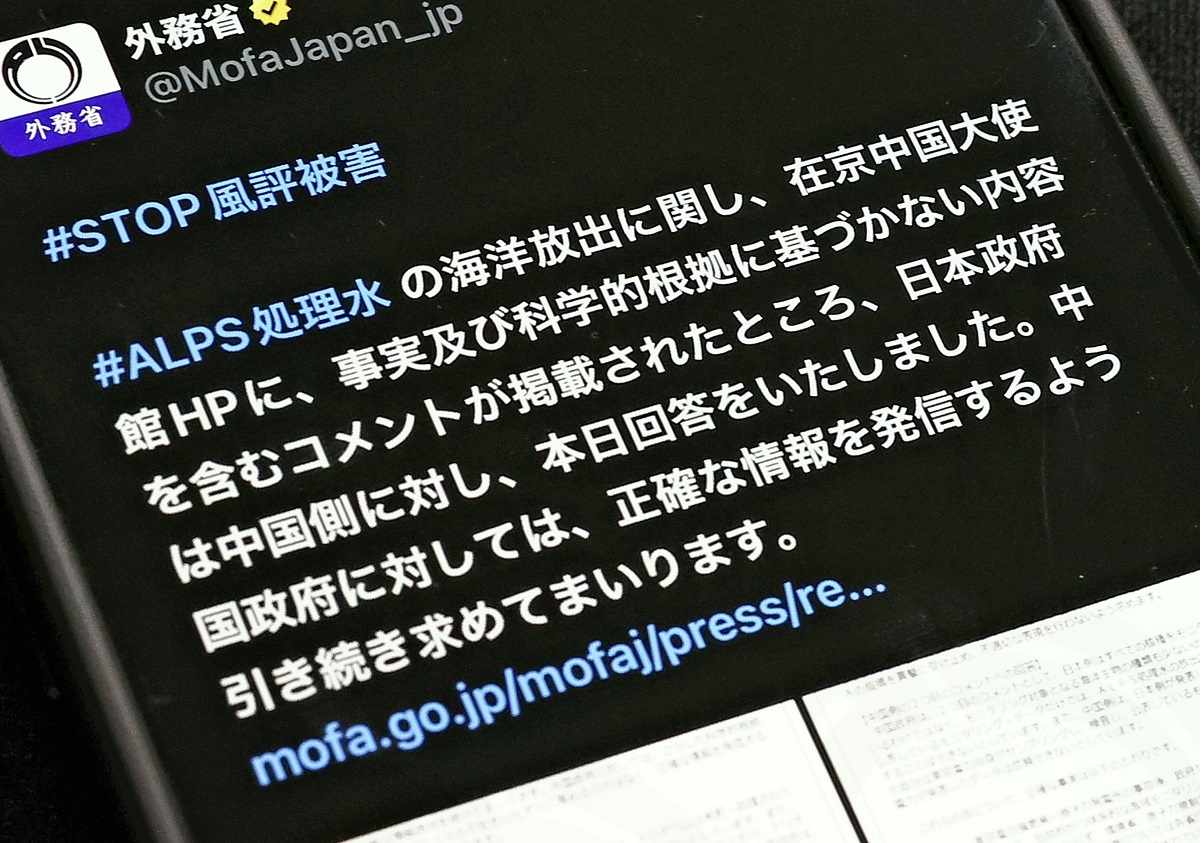
A post on the Chinese government’s criticism of the release of treated water from the Fukushima No. 1 nuclear power plant is seen on the Foreign Ministry’s account on X, formerly known as Twitter.
1:00 JST, September 4, 2023
The Japanese government is stepping up efforts to counter China’s criticisms regarding the release of treated water from the Fukushima No. 1 nuclear power plant.
The Foreign Ministry released a statement on Friday responding to the Chinese government’s comments, which are not based on scientific evidence, on the water release. As Beijing has notified the World Trade Organization of its measures to suspend all imports of Japanese marine products, Tokyo intends to take action within the WTO framework to demand the immediate elimination of the measures, according to sources.
After the Chinese Embassy in Japan posted the criticisms on its website, the Japanese government urged Beijing not to use inappropriate expressions regarding the release of the treated water.
In response to China’s claim that other countries are not taking part in the monitoring conducted by the International Atomic Energy Agency, the ministry’s statement said organizations from the United States, France and other countries were also taking part in the monitoring, and said that it is “international and objective.”
Regarding the reliability of data released by Tokyo Electric Power Company Holdings, Inc., the statement said that the data has been reviewed by the IAEA and that Chinese experts have also participated in the review. It also said that the effects on human health and the environment are “negligible,” adding that the IAEA has clearly stated this point.
On X, formerly known as Twitter, the ministry has posted messages to counter Chinese criticisms with a hashtag calling to stop the spread of reputational damage, while posting Japanese translations of statements issued by various foreign governments in support of Japan.
In a notice to the WTO dated Aug. 31, the Chinese government claimed that the import halt was an emergency measure to protect public life and health and fully contain the risks.
Under the WTO’s Sanitary and Phytosanitary Measures, known as the SPS Agreement, member states are required to notify the global trade body when they take measures that would significantly affect international trade. The Japanese side intends to argue the case at future SPS committee meetings and on other occasions, the sources said.





Most Read
Popular articles in the past 24 hours
-
6 Injured at Naked Festival in Japan’s Okayama Prefecture; Police...
-

Fiji Defense Minister Hopes Japan Will Support Stabilization of P...
-

Space One Delays Launch of No. 3 Kairos Rocket; Company to Announ...
-

Milano Cortina 2026: Malinin Highlights Dangers of Social Media i...
-

Reciprocal Tariffs Ruled Illegal: Judiciary Would Not Tolerate Pr...
-

Japanese Film, Anymart, Wins Critics’ Award at International Film...
-
3rd Japan Pacific Islands Defense Dialogue to Begin in Tokyo on S...
-

India, Brazil Sign Mining Pact As Modi Targets $20 Billion Trade ...
Popular articles in the past week
-

Japan PM Takaichi’s Cabinet Resigns en Masse
-

Man Infected with Measles Reportedly Dined at Restaurant in Tokyo...
-

Sanae Takaichi Elected Prime Minister of Japan; Keeps All Cabinet...
-
Japan's Govt to Submit Road Map for Growth Strategy in March, PM ...
-

Bus Carrying 40 Passengers Catches Fire on Chuo Expressway; All E...
-

Milano Cortina 2026: Figure Skaters Riku Miura, Ryuichi Kihara Pa...
-

Japan, U.S. Name 3 Inaugural Investment Projects; Reached Agreeme...
-

U.S. Firm to Build Training Hub in Fukushima N-plant for Debris R...
Popular articles in the past month
-
Japan PM Takaichi’s Cabinet Resigns en Masse
-

Japan Institute to Use Domestic Commercial Optical Lattice Clock ...
-

Israeli Ambassador to Japan Speaks about Japan’s Role in the Reco...
-
Man Infected with Measles Reportedly Dined at Restaurant in Tokyo...
-

Videos Plagiarized, Reposted with False Subtitles Claiming ‘Ryuky...
-

Man Infected with Measles May Have Come in Contact with Many Peop...
-

Prudential Life Insurance Plans to Fully Compensate for Damages C...
-

Woman with Measles Visited Hospital in Tokyo Multiple Times Befor...
Top Articles in Politics
-
Japan PM Takaichi’s Cabinet Resigns en Masse
-
Sanae Takaichi Elected Prime Minister of Japan; Keeps All Cabinet Appointees from Previous Term
-
Japan’s Govt to Submit Road Map for Growth Strategy in March, PM Takaichi to Announce in Upcoming Policy Speech
-

LDP Wins Historic Landslide Victory
-

LDP Wins Landslide Victory, Secures Single-party Majority; Ruling Coalition with JIP Poised to Secure Over 300 seats (UPDATE 1)
JN ACCESS RANKING
-
Japan PM Takaichi’s Cabinet Resigns en Masse
-
Japan Institute to Use Domestic Commercial Optical Lattice Clock to Set Japan Standard Time
-
Israeli Ambassador to Japan Speaks about Japan’s Role in the Reconstruction of Gaza
-
Man Infected with Measles Reportedly Dined at Restaurant in Tokyo Station
-
Videos Plagiarized, Reposted with False Subtitles Claiming ‘Ryukyu Belongs to China’; Anti-China False Information Also Posted in Japan