
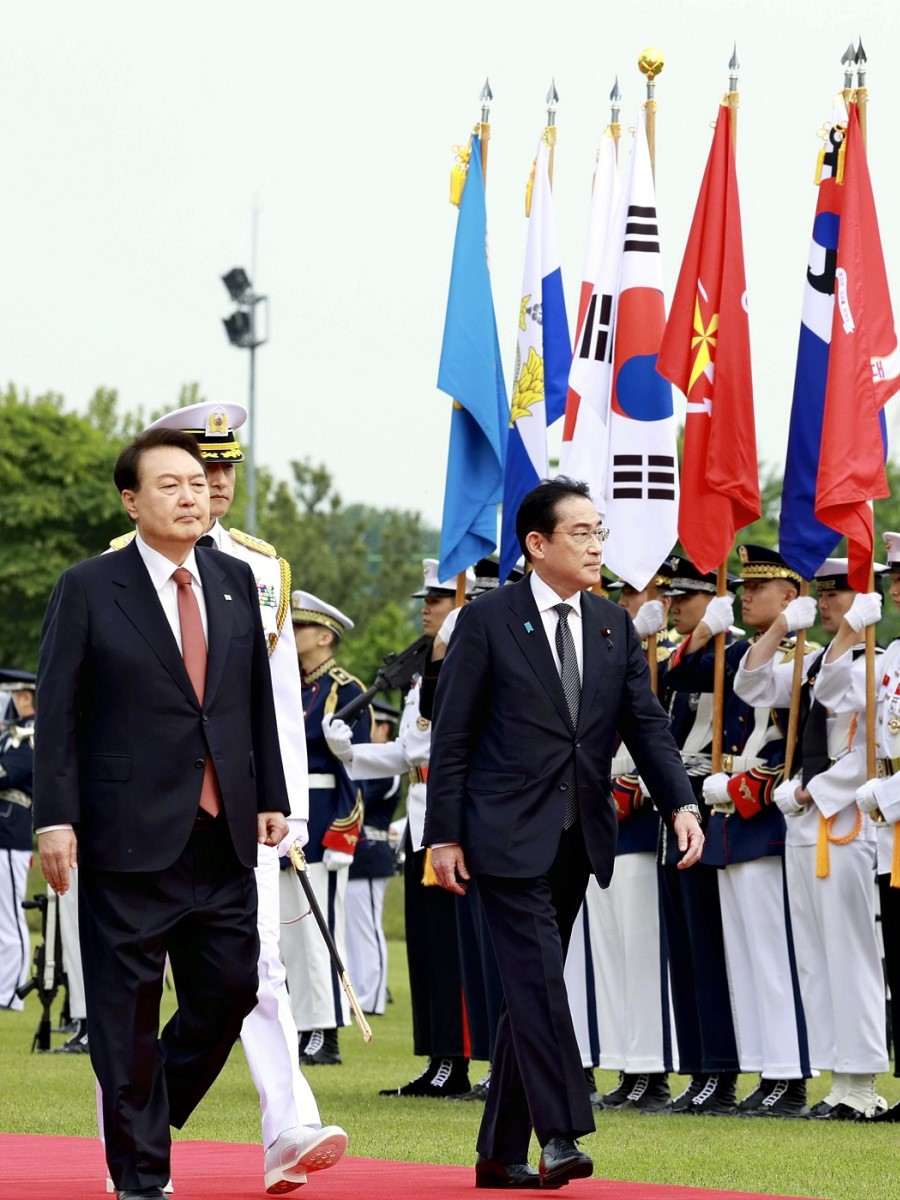
Prime Minister Fumio Kishida, center, and South Korean President Yoon Suk Yeol, left, are seen in Seoul on Sunday.
20:00 JST, May 8, 2023
SEOUL — The improvement of relations with Japan as well as the strengthening of trilateral cooperation with the United States have been a long-cherished path advocated by South Korean President Yoon Suk Yeol since even before he took the post in May last year.
“It took 12 years to resume reciprocal visits, but it didn’t take two months for the two of us to visit each other,” Yoon said in Seoul on Sunday, referring to Prime Minister Fumio Kishida’s arrival that day for a summit and his visit to Japan in March.
Yoon’s administration has broken from the previous administration’s foreign policy strategy that tended to favor reconciliation with North Korea. Instead, his administration advocates becoming a “global pivotal state” that makes contributions in the international community commensurate with its economic power.
With China among the nations in mind, South Korea’s version of an Indo-Pacific strategy released last December clearly states its opposition to “unilateral change of status quo by force.”
Sunday’s summit with Kishida can be seen as an achievement of Yoon’s proactive efforts to improve bilateral relations.
“The two leaders were able to confirm cooperation in a wide range of fields, including security cooperation, economic security and the expansion of people-to-people exchanges,” an official of the South Korean presidential office said after the summit.
Diplomacy with Japan began to make progress on March 6 when the Yoon administration announced a solution to the lawsuits related to former requisitioned workers from the Korean Peninsula.
After the Kishida-Yoon summit in Tokyo on March 16, South Korea put Japan back on its so-called white list of countries that receive preferential treatment through simplified export procedures, reflecting how keen Yoon’s government was on the swift improvement in relations. It had been four years since Japan was on the list.
South Korea will attend the G7 summit in Hiroshima later this month as an invited country. Combined with the recent diplomatic developments, Yoon aims to link them as the achievements of his administration.
Domestically, however, it is difficult to say that his diplomacy is contributing to growing support for his administration. According to a Gallup Korea poll released Friday, Yoon’s approval rating rose to 33%, up 3 percentage points from the previous week, well behind the 57% disapproval rating.
How much understanding Yoon will gain among the people of South Korea regarding his moves to improve relations with Japan will be the next challenge.



Most Read
Popular articles in the past 24 hours
-

McDonald's Japan Raises Prices; Big Mac to Cost ¥500, Double Chee...
-
20 Trapped in Tokyo Skytree Lift, Rescued 5½ Hours Later
-

Aggression against Ukraine: Malignant Precedent Must Not Be Set t...
-

Joruri Bunraku Narrative Performed in Honor of Donald Keene by La...
-
Japan Asks U.S. Not to Worsen Tariffs; Chief Cabinet Secretary Ki...
-

Milano Cortina 2026: Gold Medal Olympic Figure Skaters Riku Miura...
-

Exhibition Featuring Yoshiharu Tsuge’s Manga World Underway in Ch...
-

CARTOON OF THE DAY (February 24)
Popular articles in the past week
-

Producer Behind Pop Group XG Arrested for Cocaine Possession
-

Sanae Takaichi Elected Prime Minister of Japan; Keeps All Cabinet...
-

Japan's Govt to Submit Road Map for Growth Strategy in March, PM ...
-

Japan, U.S. Name 3 Inaugural Investment Projects; Reached Agreeme...
-

iPS Treatments Pass Key Milestone, but Broader Applications Far f...
-

Riku-Ryu Pair Wins Gold Medal: Their Strong Bond Leads to Major C...
-

Tokyo Skytree's Elevator Stops, Trapping 20 People; All Rescued (...
-

Director Naomi Kawase's New Film Explores Heart Transplants in Ja...
Popular articles in the past month
-
Producer Behind Pop Group XG Arrested for Cocaine Possession
-

Japan PM Takaichi’s Cabinet Resigns en Masse
-

Japan Institute to Use Domestic Commercial Optical Lattice Clock ...
-

Man Infected with Measles Reportedly Dined at Restaurant in Tokyo...
-

Israeli Ambassador to Japan Speaks about Japan’s Role in the Reco...
-

Videos Plagiarized, Reposted with False Subtitles Claiming ‘Ryuky...
-

Man Infected with Measles May Have Come in Contact with Many Peop...
-

Prudential Life Insurance Plans to Fully Compensate for Damages C...
Top Articles in Politics
-
Japan PM Takaichi’s Cabinet Resigns en Masse
-
Sanae Takaichi Elected Prime Minister of Japan; Keeps All Cabinet Appointees from Previous Term
-
Japan’s Govt to Submit Road Map for Growth Strategy in March, PM Takaichi to Announce in Upcoming Policy Speech
-

LDP Wins Historic Landslide Victory
-

LDP Wins Landslide Victory, Secures Single-party Majority; Ruling Coalition with JIP Poised to Secure Over 300 seats (UPDATE 1)
JN ACCESS RANKING
-
Producer Behind Pop Group XG Arrested for Cocaine Possession
-
Japan PM Takaichi’s Cabinet Resigns en Masse
-
Man Infected with Measles Reportedly Dined at Restaurant in Tokyo Station
-
Israeli Ambassador to Japan Speaks about Japan’s Role in the Reconstruction of Gaza
-
Videos Plagiarized, Reposted with False Subtitles Claiming ‘Ryukyu Belongs to China’; Anti-China False Information Also Posted in Japan