
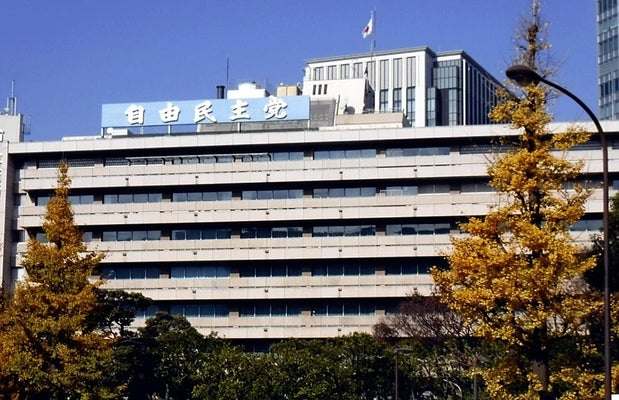
The Liberal Democratic Party’s headquarters in Chiyoda Ward, Tokyo.
12:10 JST, December 13, 2022
TOKYO (Jiji Press) — Japanese ruling party officials Monday approved the government’s draft revisions of three key national security documents, including a description of China’s military actions as threats to residents of Japan and its neighbors.
The draft was approved at a working-level meeting between the ruling Liberal Democratic Party and Komeito. The government is set to adopt the revisions as early as Friday after internal procedures at the two parties.
The National Security Strategy, one of the three documents, which deals with Japan’s basic foreign and defense policies, will be revised for the first time since its release in December 2013.
Meanwhile, the National Defense Program Guidelines will be replaced by the planned national defense strategy, which will serve as guidelines for Japan’s defense policy for the next decade.
The Medium-Term Defense Program, which lays out total defense expenditures and procurement volumes for major equipment for the next five years, will be changed to the defense buildup plan.
In their negotiations over the documents, the LDP had demanded that China’s military activities be labeled as a threat, while Komeito opposed the use of this term.
According to LDP sources, the National Security Strategy, which is the most important of the three documents, is set to describe China’s moves as a matter of serious concern to Japan and the international community in line with the government’s draft. It will also describe China as the greatest strategic “challenge” ever faced.
The revised strategy will also mention that Chinese ballistic missiles fell within Japan’s exclusive economic zone during a Chinese military drill near Taiwan in August. The document will say that the incident was perceived as a threat by regional residents.
The three documents will clearly state that Japan will possess counterstrike capabilities to strike enemy missile launch sites, as well as deploy standoff missiles that can be launched from beyond enemy range.
The documents will say that counterstrike capabilities will only be used as the minimum necessary measure for self-defense that is unavoidable to prevent an attack, based on the three requirements for using military force.
They will also specify that standoff missiles will be used to exercise counterstrike capabilities and that Japan will acquire foreign-made missiles, with the U.S.-made Tomahawk cruise missile in mind.
The defense buildup plan will call for ¥43 trillion in defense spending for the five years starting next April.





Most Read
Popular articles in the past 24 hours
-

My Spendthrift Mother Constantly Asks Me for Money
-

Japanese Students Use Traditional Pickle to Create Novel Wagashi ...
-

‘Dry Bonsai’ Gives New Life to Withered Trees, Allows Free Artist...
-

A Packed Bus Plunges off a Nepal Highway, Killing 19 and Injuring...
-

McDonald's Japan Raises Prices; Big Mac to Cost ¥500, Double Chee...
-

Nepal Bus Crash Kills 19 People, Injures 25 Including One Japanes...
-

Astellas Collaborates with Vir to Develop Its Experimental Prosta...
-

Japan’s Nikkei Stock Average Rises as AI-Related Stocks Shine; Co...
Popular articles in the past week
-

Producer Behind Pop Group XG Arrested for Cocaine Possession
-

Japan PM Takaichi’s Cabinet Resigns en Masse
-

Sanae Takaichi Elected Prime Minister of Japan; Keeps All Cabinet...
-

Japan's Govt to Submit Road Map for Growth Strategy in March, PM ...
-

Bus Carrying 40 Passengers Catches Fire on Chuo Expressway; All E...
-

U.S. Firm to Build Training Hub in Fukushima N-plant for Debris R...
-

Japan, U.S. Name 3 Inaugural Investment Projects; Reached Agreeme...
-

Riku-Ryu Pair Wins Gold Medal: Their Strong Bond Leads to Major C...
Popular articles in the past month
-
Producer Behind Pop Group XG Arrested for Cocaine Possession
-
Japan PM Takaichi’s Cabinet Resigns en Masse
-

Japan Institute to Use Domestic Commercial Optical Lattice Clock ...
-

Man Infected with Measles Reportedly Dined at Restaurant in Tokyo...
-

Israeli Ambassador to Japan Speaks about Japan’s Role in the Reco...
-

Videos Plagiarized, Reposted with False Subtitles Claiming ‘Ryuky...
-

Man Infected with Measles May Have Come in Contact with Many Peop...
-

Prudential Life Insurance Plans to Fully Compensate for Damages C...
Top Articles in Politics
-
Japan PM Takaichi’s Cabinet Resigns en Masse
-
Sanae Takaichi Elected Prime Minister of Japan; Keeps All Cabinet Appointees from Previous Term
-
Japan’s Govt to Submit Road Map for Growth Strategy in March, PM Takaichi to Announce in Upcoming Policy Speech
-

LDP Wins Historic Landslide Victory
-

LDP Wins Landslide Victory, Secures Single-party Majority; Ruling Coalition with JIP Poised to Secure Over 300 seats (UPDATE 1)
JN ACCESS RANKING
-
Producer Behind Pop Group XG Arrested for Cocaine Possession
-
Japan PM Takaichi’s Cabinet Resigns en Masse
-
Japan Institute to Use Domestic Commercial Optical Lattice Clock to Set Japan Standard Time
-
Man Infected with Measles Reportedly Dined at Restaurant in Tokyo Station
-
Israeli Ambassador to Japan Speaks about Japan’s Role in the Reconstruction of Gaza