
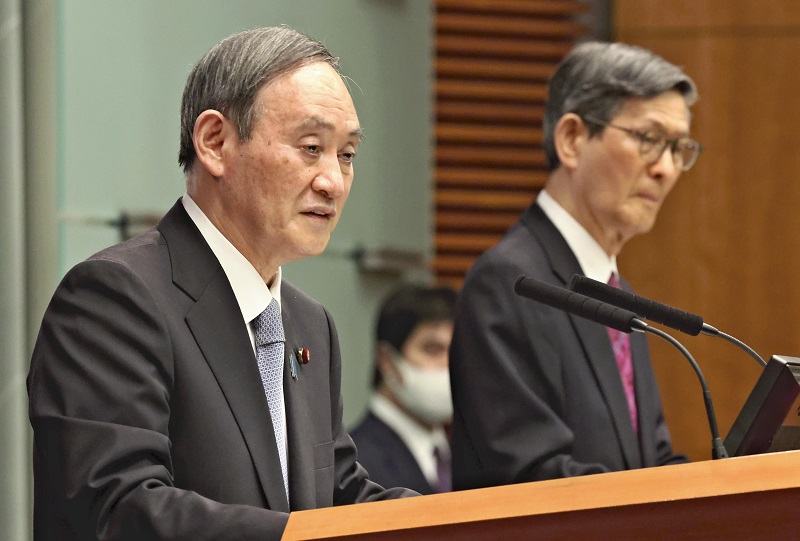
Prime Minister Yoshihide Suga, left, speaks at a press conference in Tokyo on Thursday.
16:22 JST, March 19, 2021
The government has compiled a five-pillar plan to prevent a resurgence of coronavirus infections after the state of emergency is lifted for Tokyo and three neighboring prefectures.
“There are concerns about a rebound [of infections],” Prime Minister Yoshihide Suga said at a press conference on Thursday when he announced the decision to end the emergency in Tokyo, Saitama, Chiba and Kanagawa prefectures on Sunday as scheduled. “It’s my responsibility to make sure that the five pillars are implemented so that we do not have to issue another state of emergency,” Suga said.
The state of emergency was issued on Jan. 7 and extended twice for the four prefectures.
“The conditions [for lifting the state of emergency] have been met consistently,” Suga said, citing such indicators as the number of new cases and hospital bed occupancy rates.
According to a Cabinet Secretariat report, the bed occupancy rate as of Wednesday fell below 40% in all four prefectures, a condition for lifting the emergency. The number of new patients remained low, although the figures slightly rose in Tokyo and Saitama.
The five-pillar plan set by the government’s COVID-19 task force comprises (1) measures regarding dining out; (2) coronavirus variant countermeasures; (3) the expansion of PCR testing; (4) the promotion of vaccinations; and (5) the enhancement of medical capacity.
The government will ask eateries to close by 9 p.m. in the four prefectures and will give ¥40,000 per day to each outlet that cooperates with the request. Under the state of emergency, restaurants were asked to close by 8 p.m. A financial support package is also being drawn up to help businesses continue their operations. There will also be calls via social media to urge people dining out to limit groups to no more than four people.
Regarding virus variants, the government is planning to analyze samples of about 40% of new coronavirus cases: Currently, about 10% of cases are checked for variants. The government also decided to continue the current border measures for the time being, including the suspension of new entries from all countries and regions. The number of Japanese nationals returning or foreign residents re-entering Japan will be limited to about 2,000 a day.
In cooperation with local governments, the central government will focus on testing people in major cities who are not showing symptoms, increasing the number of such tests to 5,000 a day in April.



Most Read
Popular articles in the past 24 hours
-

National Intelligence Council: Proposed Body Must Be Utilized To ...
-
Japan's Defense Ministry: North Korea Appears to Have Fired Balli...
-

Aichi Fisheries Cooperatives Use Smart Tech to Farm Triploid Oyst...
-

CARTOON OF THE DAY (March 14)
-
Japan's Lower House Passes Budget Proposal; Could Be Delayed in U...
-

Fukuoka: American Beavers at Japan's Zoo Create Sculptures; Visit...
-
Hyogo: Family in Japan Produces Traditional Charcoal to Help Pres...
-

Election Fraud in Tokyo’s Ota Ward: Use Incident As Catalyst for ...
Popular articles in the past week
-

Japan Figure Skating Legend Yuzuru Hanyu Is Proud Disaster Surviv...
-
Govt to Utilize ODA for Ensuring Economic Security; Securing Ener...
-
15 Measles Patients Confirmed in Tokyo in Past 6 Days; 1 May Have...
-
Massive Sewer Pipe Found Jutting Out of Highway in Osaka
-
Japan Govt to Tighten Requirements to Receive Permanent Residency...
-
JR Tokai Breaks Ground on Yamanashi Maglev Station; Will Be Part ...
-
Power Outage Forces About 980 Passengers in Yokohama to Walk to T...
-

Beckoning Cats Get Makeover to Fit Modern Lifestyles with Sleek D...
Popular articles in the past month
-

Producer Behind Pop Group XG Arrested for Cocaine Possession
-

Japan PM Takaichi’s Cabinet Resigns en Masse
-

Man Infected with Measles Reportedly Dined at Restaurant in Tokyo...
-
Japan Figure Skating Legend Yuzuru Hanyu Is Proud Disaster Surviv...
-

iPS Treatments Pass Key Milestone, but Broader Applications Far f...
-

Sanae Takaichi Elected Prime Minister of Japan; Keeps All Cabinet...
-
South Korea Tightens Rules on Foreigners Buying Homes in Seoul Me...
-

Nepal Bus Crash Kills 19 People, Injures 25 Including One Japanes...
Top Articles in Politics
-
Japan PM Takaichi’s Cabinet Resigns en Masse
-
Sanae Takaichi Elected Prime Minister of Japan; Keeps All Cabinet Appointees from Previous Term
-

Japan’s Govt to Submit Road Map for Growth Strategy in March, PM Takaichi to Announce in Upcoming Policy Speech
-
LDP Begins Training New Lawmakers to Avoid Scandal, Gaffes; Historic Victory in Latest Election Heightens Focus on Party
-

Japan PM Sanae Takaichi Welcomes Peach Ambassadors Koga Momo Musume to Official Residence
JN ACCESS RANKING
-
Producer Behind Pop Group XG Arrested for Cocaine Possession
-
Japan PM Takaichi’s Cabinet Resigns en Masse
-
Man Infected with Measles Reportedly Dined at Restaurant in Tokyo Station
-
Japan Figure Skating Legend Yuzuru Hanyu Is Proud Disaster Survivor and Gold Medalist, Vows to Continue Support Efforts
-
iPS Treatments Pass Key Milestone, but Broader Applications Far from Guaranteed