
Upper House Election: Political Parties Intensify Debates on Foreign Workers; Some Try to Capitalize on Voters’ Economic Discontent
17:17 JST, July 19, 2025
Political parties in Japan are intensifying debates over the acceptance of foreign workers as the issue emerged as a main point of contention for the House of Councillors election on Sunday.
In light of the deepening labor shortage in service and other industries, the government and the ruling coalition parties have been promoting the acceptance of foreign workers. However, some opposition parties are making arguments that appear meant to stir up conflict, in an apparent effort to attract voters who are increasingly frustrated over surging prices and a stagnant economy.
“Nothing will come from confrontation and division,” Prime Minister Shigeru Ishiba, who heads the ruling Liberal Democratic Party, said in a roadside speech in Yokohama on Friday. He apparently meant to counter some opposition parties that are calling for an exclusionary policy on foreigners.
In 2019, the government set up a new “specified skilled worker” residence status, changing the direction of its policy on foreign workers by accepting not only highly skilled workers, such as doctors and lawyers, but also those who engage in simpler labor.
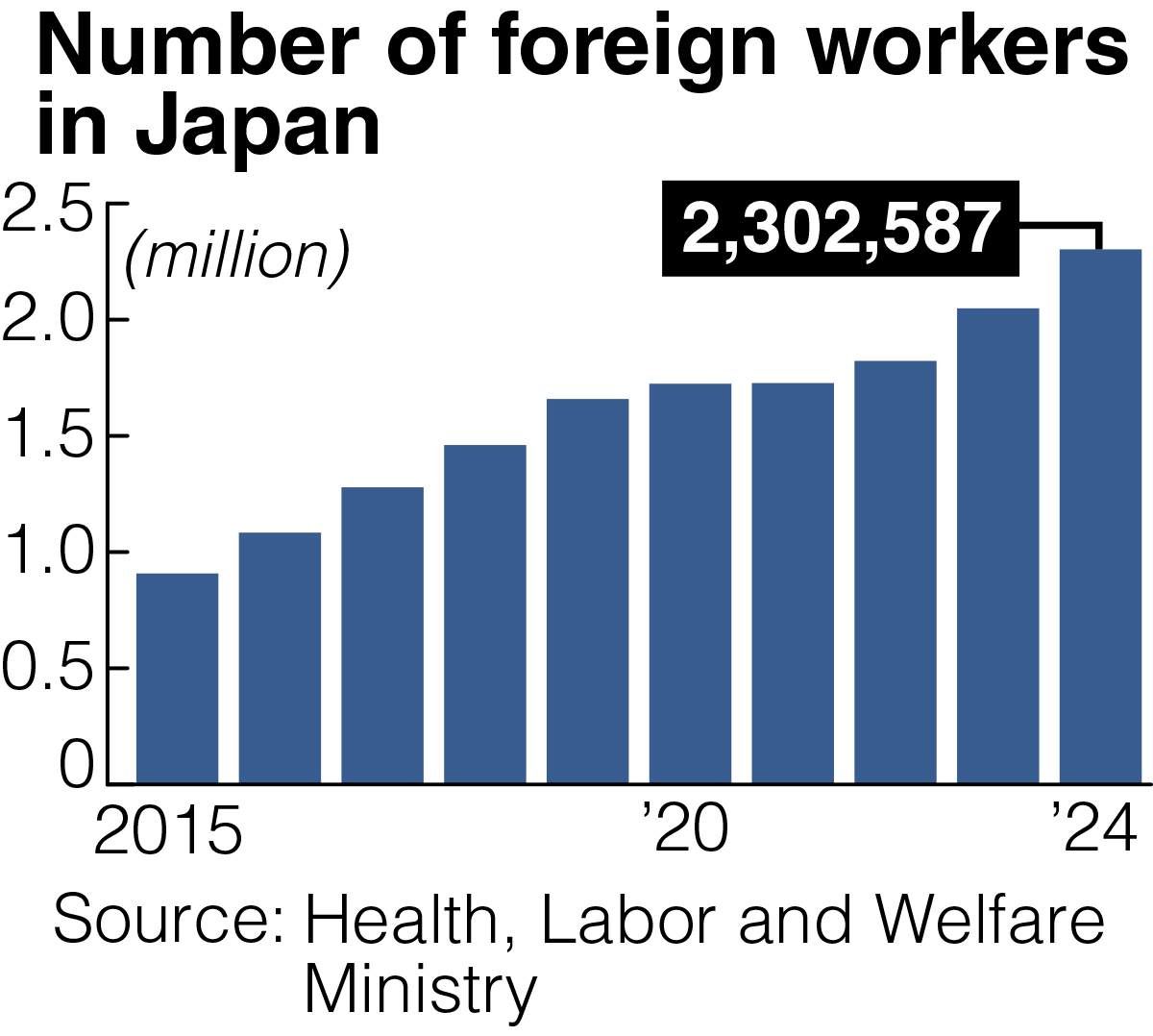
According to the Health, Labor and Welfare Ministry, there were about 2.3 million foreign workers in the country as of the end of October 2024, accounting for about 3.4% of the overall number of workers.
The percentage is not so high compared with figures in European nations, which have large numbers of immigrants. Yet, the number in Japan rose significantly from about 900,000 in 2015.
Issues related to foreign nationals appeared on the political agenda after a series of incidents and accidents involving foreigners and cases of nonpayment of social security premiums by foreigners began drawing public attention.
In response to criticism that the rules have failed to keep up with the problems, the government established an administrative office to serve as a command center for policies concerning foreign nationals on Tuesday, stressing its stance of taking thorough measures. Even so, it is on the defensive.
Under such circumstances, the Democratic Party for the People and Sanseito are trying to win support from voters who find it increasingly difficult to get by due to prolonged high cost of living and other factors by calling for tougher regulations on accepting foreign workers.
“What has to be done first is taking steps to help Japanese young people work more,” said DPFP leader Yuichiro Tamaki in a speech in Tokyo on Friday. “[The government and the ruling parties] got the order wrong by accepting foreign workers simply because workforce is in short supply.”
Yet, there are many fields where foreign workers play essential roles, such as jobs at convenience stores and restaurants, which attract few Japanese applicants.
Tamaki apparently made the statement in rivalry with Sanseito, which is touting a “Japanese First” policy. Sanseito leader Sohei Kamiya, who is against excessively accepting foreign nationals, told reporters in Nagoya, “Appropriate acceptance is required.”
In contrast, the Constitutional Democratic Party of Japan takes the position that “unless Japan accepts foreign nationals, it will become difficult for the country to maintain its level of economic strength and social security,” as former Finance Minister Jun Azumi said.
In its election pledges, the party calls for enactment of a basic law on a multicultural society. The party is stepping up criticism against the argument made by Sanseito and other parties, calling it “exclusionism.”


Related Tags


Most Read
Popular articles in the past 24 hours
-

Strait of Hormuz Closure Shakes Markets; Prolonged Closure Could ...
-

Iran Situation: Japan Must Exert Diplomatic Efforts without Merel...
-

Japan Traditional Puppet Performance Held at Onsen Resort in Shiz...
-
2 of Japan's Opposition Parties Submit Bill to Revise Political F...
-

U.S. Urges Citizens to Immediately Depart over A Dozen Middle Eas...
-
Chiba Police to Arrest Japanese National in Midair; Man Accused o...
-

Trump Pursues Iranian Decapitation without a Plan for What Comes ...
-

Japanese Firms Ban Business Trips, Cancel Vacation Tours Amid Mid...
Popular articles in the past week
-

Milano Cortina 2026: Japanese Gold Medalist Figure Skater Miura S...
-
Tokyo Spends Big on Children, Wins Over Parents
-

Japan’s Miura, Kihara Announce Withdrawal from Figure Skating Wor...
-

Exhibition Featuring Yoshiharu Tsuge’s Manga World Underway in Ch...
-

Yokohama to Test Out Renewable-Powered Offshore Floating Data Cen...
-

BOJ Keeping Eye on Economy and Takaichi's ‘Proactive Fiscal Polic...
-
Tokyo Measles Patient Traveled to Fukuoka Aboard JAL Planes; Susp...
-
Japan’s Takaichi Speaks on New U.S. Tariff in Upper House, Says P...
Popular articles in the past month
-

Producer Behind Pop Group XG Arrested for Cocaine Possession
-

Japan PM Takaichi’s Cabinet Resigns en Masse
-

Man Infected with Measles Reportedly Dined at Restaurant in Tokyo...
-

Israeli Ambassador to Japan Speaks about Japan’s Role in the Reco...
-

Videos Plagiarized, Reposted with False Subtitles Claiming ‘Ryuky...
-

Prudential Life Insurance Plans to Fully Compensate for Damages C...
-

Woman with Measles Visited Hospital in Tokyo Multiple Times Befor...
-

iPS Treatments Pass Key Milestone, but Broader Applications Far f...
Top Articles in Politics
-
Japan PM Takaichi’s Cabinet Resigns en Masse
-

Sanae Takaichi Elected Prime Minister of Japan; Keeps All Cabinet Appointees from Previous Term
-

Japan’s Govt to Submit Road Map for Growth Strategy in March, PM Takaichi to Announce in Upcoming Policy Speech
-

LDP Wins Landslide Victory, Secures Single-party Majority; Ruling Coalition with JIP Poised to Secure Over 300 seats (UPDATE 1)
-

LDP Wins Historic Landslide Victory
JN ACCESS RANKING
-
Producer Behind Pop Group XG Arrested for Cocaine Possession
-
Japan PM Takaichi’s Cabinet Resigns en Masse
-
Man Infected with Measles Reportedly Dined at Restaurant in Tokyo Station
-
Israeli Ambassador to Japan Speaks about Japan’s Role in the Reconstruction of Gaza
-
Videos Plagiarized, Reposted with False Subtitles Claiming ‘Ryukyu Belongs to China’; Anti-China False Information Also Posted in Japan