
Defense Ministry Begins Development of ‘Bodyguard’ Satellites to Prevent Attacks by Other Countries’ ‘Killer’ Satellites

The Defense Ministry in Shinjuku Ward, Tokyo
1:00 JST, September 11, 2025
The Defense Ministry has begun work to create a prototype of “bodyguard” satellites that can protect Japanese satellites from attacks by other countries’ “killer” satellites.
The prototype is planned to pave the way for the introduction of bodyguard satellites in the future.
As China and Russia are developing killer satellites, the ministry plans to launch a small prototype of the bodyguard satellite by the end of fiscal 2029 to strengthen defense preparedness in outer space.
Killer satellites approach target satellites and obstruct their moves with robot arms or neutralize them with electromagnetic rays or by other means.
The Self-Defense Forces operate a set of three communications satellites. If these satellites are damaged, it is possible that communication among SDF units will be disrupted.
Such a scenario could seriously affect Japan’s national security.
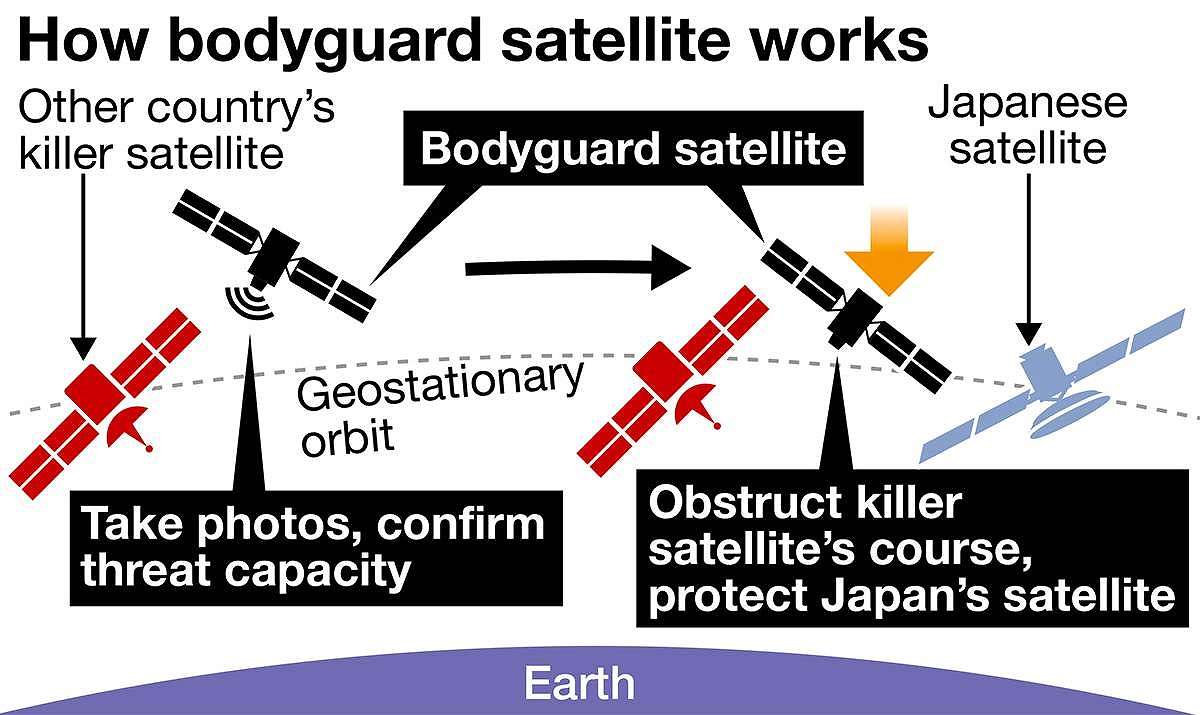
The ministry aims to equip bodyguard satellites with the capability to obstruct the course of killer satellites when they approach Japanese satellites to stop the former from getting close to the latter.
The prototype will be used to confirm whether bodyguard satellites will be able to be quickly mobilized without any problems regarding geostationary orbits about 36,000 kilometers above the Earth in order to protect Japanese satellites from physical attacks.
In outer space, in addition to killer satellites, there is debris that could collide with satellites, and the amount of debris has been on the rise partly due to experiments by China and Russia to destroy satellites.
There is a separate plan to launch in fiscal 2026 the first of Space Domain Awareness (SDA) satellites, which will be used to confirm whether other countries’ satellites or other objects in orbit could be a threat to Japan.
It will check whether the camera installed in the prototype satellite will be able to take photos of other satellites. In the future, it is expected that bodyguard satellites will supplement the SDF’s monitoring capabilities.
The ministry plans to develop the prototype satellite at a cost of about ¥7 billion in a three-year period until fiscal 2027 and launch it in fiscal 2029 at the earliest.
The ministry is requesting hundreds of millions of yen as a preparatory expense for a full-fledged introduction in its initial budget request for next fiscal year.
Regarding the strengthening of defense capabilities in outer space, the Space Domain Defense Guidelines, which the ministry formulated in July, stipulate that the ministry aims “to deepen consideration on the protection of satellites.”






Most Read
Popular articles in the past 24 hours
-

SoftBank Launches AI Service for Call Centers That Converts Harsh...
-

Tokyo, Many Regions across Japan Hit with Heavy Snow
-
High Chocolate Prices Shake Up Valentine's Lineup at Japan's Depa...
-

Milano Cortina 2026: Japan’s Maruyama Wins Bronze Medal in Women’...
-

Milano Cortina 2026: Japan's Kimura, Kimata Dazzle in Big Air To ...
-
6 Injured, Taken to Hospital After Snow-related Car Collisions in...
-

Avg. Voter Turnout in Japan at 16.05% Nationwide as of 2:00 P.M. ...
-
Heavy Snow Affects Polling Stations in Japan’s Chugoku Region
Popular articles in the past week
-

Man Infected with Measles May Have Come in Contact with Many Peop...
-

BTS to Hold Comeback Concert in Seoul on March 21; Popular Boy Ba...
-

Israeli Ambassador to Japan Speaks about Japan’s Role in the Reco...
-

Milano Cortina 2026: Japan’s Athletes Arrive in Italy for Milano ...
-

Tokyo Had 65,000 More People Move In Than Out In 2025; Osaka Area...
-

Green Tea Exports Hit Record High in 2025 Amid Growing Demand, Li...
-
Sapporo Snow Festival Opens with 210 Snow and Ice Sculptures at 3...
-
U.N. Plans to Set Safety Regulation Standards on Automated Drivin...
Popular articles in the past month
-
Univ. in Japan, Tokyo-Based Startup to Develop Satellite for Disa...
-

Japan Institute to Use Domestic Commercial Optical Lattice Clock ...
-
JAL, ANA Cancel Flights During 3-day Holiday Weekend due to Blizz...
-

China Eyes Rare Earth Foothold in Malaysia to Maintain Dominance,...
-
Man Infected with Measles May Have Come in Contact with Many Peop...
-
Japan, Qatar Ministers Agree on Need for Stable Energy Supplies; ...
-
Australian Woman Dies After Mishap on Ski Lift in Nagano Prefectu...
-

Japan, Italy to Boost LNG Cooperation; Aimed at Diversifying Japa...
Top Articles in Politics
-

Japan Tourism Agency Calls for Strengthening Measures Against Overtourism
-

Voters Using AI to Choose Candidates in Japan’s Upcoming General Election; ChatGPT, Other AI Services Found Providing Incorrect Information
-

Japan’s Prime Minister: 2-Year Tax Cut on Food Possible Without Issuing Bonds
-
Japan-South Korea Leaders Meeting Focuses on Rare Earth Supply Chains, Cooperation Toward Regional Stability
-
Japanese Government Plans New License System Specific to VTOL Drones; Hopes to Encourage Proliferation through Relaxed Operating Requirements
JN ACCESS RANKING
-
Japan Institute to Use Domestic Commercial Optical Lattice Clock to Set Japan Standard Time
-
China Eyes Rare Earth Foothold in Malaysia to Maintain Dominance, Counter Japan, U.S.
-
Man Infected with Measles May Have Come in Contact with Many People in Tokyo, Went to Store, Restaurant Around When Symptoms Emerged
-
Japan, Qatar Ministers Agree on Need for Stable Energy Supplies; Motegi, Qatari Prime Minister Al-Thani Affirm Commitment to Cooperation
-
Australian Woman Dies After Mishap on Ski Lift in Nagano Prefecture