
15:41 JST, November 9, 2022
The Maritime Self-Defense Force and the Japan Coast Guard plan to conduct a joint drill simulating an armed attack on the Senkaku Islands for the first time, according to government sources.
The joint MSDF-JCG exercise will be conducted before the end of the fiscal year as part of efforts to strengthen cooperation between the services. After the exercise, the government plans to compile guidelines on procedures and other matters concerning the JCG’s involvement in the event of an armed attack, the sources said.
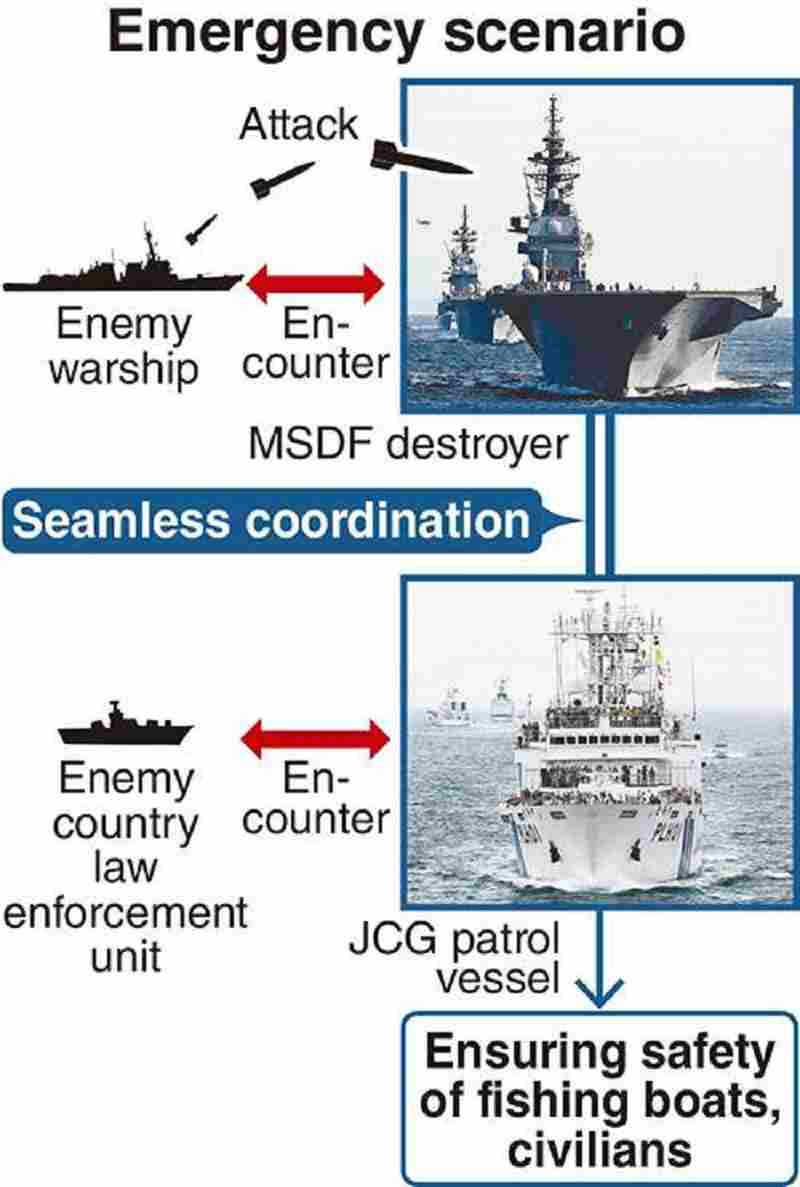
The exercise is intended to ensure a seamless response between the MSDF and the JCG in waters surrounding the Senkaku Islands in Okinawa Prefecture and elsewhere in the event of an emergency.
The government aims to enhance defense capabilities by significantly increasing the related budgets of the JCG and Self-Defense Forces. The government also plans to establish a cooperative framework between the services.
The JCG — an external bureau of the Land, Infrastructure, Transport and Tourism Ministry — and the MSDF share surveillance information, but they have different systems of command.
The joint MSDF-JCG training exercises conducted so far have been limited to scenarios that do not involve an armed attack situation, such as maritime patrols in which the SDF is responsible for maintaining security.
However, the Liberal Democratic Party and others have stressed the need to conduct realistic drills in anticipation of an emergency.
According to the sources, the upcoming drill will involve the mobilization of an MSDF destroyer assuming an attack such as a missile launch by an enemy vessel during a separate stand-off between a JCG patrol vessel and a law enforcement unit of an enemy country.
The JCG is likely to provide logistical support in the event of an emergency, transporting evacuees and ensuring the safety of fishing boats and other civilian vessels.
Article 80 of the Self-Defense Forces Law states that the prime minister can bring the JCG under the control of the defense minister if the SDF is mobilized in the event of an armed attack. However, guidelines for such scenarios have yet to be formulated.
According to the sources, the government is considering compiling such guidelines amid a situation in which cooperation between the China Coast Guard and the military has been increasing.
In 2018, the CCG came under the command of the Armed Police Force, an organization under the direct control of the Central Military Commission, the Chinese military’s command organ.
CCG vessels that navigate in waters surrounding the Senkakus are backed up by Chinese Navy.
“It seems they’re taking all possible measures to prepare for a clash,” a senior SDF official said.







Most Read
Popular articles in the past 24 hours
-

TEPCO's Rebuilding Still Far from Complete; Effects of 2011 Fukus...
-
G7 Agrees to Support Global Energy Supply Amid Soaring Oil Prices...
-
78% Interested in Reconstruction from 2011 Disaster; Concern High...
-

Toyota Advancing Plant-Based Biofuel Development in Fukushima Tow...
-

2nd Japanese Govt-Chartered Flight Brings 281 Back from Middle Ea...
-

Nissan to Work with Uber on Autonomous Driving, Aims to Provide U...
-
Japan's Takaichi Considers Using Reserve Funds to Counter Rising ...
-

Fears of a Long Mideast War Drive Crude Oil Prices Skyward
Popular articles in the past week
-

Ibaraki Pref.'s 1st Foreign Bus Driver Hired in Tsukuba
-
Govt to Utilize ODA for Ensuring Economic Security; Securing Ener...
-
Amid Strait of Hormuz Blockade, Shipping Companies Scramble to Ge...
-

Nippon Life Insurance's U.S. Arm Sues OpenAI Over Legal Assistanc...
-
Japan Govt Survey Finds Just 10% of Workers Want Working Hours to...
-

Japan's 2nd Round of U.S. Investments May Be Worth Over $100 Bill...
-

Imperial Family Watches World Baseball Classic Game Against Austr...
-

Beckoning Cats Get Makeover to Fit Modern Lifestyles with Sleek D...
Popular articles in the past month
-

Producer Behind Pop Group XG Arrested for Cocaine Possession
-

Japan PM Takaichi’s Cabinet Resigns en Masse
-

Man Infected with Measles Reportedly Dined at Restaurant in Tokyo...
-

Videos Plagiarized, Reposted with False Subtitles Claiming ‘Ryuky...
-

iPS Treatments Pass Key Milestone, but Broader Applications Far f...
-

Sanae Takaichi Elected Prime Minister of Japan; Keeps All Cabinet...
-

Nepal Bus Crash Kills 19 People, Injures 25 Including One Japanes...
-
South Korea Tightens Rules on Foreigners Buying Homes in Seoul Me...
Top Articles in Politics
-
Japan PM Takaichi’s Cabinet Resigns en Masse
-
Sanae Takaichi Elected Prime Minister of Japan; Keeps All Cabinet Appointees from Previous Term
-

Japan’s Govt to Submit Road Map for Growth Strategy in March, PM Takaichi to Announce in Upcoming Policy Speech
-
CRA Leadership Election Will Center on Party Rebuilding; Lower House Defeat Leaves Divisions among Former CDPJ, Komeito Members
-
LDP Begins Training New Lawmakers to Avoid Scandal, Gaffes; Historic Victory in Latest Election Heightens Focus on Party
JN ACCESS RANKING
-
Producer Behind Pop Group XG Arrested for Cocaine Possession
-
Japan PM Takaichi’s Cabinet Resigns en Masse
-
Man Infected with Measles Reportedly Dined at Restaurant in Tokyo Station
-
Videos Plagiarized, Reposted with False Subtitles Claiming ‘Ryukyu Belongs to China’; Anti-China False Information Also Posted in Japan
-
iPS Treatments Pass Key Milestone, but Broader Applications Far from Guaranteed