
Appropriateness of term ‘enemy base attack’ debated among Japan’s government, ruling parties
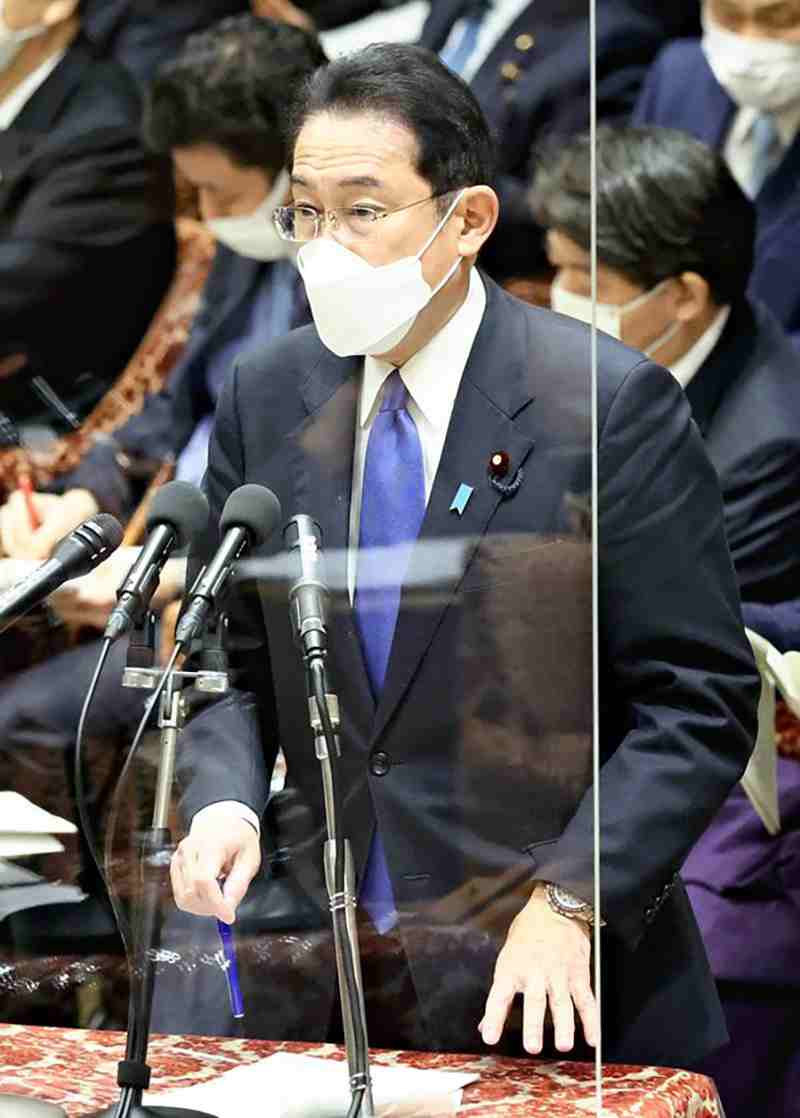
Prime Minister Fumio Kishida speaks at a budget committee meeting of the House of Representatives on Jan. 26.
11:27 JST, February 6, 2022
As the government and the ruling parties discuss Japan’s possession of the “capability to attack enemy bases,” or the ability to destroy missile launch bases for self-defense, the appropriateness of that term is being called into question.
Ruling coalition partner Komeito has taken a cautious stance on the possession of this capability, concerned in particular that the current term could be interpreted as a “preemptive strike,” which could infringe on international law.
“We’d like a different expression to be used,” Kazuo Kitagawa, the deputy head of Komeito, said at a press conference on Jan. 27. “The terms ‘enemy base’ and ‘attack’ are both inappropriate.”
In recent years, it has become possible to fire missiles from mobile launch pads and submarines. Kitagawa also believes that targets are not limited to “enemy bases,” as missile attacks are not the only threat.
He further argued that the term “attack” could be misinterpreted as a preemptive strike.
“What’s important is not the term but the substance,” Kitagawa said. “Our party will discuss the matter thoroughly.”
Prime Minister Fumio Kishida has expressed his willingness to proceed with “realistic consideration, without excluding any options, including the so-called enemy base attack capability.” He also directly conveyed this intention during a teleconference with U.S. President Joe Biden on Jan. 21.
The Liberal Democratic Party has begun discussions toward specifying possession of the capability in the government’s National Security Strategy, which will be revised at the end of the year. The LDP plans to compile a proposal before this summer’s House of Councillors election.
Even within the LDP, many members have voiced their desire to change the current expression of “enemy base attack capability.”
In its pledges for the House of Representatives election last year, the LDP vowed to work harder to establish a system to enhance the nation’s deterrence capabilities, including the possession of the ability to intercept ballistic missiles and other weapons in enemy territory. This stance was based on intraparty discussions held in 2020, when Shinzo Abe was prime minister.
In speeches and on other occasions, LDP Secretary General Toshimitsu Motegi has used the term “counterattack” instead of “attack” when describing this capability.
The LDP has adhered to the government view stated by then Prime Minister Ichiro Hatoyama when responding to questions in the Diet in 1956. Naka Funada, then director general of the Defense Agency, read a statement by Hatoyama saying, “Striking bases [capable of firing] guided missiles and other weapons is possible from a legal standpoint, as it is within the scope of self-defense.”
However, as a policy decision, successive governments have not possessed such capability.




Most Read
Popular articles in the past 24 hours
-
Japanese High School Student Aims to Share Kaiten History Through...
-
PM Takaichi Spells out Plans to Advance Bold Policy Shifts in Spe...
-
Chronic Issues Erode Thailand’s Economy as Political Confusion Pe...
-

Japanese Version of Shohei Ohtani's Picture Book Published
-

Tottori: 95-Year-Old Japanese Descendent from Philippines Visits ...
-

Japan to Monitor Trump Administration's Response to U.S. Supreme ...
-

Milano Cortina 2026: Speed Skater Takagi Finishes 6th in the 1,50...
-
Osaka: 40 Ninjas Display Shuriken Throwing Skills at Japan Champi...
Popular articles in the past week
-

Japan PM Takaichi’s Cabinet Resigns en Masse
-

Man Infected with Measles Reportedly Dined at Restaurant in Tokyo...
-

Sanae Takaichi Elected Prime Minister of Japan; Keeps All Cabinet...
-

Japan's Govt to Submit Road Map for Growth Strategy in March, PM ...
-

Bus Carrying 40 Passengers Catches Fire on Chuo Expressway; All E...
-

Milano Cortina 2026: Figure Skaters Riku Miura, Ryuichi Kihara Pa...
-

Japan, U.S. Name 3 Inaugural Investment Projects; Reached Agreeme...
-

U.S. Firm to Build Training Hub in Fukushima N-plant for Debris R...
Popular articles in the past month
-
Japan PM Takaichi’s Cabinet Resigns en Masse
-

Japan Institute to Use Domestic Commercial Optical Lattice Clock ...
-

Israeli Ambassador to Japan Speaks about Japan’s Role in the Reco...
-
Man Infected with Measles Reportedly Dined at Restaurant in Tokyo...
-

Videos Plagiarized, Reposted with False Subtitles Claiming ‘Ryuky...
-

Man Infected with Measles May Have Come in Contact with Many Peop...
-

Prudential Life Insurance Plans to Fully Compensate for Damages C...
-

Woman with Measles Visited Hospital in Tokyo Multiple Times Befor...
Top Articles in Politics
-
Japan PM Takaichi’s Cabinet Resigns en Masse
-
Sanae Takaichi Elected Prime Minister of Japan; Keeps All Cabinet Appointees from Previous Term
-
Japan’s Govt to Submit Road Map for Growth Strategy in March, PM Takaichi to Announce in Upcoming Policy Speech
-

LDP Wins Historic Landslide Victory
-

LDP Wins Landslide Victory, Secures Single-party Majority; Ruling Coalition with JIP Poised to Secure Over 300 seats (UPDATE 1)
JN ACCESS RANKING
-
Japan PM Takaichi’s Cabinet Resigns en Masse
-
Japan Institute to Use Domestic Commercial Optical Lattice Clock to Set Japan Standard Time
-
Israeli Ambassador to Japan Speaks about Japan’s Role in the Reconstruction of Gaza
-
Man Infected with Measles Reportedly Dined at Restaurant in Tokyo Station
-
Videos Plagiarized, Reposted with False Subtitles Claiming ‘Ryukyu Belongs to China’; Anti-China False Information Also Posted in Japan