
Barriers to Nursing Care Services Remain High for Elderly Foreign Residents; Government Seeks Ways to Help Growing Number of Aging Foreigners
16:06 JST, December 9, 2025
Aging spares no one, including foreign residents of Japan. There have been concerns that the language barrier makes it difficult for older foreign residents to use the public nursing care insurance services that they are eligible for. So I looked into efforts to support elderly foreign residents of Japanese descent and explored what measures are needed to help such people.
On a Sunday afternoon in late August, about 20 people from their 60s to their 80s were slowly raising and lowering their left and right legs alternately, calling out, “Uno, dos, tres,” while seated in chairs in a meeting room at a community facility in Isesaki, Gunma Prefecture.
This is a monthly preventive care program for elderly residents of Japanese descent from South America. Participants engaged in exercises and brain training, among other activities. During a break, they ate sweets and chatted about topics such as travel.
You may also like to read
Japan to Tighten Screening of Foreigners’ Residential Status by Providing Information of Nonpayment of Taxes Japan to Charge Foreigners More for Residence Permits, Looking to Align with Western CountriesThe city and surrounding area are home to various factories, including automotive-related plants. One 69-year-old Japanese-Peruvian woman who used to work in such a factory said she recently joined the program because she had become concerned about her declining physical condition.
“I’m not good at working out, but it’s not so bad if I do it with other people,” she said. “It’s nice to be able to speak freely in my mother tongue. I look forward to coming here every time.”
Speaking Spanish
This program is offered by Elisa Ozawa, 60, a second-generation Japanese Argentine. She works as a certified care worker at a nursing facility in Tokyo on weekdays. She also holds a preventive care class once a month in Fujisawa, Kanagawa Prefecture, which like Isesaki has many foreign residents.
Ozawa came to Japan in her early 20s when she married a Japanese citizen. Taking advantage of her ability to speak both Japanese and Spanish, she has been involved in supporting the lives of foreign residents of Japanese descent for more than 20 years, working at consultation desks for municipal governments in Kanagawa Prefecture and elsewhere. Through this work, she began to look at aging as a challenge for foreign residents.
Like Japanese citizens, foreign nationals who stay in Japan for more than three months are obliged to pay insurance premiums and are eligible to receive public nursing care insurance services if they need such care. The Health, Labor and Welfare Ministry provides materials explaining the public nursing care system in foreign languages, but interest remains low among foreign residents because it is an unfamiliar system that does not exist in their home countries, according to Ozawa.
Even when foreign residents are introduced to Japanese day care services, some people stop using them because they find it difficult to communicate with Japanese seniors and facility staff. Foreign residents also tend to shy away from preventive care programs due to their own lack of Japanese language ability.
“If public services remain difficult to use, the burden on children who look after their elderly parents will grow further,” Ozawa said. “To prevent the elderly from becoming isolated, we at least need [to offer them] places where they can maintain their health using their native languages.”
“Since this is my own personal initiative, I do face the issue of a lack of funding, but I’ll be glad if it helps even a little in solving the challenges that come along with aging,” said Ozawa, who first started offering her classes about 10 years ago.
Challenges surfacing
In Aichi Prefecture, which is home to many foreign residents, including some of Japanese descent, challenges associated with aging have increasingly been coming to the surface.
In a survey conducted by the prefectural government in 2020, 45% of regional comprehensive support centers in the prefecture said they had received inquiries from foreign seniors or their families in fiscal 2018 and fiscal 2019.
Of these, 80% of the inquiries were related to difficulties due to language barriers. Specifically, some said they could not make themselves understood, but could not always ask for an interpreter. Others pointed to a near-total lack of information on certified care managers and care providers who can cater to them, while others mentioned difficulty in achieving mutual understanding due to cultural differences and other factors.
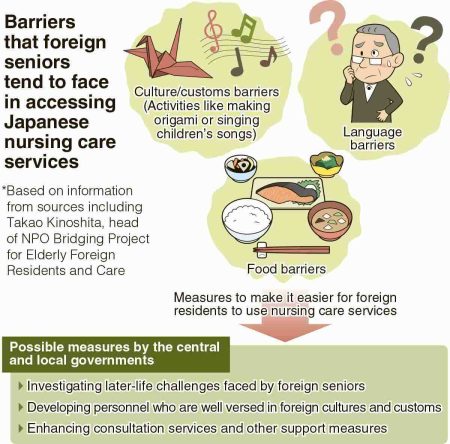
“There are various other barriers in addition to language, such as culture, customs and food,” said Takao Kinoshita, 61, who heads Bridging Project for Elderly Foreign Residents and Care, a Nagoya-based NPO that connects elderly foreign residents to nursing care. The NPO was involved in conducting the survey.
“It’s also crucial to review programs such as those involving singing children’s songs and doing origami, as well as meal menus, [and adjust them] to better suit foreign residents,” he said.
“I hope the central and local governments will support the development of personnel who are well-versed in foreign languages and cultures,” in order to move these projects forward, “so that foreign seniors can receive the nursing care they need,” said Kinoshita.
Number of foreign seniors rising
According to the Immigration Services Agency, the number of foreign residents aged 65 or older has been increasing every year and reached 230,447 as of the end of December 2024. The central government welcomed foreign nationals such as South Americans of Japanese descent in the 1990s as a way to address the nation’s labor shortages. With these people now starting to reach old age, the population of foreign seniors is expected to continue rising.
However, when the government’s comprehensive plan for accepting and integrating foreign workers was reviewed in June, it was noted that the actual circumstances and challenges surrounding elderly foreign residents are not fully understood at present.
Regarding a delay in the government’s response to increasing foreign seniors, Mie Asakura, a professor at Kinjo Gakuin University who specializes in multicultural coexistence, said, “The government has prioritized accepting [foreign nationals] as a labor force and put off addressing their nursing care-related needs and providing other support necessary for them as residents.
“The government urgently needs to look into the living conditions of elderly foreign residents, including their use of nursing care services, and accelerate its efforts to create an environment that fits our multicultural aging society.”


Related Tags




Most Read
Popular articles in the past 24 hours
-
Rising Kabuki Star Works to Ensure Deaf Audience's Enjoyment of P...
-

Lady Bess: Iroha Okuda, Mayuko Kominami Discuss Performing Elizab...
-

Japan Considering Taking Part in U.S. ‘Golden Dome’ Defense Syste...
-

Japan's TEPCO Releases Footage from Fukushima N-Plant Reactor
-

Oil Reserve Releases: G7 Members Unite against Growing Threat
-

46 Evacuated from UAE, Oman on Japanese Govt-chartered Flight
-

Japan's Sanyo Shinkansen Suspended Again; Between Okayama, Aioi S...
-

Driver Dies in Collision with Express Train at Crossing in Mito; ...
Popular articles in the past week
-

Japan Figure Skating Legend Yuzuru Hanyu Is Proud Disaster Surviv...
-

Nippon Life Insurance's U.S. Arm Sues OpenAI Over Legal Assistanc...
-
Govt to Utilize ODA for Ensuring Economic Security; Securing Ener...
-

15 Measles Patients Confirmed in Tokyo in Past 6 Days; 1 May Have...
-

Massive Sewer Pipe Found Jutting Out of Highway in Osaka
-

Japan Govt to Tighten Requirements to Receive Permanent Residency...
-

Beckoning Cats Get Makeover to Fit Modern Lifestyles with Sleek D...
-
Japan Govt Survey Finds Just 10% of Workers Want Working Hours to...
Popular articles in the past month
-

Producer Behind Pop Group XG Arrested for Cocaine Possession
-

Japan PM Takaichi’s Cabinet Resigns en Masse
-

Man Infected with Measles Reportedly Dined at Restaurant in Tokyo...
-

Videos Plagiarized, Reposted with False Subtitles Claiming ‘Ryuky...
-
Japan Figure Skating Legend Yuzuru Hanyu Is Proud Disaster Surviv...
-

iPS Treatments Pass Key Milestone, but Broader Applications Far f...
-

Sanae Takaichi Elected Prime Minister of Japan; Keeps All Cabinet...
-

Nepal Bus Crash Kills 19 People, Injures 25 Including One Japanes...
Top Articles in JN Specialities
-

Step Back in Time at Historical Estate Renovated into a Commercial Complex in Tokyo
-

The Japan News / Weekly Edition (2/20-2/26)
-
‘World’s Oldest Bio-Business’ Is Japan’s Seed Koji Retailing, Mold Used to Make Fermented Products like Sake, Miso, Soy Sauce
-
Donald Keene’s Drinking Buddy and Translator Yukio Kakuchi Pays Tribute to Japanologist’s Lifelong Work
-
“The Tale of Genji” Back-Translation Project Led to Touching Encounter with Keene; Poet Sisters Recount Memories of Scholar at Packed Talk Event in Tokyo
JN ACCESS RANKING
-
Producer Behind Pop Group XG Arrested for Cocaine Possession
-
Japan PM Takaichi’s Cabinet Resigns en Masse
-
Man Infected with Measles Reportedly Dined at Restaurant in Tokyo Station
-
Videos Plagiarized, Reposted with False Subtitles Claiming ‘Ryukyu Belongs to China’; Anti-China False Information Also Posted in Japan
-
Japan Figure Skating Legend Yuzuru Hanyu Is Proud Disaster Survivor and Gold Medalist, Vows to Continue Support Efforts