
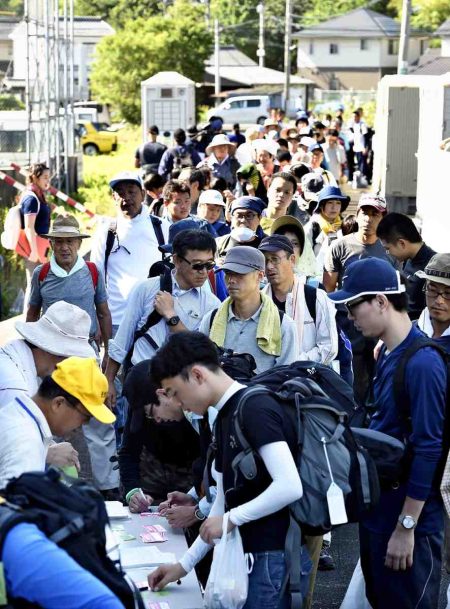
People wanting to work as volunteers line up at a reception desk in Kurashiki, Okayama Prefecture, in July 2018.
18:56 JST, October 21, 2025
When a disaster occurs, volunteers play an important role in helping damage-hit residents rebuild their lives. However, in disaster-struck areas where there is a high level of risk, volunteers themselves need to consider how to ensure their own safety.
It is recommended that volunteers review the basics of carrying out their activities safely.
Medical services in disaster-hit areas tend to struggle. Nobuyuki Kurita, president of Rescue Stock Yard, a nonprofit organization certified to carry out relief activities in disaster-hit areas, said, “To avoid causing trouble, it is important that volunteers ensure their own safety.”
***
First of all, when calm, they should check whether they feel physically well.
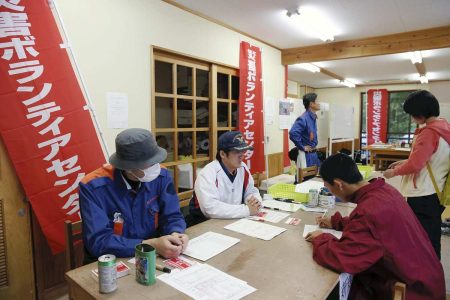
A volunteer, front right, registers at a volunteer center in Minami-Aso, Kumamoto Prefecture, in April 2016.
It is necessary to find out in advance what types of volunteers are sought after. Then, they should apply for a volunteer insurance plan at the social welfare council in their local municipality before departing.
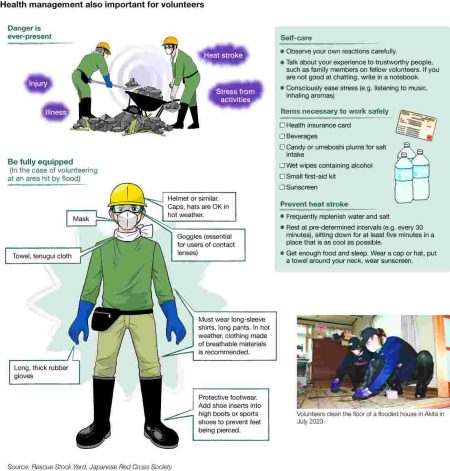
There can be a lot of dirt and dust in the air in disaster-hit areas. Volunteers should wear a mask and goggles. Since cotton work gloves absorb water, rubber gloves are best.
To prevent feet from being pierced by nails and other sharp objects, volunteers should wear high boots or sports shoes with steel plates inserted to prevent accidents. If other kinds of inserts to prevent feet from being pierced are available, it is OK to use them.
During activity orientations, dangerous places and off-limit zones are explained. Volunteers should listen very carefully.
If there is a risk of tsunami, it is best to confirm places for evacuation.
There may be cases in which volunteers will be asked to do risky work that they did not expect. In such cases, they need to say, “I cannot do that,” or consult volunteer centers.
Kurita urged, “It is important not to work beyond your abilities. If you feel anxious, you should consult somebody and carry out tasks without becoming overconfident.”
Prevent stress, heat stroke
There will be cases of volunteers witnessing damage or hearing about survivors’ experiences.
Yukari Maeda, a nurse and adviser in the Japanese Red Cross Society’s department for life saving and welfare, said: “Volunteers can also suffer from stress. You must never believe, ‘I’m different and all right.’”
Maeda pointed out self-care is important, saying, “It is natural to feel sympathy, imagining the same thing that happened to a survivor happening to yourself and becoming emotional.”
Concerning their feelings and the scenes volunteers may witness, simply talking to fellow volunteers or others whom they trust can reduce stress.
If you are not good at chatting, it is recommended to write down your feelings in a notebook.
“Volunteers are also victims behind the scenes. Verbalizing what you felt can ease confused feelings in your mind,” Maeda said.
In the hot summer season, volunteers need to be careful about heat stroke. “When people focus on the work, they tend to forget to take steps to prevent heat stroke,” Maeda said.
Volunteers need to sleep well and eat enough breakfast. If you feel even a little bit physically unwell, be sure to not do too much. It is also necessary to rest at intervals, such as every 30 minutes.
Make sure to hydrate before you get thirsty. “Never drink too little just because you have less time to go to the restroom. You need to drink water and also intake salt regularly,” Maeda said.




Most Read
Popular articles in the past 24 hours
-

Japan Defense Agency to Develop AI Intelligence Analysis System f...
-
Moai Statue Shows Lasting Bond Between Miyagi Pref. Town, Easter ...
-

Milano Cortina 2026: Japan’s Oguri Wins Para Snowboard Silver at ...
-
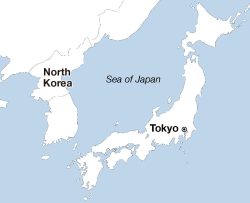
Japan's Defense Ministry: North Korea Appears to Have Fired Balli...
-
Aichi Fisheries Cooperatives Use Smart Tech to Farm Triploid Oyst...
-
Teachers Support Students’ Inquiry Learning behind the Scenes
-
Japan's Lower House Passes Budget Proposal; Could Be Delayed in U...
-

National Intelligence Council: Proposed Body Must Be Utilized To ...
Popular articles in the past week
-
Japan Figure Skating Legend Yuzuru Hanyu Is Proud Disaster Surviv...
-
Govt to Utilize ODA for Ensuring Economic Security; Securing Ener...
-
15 Measles Patients Confirmed in Tokyo in Past 6 Days; 1 May Have...
-
Massive Sewer Pipe Found Jutting Out of Highway in Osaka
-
Japan Govt to Tighten Requirements to Receive Permanent Residency...
-
JR Tokai Breaks Ground on Yamanashi Maglev Station; Will Be Part ...
-
Beckoning Cats Get Makeover to Fit Modern Lifestyles with Sleek D...
-
Power Outage Forces About 980 Passengers in Yokohama to Walk to T...
Popular articles in the past month
-

Producer Behind Pop Group XG Arrested for Cocaine Possession
-

Japan PM Takaichi’s Cabinet Resigns en Masse
-

Man Infected with Measles Reportedly Dined at Restaurant in Tokyo...
-

Videos Plagiarized, Reposted with False Subtitles Claiming ‘Ryuky...
-
Japan Figure Skating Legend Yuzuru Hanyu Is Proud Disaster Surviv...
-

iPS Treatments Pass Key Milestone, but Broader Applications Far f...
-

Sanae Takaichi Elected Prime Minister of Japan; Keeps All Cabinet...
-

Nepal Bus Crash Kills 19 People, Injures 25 Including One Japanes...
Top Articles in JN Specialities
-

Step Back in Time at Historical Estate Renovated into a Commercial Complex in Tokyo
-

The Japan News / Weekly Edition (2/20-2/26)
-
‘World’s Oldest Bio-Business’ Is Japan’s Seed Koji Retailing, Mold Used to Make Fermented Products like Sake, Miso, Soy Sauce
-
Donald Keene’s Drinking Buddy and Translator Yukio Kakuchi Pays Tribute to Japanologist’s Lifelong Work
-
“The Tale of Genji” Back-Translation Project Led to Touching Encounter with Keene; Poet Sisters Recount Memories of Scholar at Packed Talk Event in Tokyo
JN ACCESS RANKING
-
Producer Behind Pop Group XG Arrested for Cocaine Possession
-
Japan PM Takaichi’s Cabinet Resigns en Masse
-
Man Infected with Measles Reportedly Dined at Restaurant in Tokyo Station
-
Videos Plagiarized, Reposted with False Subtitles Claiming ‘Ryukyu Belongs to China’; Anti-China False Information Also Posted in Japan
-
Japan Figure Skating Legend Yuzuru Hanyu Is Proud Disaster Survivor and Gold Medalist, Vows to Continue Support Efforts