
Caring for Babies When Water Supply Is Cut Off; Look out for Heat Rash, Use Right Water for Formula
11:32 JST, August 15, 2025
Summertime is the season for certain natural disasters, such as concentrated downpours and typhoons. Depending on the damage they cause, your water supply may be cut off for many hours.
Families with babies are particularly vulnerable when no water is available because they cannot make baby formula or properly give their children a bath. So, it is important to learn the basics of what to do in an emergency so that you can deal with an unexpected loss of water supply.
Be on lookout for diaper rash
Babies are usually kept clean by giving them a bath.
“A baby’s skin is structurally immature and delicate. The epidermis [outer layer of skin] acts as a barrier against infection,” said Takuya Tokuhisa, a neonatal intern and the head of the disaster control committee at the Japan Society for Neonatal Health and Development.
The important thing is to know how to keep a baby’s skin clean even when the water supply has been cut off.
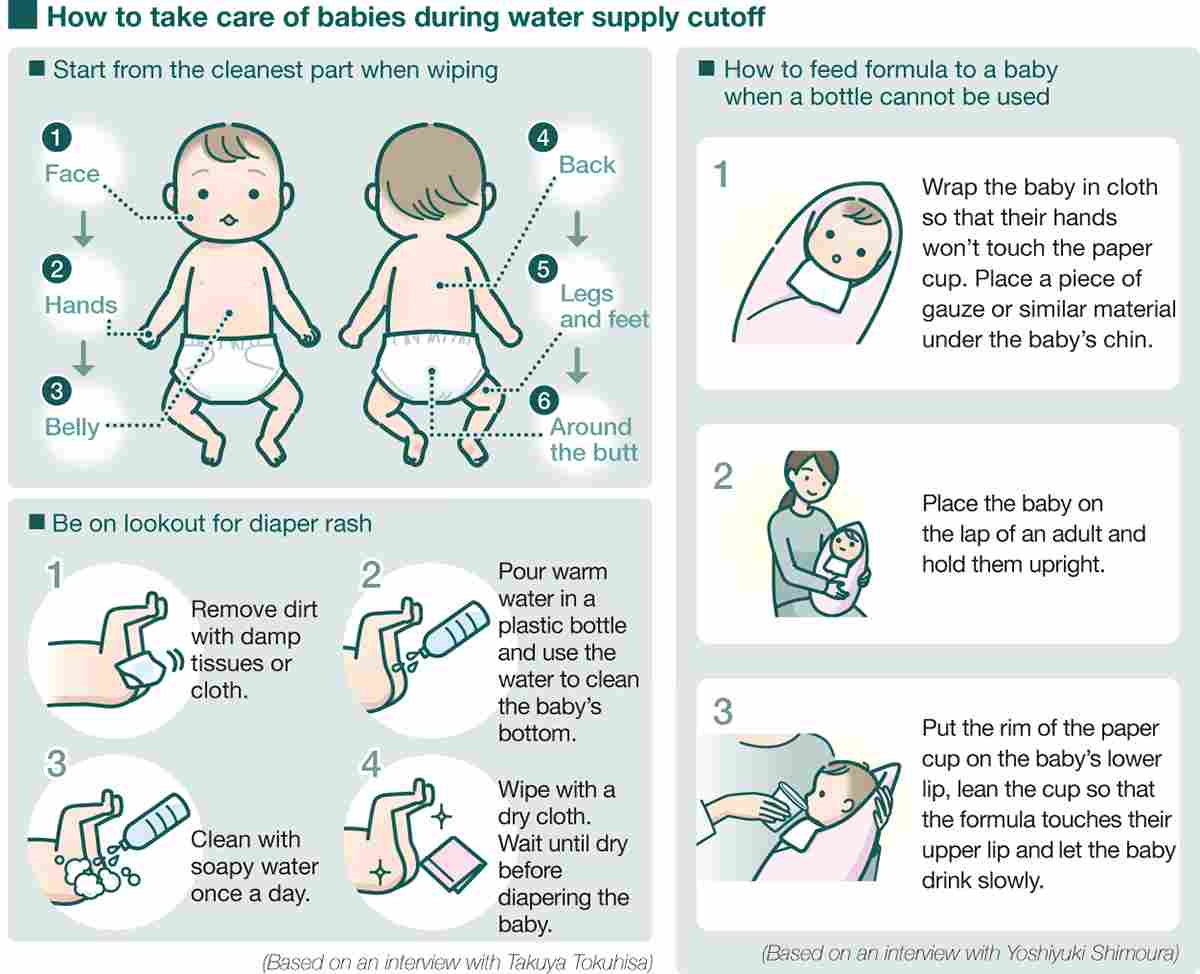
When it is impossible to give your baby a bath, boil water from a plastic bottle. Wet a towel with the water and wipe your baby’s body from the cleanest part — face, head, torso and so on — to remove any dirt. Then, lather the baby’s body with soap. Lastly, wipe them with a wet towel so that no soap remains.
It also necessary to look out for diaper rash during the hot season. Clean the baby’s bottom with soapy water once a day and rinse with warm water. Dry by pressing a dry cloth on the skin. Wait until the baby is completely dry before diapering the infant.
If you have no clean towels, it is fine to use tissues instead. Shops now sell baby wash and cleansing products that are gentle on the skin, so make things easier for yourself by having them on hand.
“I hope that families consider securing water for cleaning babies or young children as a separate issue from securing drinking water,” Tokuhisa said. “If rashes or skin boils irritate your children, or if their eczema lasts for days [during evacuation], consult medical staff at the shelter.”
Use paper cups for formula
Water is necessary when making baby formula, too. In the event of a disaster, even a mother who usually breastfeeds her baby may temporarily have to rely on baby formula because she has trouble producing enough breast milk due to stress and other reasons.
“Please take the utmost care regarding water when you make baby formula,” said Yoshiyuki Shimoura, a senior director of the Japan Dietetic Association. Shimoura warned against using bottled mineral water, which can contain a high amount of calcium and magnesium. “It can be potentially stressful to babies’ kidneys and can cause digestive problems.”
Make it a habit to always check the ingredient list on mineral water bottles. As for water from a water truck, it is best to use water provided on the very day if it is to be used to make baby formula. Never use water from a well.
“To sanitize a baby bottle, you need even more water,” Shimoura said, adding that if a baby bottle cannot be used, there is a way to feed baby formula to an infant by using a paper cup.
Make sure the baby is awake and hold them upright. Bring a paper cup with the baby formula close to the baby’s mouth. Put the cup’s rim to their lower lip and lean the cup a little so that the formula touches the baby’s upper lip. The baby should slowly start drinking.
Do not pour the formula into the baby’s mouth. Let them drink at their own pace. They tend to spill about 30% of the formula, so prepare more formula than usual.
“It’s difficult to suddenly do this method, so it may be a good idea to practice beforehand,” Shimoura recommended.




Most Read
Popular articles in the past 24 hours
-
Moai Statue Shows Lasting Bond Between Miyagi Pref. Town, Easter ...
-

Milano Cortina 2026: Japan’s Oguri Wins Para Snowboard Silver at ...
-
Japan's Defense Ministry: North Korea Appears to Have Fired Balli...
-
Aichi Fisheries Cooperatives Use Smart Tech to Farm Triploid Oyst...
-

National Intelligence Council: Proposed Body Must Be Utilized To ...
-
Teachers Support Students’ Inquiry Learning behind the Scenes
-
Japan's Lower House Passes Budget Proposal; Could Be Delayed in U...
-

CARTOON OF THE DAY (March 14)
Popular articles in the past week
-

Japan Figure Skating Legend Yuzuru Hanyu Is Proud Disaster Surviv...
-

Govt to Utilize ODA for Ensuring Economic Security; Securing Ener...
-
15 Measles Patients Confirmed in Tokyo in Past 6 Days; 1 May Have...
-
Massive Sewer Pipe Found Jutting Out of Highway in Osaka
-
Japan Govt to Tighten Requirements to Receive Permanent Residency...
-
JR Tokai Breaks Ground on Yamanashi Maglev Station; Will Be Part ...
-
Power Outage Forces About 980 Passengers in Yokohama to Walk to T...
-
Beckoning Cats Get Makeover to Fit Modern Lifestyles with Sleek D...
Popular articles in the past month
-

Producer Behind Pop Group XG Arrested for Cocaine Possession
-

Japan PM Takaichi’s Cabinet Resigns en Masse
-

Man Infected with Measles Reportedly Dined at Restaurant in Tokyo...
-

Videos Plagiarized, Reposted with False Subtitles Claiming ‘Ryuky...
-
Japan Figure Skating Legend Yuzuru Hanyu Is Proud Disaster Surviv...
-

iPS Treatments Pass Key Milestone, but Broader Applications Far f...
-

Sanae Takaichi Elected Prime Minister of Japan; Keeps All Cabinet...
-

Nepal Bus Crash Kills 19 People, Injures 25 Including One Japanes...
Top Articles in JN Specialities
-

Step Back in Time at Historical Estate Renovated into a Commercial Complex in Tokyo
-

The Japan News / Weekly Edition (2/20-2/26)
-
‘World’s Oldest Bio-Business’ Is Japan’s Seed Koji Retailing, Mold Used to Make Fermented Products like Sake, Miso, Soy Sauce
-

Donald Keene’s Drinking Buddy and Translator Yukio Kakuchi Pays Tribute to Japanologist’s Lifelong Work
-
“The Tale of Genji” Back-Translation Project Led to Touching Encounter with Keene; Poet Sisters Recount Memories of Scholar at Packed Talk Event in Tokyo
JN ACCESS RANKING
-
Producer Behind Pop Group XG Arrested for Cocaine Possession
-
Japan PM Takaichi’s Cabinet Resigns en Masse
-
Man Infected with Measles Reportedly Dined at Restaurant in Tokyo Station
-
Videos Plagiarized, Reposted with False Subtitles Claiming ‘Ryukyu Belongs to China’; Anti-China False Information Also Posted in Japan
-
Japan Figure Skating Legend Yuzuru Hanyu Is Proud Disaster Survivor and Gold Medalist, Vows to Continue Support Efforts