
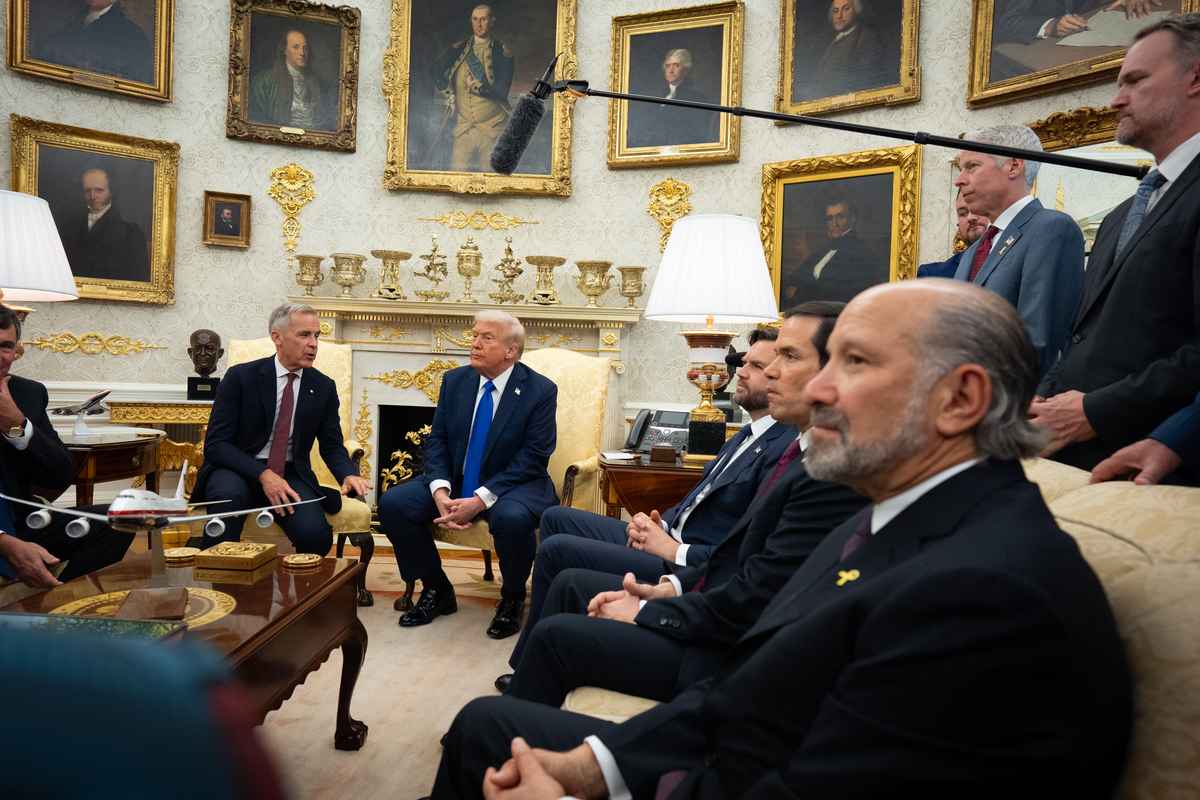
President Donald Trump meets with Canadian Prime Minister Mark Carney in the Oval Office of the White House on Oct. 7.
11:57 JST, March 9, 2026
WINDSOR, Ontario – Sales are down nearly 70 percent at Jahn Engineering, a tool and die shop that serves automakers here and in the United States. Dozens of workers have been let go following decisions made in the White House. Worse may lie ahead.
The Canadian auto industry has been rocked by President Donald Trump’s abandonment of subsidies for electric vehicles and embrace of tariffs. Major automakers have abandoned planned vehicles and delayed the start of new ones, battering Jahn Engineering and scores of outfits like it in Canada’s automotive heartland.
“This is definitely the worst I’ve seen it in 42 years,” said Louis Jahn, the company’s president. “We’re just trying to stay alive.”
Trump’s hostility to his northern neighbor is not helping. In recent weeks, the president threatened to block the opening of the new Gordie Howe International Bridge between Windsor and Detroit. After Canadian Prime Minister Mark Carney agreed to allow the importation of 49,000 Chinese electric vehicles, Trump suggested he would retaliate with 100 percent tariffs on Canadian goods. And in a remarkable breach of diplomatic niceties, U.S. diplomats met on multiple occasions with Alberta separatists.
White House antagonism, and the sense of betrayal it triggered, is shadowing the scheduled July 1 review of the North American trade agreement that Trump signed during his first term. In 2020, the president hailed the U.S.-Mexico-Canada Agreement (USMCA) as “the largest, fairest, most balanced, and modern trade agreement ever achieved.” But in recent weeks he derided it as “irrelevant” and mused publicly about replacing the tripartite pact with separate bilateral deals.
The dustup shows that – despite the Supreme Court’s recent nullification of his emergency tariffs – Trump’s campaign to reshape the global trading system continues to advance with far-reaching implications.
“US tariffs and the unpredictability of future trade arrangements are disrupting the Canadian economy,” the nation’s central bank, the Bank of Canada, concluded in a January report.
The bank forecasts growth this year of just 1.1 percent, down from 1.7 percent in 2025, as the economy adjusts to Trump’s remaking of global commerce. The average U.S. tariff rate on Canadian products has risen over the past year from 0.1 percent to 5.8 percent, the bank said, a huge increase that helps explain the decline in Canadian exports.
One White House target is the integrated North American auto industry.
Ever since a 1965 U.S.-Canada agreement, trade rules encouraged automakers and their suppliers to regard the border between the U.S. and Canada as no more important than the line between Michigan and Ohio. Trump and his team now are determined to change that and to reclaim some of the manufacturing work that moved north in globalization’s heyday.
Windsor lies in the crosshairs of the president’s drive to repatriate lost auto industry jobs.
The city’s automotive pedigree dates to 1904, when Henry Ford established a factory on former farmland along the Detroit River. The rest of the Big Three followed, later joined by Japan’s Toyota and Honda.
“There is no border. We work seamlessly,” said Jahn. “The American auto manufacturers can’t survive without Canadian mold shops. They just can’t. They’d have to go to China.”
To Canadian suppliers, the president’s focus on recapturing work that’s done in Canada is misplaced. Instead of squabbling, the U.S. and Canada should be cooperating against unfair competition from China, they said.
Ray Sparnaay, Jahn’s general manager, said Chinese tool and die shops routinely underbid their North American rivals, often offering prices that are less than his material costs.
“Competition with China is just decimating this industry,” he said.
Less than two weeks after returning to the White House last year, Trump hit Canadian goods with a 25 percent tariff, citing concerns over drug smuggling across the northern U.S. border. In March, a separate 25 percent levy took effect on global imports of steel and aluminum, which cost Canadian steelmakers. When Canada retaliated with its own import taxes, Canadian manufacturers that relied on U.S. steel suffered.
The tariffs, combined with the president’s aggressive rollback of EV support, roiled the auto industry. Plans for vehicles such as Ford’s F-150 Lightning pickup were scrapped, stranding Jahn with half-built tooling designed for a project that no longer existed. Uncertainty about U.S. government policy froze automakers’ investment in new programs that would have kept his employees busy.
“We had a lot of projects on the go, and they were maybe 30 to 60 percent complete, and then our customers came back to us and said ‘okay, these are all canceled,’” Jahn said.
The chill was not limited to the auto sector. James Maitland, CEO of Dainty Foods, said he delayed plans for a new U.S. plant amid Trump’s multiple tariff announcements.
“It was pure panic mode for us at the time. The tariffs kind of derailed everything,” he said.
Maitland eventually decided to proceed with the new plant after evaluating the impact of the U.S. tariffs on the cost of the imported equipment and materials needed to construct it. The company produces microwavable pouches of pasta and rice and gets three-quarters of the grain it uses from Arkansas farmers. It’s committed to the U.S. market, he said.
Fallout from Trump’s policies also landed on the NARMCO Group. Don Rodzik, the company’s director of operations, lost a significant amount of business when GM canceled plans to produce an electric delivery van in Ingersoll, Ontario, and reduced production of electric Hummers and Escalades in Detroit.
NARMCO’s Alabama plant, which produces subassemblies for Mercedes-Benz, saw costs rise for the fasteners it buys from Germany, thanks to Trump’s 15 percent tariff on European goods.
Other companies are moving work to avoid the president’s tariffs. Stellantis said in October it would invest $13 billion in its U.S. facilities, boosting annual made-in-America vehicle production by 50 percent. But the good news for the U.S. came at the expense of the company’s Brampton, Ontario, factory.
“As a big supplier to Stellantis, that affects our book of business,” Rodzik said. “So the demand of made-in-America or manufactured-in-America has changed our economic outlook.”
NARMCO’s workforce over the past year has dropped below 1,200 from about 1,400.
Most of what the company produces in Canada is shipped to the U.S. duty-free, thanks to USMCA. Keeping North American trade largely tariff-free has been a central U.S. policy objective for decades. But higher U.S. tariffs could be coming as Trump tries to unwind the economic integration that his predecessors championed.
The gloomy auto outlook is pushing some manufacturers to diversify. Jahn Engineering is performing more work for the nuclear energy and defense industries. Elsewhere, Bruce Lane, president of Lanex Manufacturing, produces parts for solar panel arrays and metal frames that serve as the skeleton of modular homes.
Lanex still depends on automakers for roughly three-quarters of its roughly $7 million in annual sales.
“I still sell to the U.S. I’m still quoting lots of business to the U.S. But our hope for a brighter future is we do some modular prefab housing,” Lane said.
Trump has been dismissive of USMCA in his recent public statements. In mid-February, the president threatened to block the Gordie Howe bridge from opening later this year, which some saw as an effort to gain leverage over the trade talks.
“I want to build the cars here, not in Canada,” Trump said during a January tour of a Ford plant in Detroit.
Indeed, from the outset of Trump’s second term, aides such as White House trade adviser Peter Navarro have complained that U.S. auto plants are underutilized. Automobile and light vehicle factories are operating at just 58 percent of capacity, their lowest mark in more than four years, according to the Federal Reserve.
Jamieson Greer, Trump’s chief trade negotiator, who will be leading the USMCA review, recently told CBC that Canada should accept “some level of high tariff” on Canadian exports to the U.S. while opening its market to U.S. dairy products.
“Reshoring didn’t happen fast enough,” he added, when asked to describe U.S. complaints about USMCA.
A reworked deal that resulted in higher tariffs on U.S.-Canada trade would upend auto industry supply chains that often send parts across North American borders up to eight times before they are installed in a vehicle.
In Windsor, emotions toggle between certainty that the profitable U.S.-Canada commercial partnership will endure and fear that a changing United States will scuttle it.
Signs of erosion in the president’s political standing are welcomed. In February, six House Republicans joined Democrats in passing a largely symbolic resolution that would overturn Trump’s tariffs on Canadian goods.
Windsor Mayor Drew Dilkens hopes that American voters deal Trump’s agenda a knockout blow in November.
“We will always love Americans. You’re our close friends. We’ve fought wars next to you,” said Dilkens. “We have your back. We hope that one day again, you’ll have ours.”




Most Read
Popular articles in the past 24 hours
-

Tokyo Stocks Dive amid Crude Surge; Nikkei Down Over 4,000 Points
-

Foreign Influence Operations: This Issue Is No Longer Someone Els...
-

Japan's Lower House Holds Public Hearings on Budget Over Weekend ...
-

Tokyo’s Classic ‘Pointed Hat’ Intake Tower Cameos in Films, Anime...
-

World's Oldest Bio-Business Is Japan's Seed Koji Retailing, Mold ...
-

Former Unification Church Files Special Appeal to Supreme Court t...
-
208 Japanese Nationals Who Evacuated Qatar Arrive in Saudi Arabia
-

Man Attacked by Bear in Iwate Pref.; Injuries Not Life-Threatenin...
Popular articles in the past week
-

Ibaraki Pref.'s 1st Foreign Bus Driver Hired in Tsukuba
-

Amid Strait of Hormuz Blockade, Shipping Companies Scramble to Ge...
-

Strait of Hormuz Closure Shakes Markets; Prolonged Closure Could ...
-
2 Unpublished Early Novellas by Japan's Kenzaburo Oe Discovered, ...
-
Japan's 2nd Round of U.S. Investments May Be Worth Over $100 Bill...
-
Japan Govt Survey Finds Just 10% of Workers Want Working Hours to...
-
Iran Situation: Japan Must Exert Diplomatic Efforts without Merel...
-

Imperial Family Watches World Baseball Classic Game Against Austr...
Popular articles in the past month
-

Producer Behind Pop Group XG Arrested for Cocaine Possession
-

Japan PM Takaichi’s Cabinet Resigns en Masse
-

Man Infected with Measles Reportedly Dined at Restaurant in Tokyo...
-

Videos Plagiarized, Reposted with False Subtitles Claiming ‘Ryuky...
-

Prudential Life Insurance Plans to Fully Compensate for Damages C...
-

iPS Treatments Pass Key Milestone, but Broader Applications Far f...
-

Sanae Takaichi Elected Prime Minister of Japan; Keeps All Cabinet...
-

Nepal Bus Crash Kills 19 People, Injures 25 Including One Japanes...
Top Articles in News Services
-
Survey Shows False Election Info Perceived as True
-

Hong Kong Ex-Publisher Jimmy Lai’s Sentence Raises International Outcry as China Defends It
-

Japan’s Nikkei Stock Average Falls as US-Iran Tensions Unsettle Investors (UPDATE 1)
-
Japan’s Nikkei Stock Average Touches 58,000 as Yen, Jgbs Rally on Election Fallout (UPDATE 1)
-
Japan’s Nikkei Stock Average Rises on Tech Rally and Takaichi’s Spending Hopes (UPDATE 1)
JN ACCESS RANKING
-
Producer Behind Pop Group XG Arrested for Cocaine Possession
-
Japan PM Takaichi’s Cabinet Resigns en Masse
-
Man Infected with Measles Reportedly Dined at Restaurant in Tokyo Station
-
Videos Plagiarized, Reposted with False Subtitles Claiming ‘Ryukyu Belongs to China’; Anti-China False Information Also Posted in Japan
-
Prudential Life Insurance Plans to Fully Compensate for Damages Caused by Fraudulent Actions Without Waiting for Third-Party Committee Review