
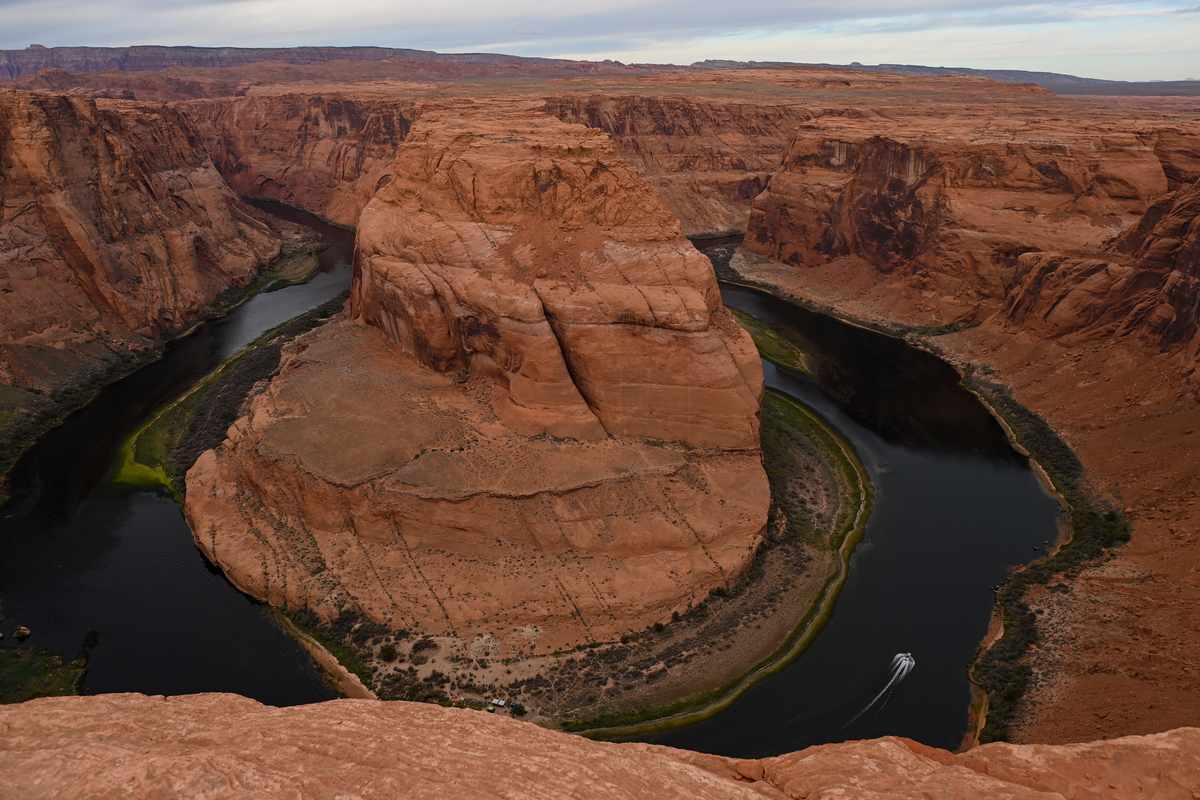
A boat moves around Horseshoe Bend along the Colorado River in Page, Arizona.
16:05 JST, January 31, 2026
For a life-sustaining natural resource relied on by tens of millions of people and fought over by seven states and two countries, the fate of the Colorado River often flies under the national political radar.
The struggle over how to share the dwindling river has mostly been hashed out in the insular world of water managers, experienced technocrats who often keep their jobs as governors come and go. Alliances among Colorado Basin states cross partisan lines. And even though the federal government controls the flow from reservoirs, the White House generally stays out of the fray.
That may be changing.
Interior Secretary Doug Burgum on Friday is expected to host most of the governors from the Basin states, a rare if not unprecedented gathering during the past two decades of haggling over how to address the drought and warming temperatures that have drained the country’s biggest reservoirs to near disaster levels, according to participants.
“Governors don’t really get involved in this stuff, typically,” said one participant in the negotiations.
For months, the states of the Upper Basin (Colorado, Wyoming, Utah and New Mexico) and the Lower Basin (Arizona, California and Nevada) have failed to reach agreement on new rules over how to divvy up a river that sustains major farming regions and cities such as Phoenix and Los Angeles. The meeting with Burgum is an attempt to break the standoff ahead of a Valentine’s Day deadline set by the Interior Department for the states to reach a deal.
“We are at such a level of stalemate,” said Tom Buschatzke, Arizona’s representative to the talks, that having the governors together might “break loose” some things that he and his colleagues “can’t really do in real time.”
But like much around the Colorado River, there was little agreement on that, either. One water official described the meeting as little more than a PR stunt.
“I will be heading to Washington, D.C., along with my fellow commissioners to have some more discussions,” Becky Mitchell, Colorado’s top negotiator, told a conference this week, according to the Colorado Sun. “It is tough to say I’m looking forward to it because that would be a lie.”
Getting the governors directly involved also raises a new risk of injecting national political calculations into an issue that has been widely considered relatively nonpartisan in recent years. The Trump administration’s favor doesn’t fall evenly across this wide swath of the West, or the states most stubbornly at odds, Colorado and Arizona.
While both have Democratic governors, President Donald Trump has been feuding with Colorado, a state Trump lost three times. The state has refused to free a convicted election denier, and Trump has vetoed bipartisan legislation to fund a water project. Arizona, facing potentially the largest cuts to its water use, is a key swing state and one Trump won twice.
But if the Colorado River turns into a partisan prizefight, it’s unclear who would win. Colorado’s Upper Basin allies include powerful Republican senators on natural resource issues in Wyoming and Utah. And for the past few years, Arizona has been aligned with its neighbor California, which uses more of the river’s water than any other state, and is often a Trump administration nemesis.
California Gov. Gavin Newsom (D) was the only one of the seven governors not planning to attend the meeting with Burgum, according to their offices. The state’s natural resources secretary, Wade Crowfoot, will attend in his place.
In recent months, the governors of the Upper Basin states have met among themselves to discuss the Colorado River issue, according to people close to the negotiations, but the wider group has not convened.
“It is pretty unprecedented,” said John Berggren, regional policy manager with Western Resource Advocates, an environmental nonprofit group. “It shows the elevation of where things stand and how important it is for the states to reach an agreement.”
The Interior Department, which declined to discuss the governors meeting, has urged the states to make a deal but has not threatened specific consequences if they don’t. The Bureau of Reclamation earlier this month published an environmental review of Colorado River operations that showed that deep cuts in water use would probably be unavoidable.
“If conditions do not improve, achieving a balance is more difficult, and, under critically dry futures, even large and unprecedented reductions may not be enough to stabilize storage,” the report said.
In some of the scenarios outlined by the federal government, Arizona would face nearly 80 percent of the cuts, a potentially devastating amount that has alarmed state officials. Gov. Katie Hobbs (D) and other Arizona officials wrote Burgum in November about the importance of the state’s share of the river to national security – including its semiconductor industry and key farming regions – and have been pushing for federal government help to avert disaster to the state’s economy.
“The Colorado River is at a pivotal moment, and the status quo is not sustainable; the stakes couldn’t be higher,” Hobbs said in a statement. “I am going to Washington because I believe a path forward is still possible.”
Arizona is in a particularly precarious position because its rights to the river are subordinate to California’s – an arrangement dating back to the 1960s deal that got the Central Arizona Project canal built. That canal network now supplies about 40 percent of the water used by Phoenix, the nation’s fifth-largest city.
“The canal is our lifeline. It is so essential to economic activity and well-being,” Phoenix Mayor Kate Gallego said in an interview. The path laid out by the federal government “could lead to proposals where the canal would be effectively dry.”
Gallego said that outcome would be devastating for semiconductor manufacturing, medical services, cancer research and other key drivers of the region’s economy. She described the fate of the river as “arguably the most important decision for a very large region of our country” and one that should not be left to the Bureau of Reclamation alone.
“This is far more than just arguing over numbers,” she said. “This is people’s daily lives and economic realities.”
Upper Basin states such as Colorado use less water than what was granted under the century-old compact among the states. These states have argued that they do not want to agree to mandatory cuts before they have used their full allocations.
The states are also at odds about when to release water from reservoirs in Upper Basin states to keep the country’s largest reservoirs, Lake Powell and Lake Mead, from dropping to the point that hydropower is threatened.
The meager snowpack in Western mountains this winter and low projected runoff have raised the stakes on these talks. All parties want to keep Lake Powell, about a quarter full, above critical levels, so that an adjacent dam can continue to produce hydropower and deliver water reliably to Lower Basin states. The lake is currently 45 feet above that threshold. The federal government projects it could drop that far by the end of the year.
If there is no agreement among the states, “we’re looking at crashing reservoirs and most likely litigation,” Berggren said. “It’ll end up in a very bad spot.”
For the past few years, the divide between the Upper and Lower basins has held firm. But some people close to the talks believe those blocs could splinter, with six states coalescing to isolate either Arizona or Colorado.
“If you just gathered six people in a room, I think there would be a deal possible,” one state official said.
But with little tangible progress, states have been gearing up for the prospect of a prolonged court battle. Arizona has set aside some $30 million for legal defense of its river interests. Colorado has also added water lawyers.
“The reason it’s hard to get a deal is you need two parties living in reality, and if one party is living in la-la land, you’re not going to get a deal,” Colorado Attorney General Phil Weiser told state lawmakers last week.
“We’ve built up our team to be ready for this moment,” he said.






Most Read
Popular articles in the past 24 hours
-

Milano Cortina 2026: Sakamoto Serves as Flag Bearer; Japan Earns ...
-

Milano Cortina 2026: There Were Cheers across the Country, after ...
-

Emperor Turns 66 Ahead of Disaster Milestones
-

Luna Sea Drummer Shinya Dies at 56; Powerful Drummer Behind ‘Desi...
-

Milano Cortina 2026: ‘Magical’ Italian Games Close wi...
-

Milano Cortina 2026: Riku-Ryu Duo Stick Together During Closing C...
-

1.2 Mil. Rapeseed Flowers Attract Cute Birds, People in Aichi Pre...
-

Mexican Army Kills Leader of Powerful Jalisco New Generation Cart...
Popular articles in the past week
-

Japan PM Takaichi’s Cabinet Resigns en Masse
-

Man Infected with Measles Reportedly Dined at Restaurant in Tokyo...
-

Sanae Takaichi Elected Prime Minister of Japan; Keeps All Cabinet...
-

Japan's Govt to Submit Road Map for Growth Strategy in March, PM ...
-

Bus Carrying 40 Passengers Catches Fire on Chuo Expressway; All E...
-

Milano Cortina 2026: Figure Skaters Riku Miura, Ryuichi Kihara Pa...
-
U.S. Firm to Build Training Hub in Fukushima N-plant for Debris R...
-

Japan, U.S. Name 3 Inaugural Investment Projects; Reached Agreeme...
Popular articles in the past month
-
Japan PM Takaichi’s Cabinet Resigns en Masse
-

Japan Institute to Use Domestic Commercial Optical Lattice Clock ...
-

Israeli Ambassador to Japan Speaks about Japan’s Role in the Reco...
-
Man Infected with Measles Reportedly Dined at Restaurant in Tokyo...
-

Videos Plagiarized, Reposted with False Subtitles Claiming ‘Ryuky...
-

Man Infected with Measles May Have Come in Contact with Many Peop...
-

Prudential Life Insurance Plans to Fully Compensate for Damages C...
-

Woman with Measles Visited Hospital in Tokyo Multiple Times Befor...
Top Articles in News Services
-
Survey Shows False Election Info Perceived as True
-

Prudential Life Expected to Face Inspection over Fraud
-
Hong Kong Ex-Publisher Jimmy Lai’s Sentence Raises International Outcry as China Defends It
-

Japan’s Nikkei Stock Average Touches 58,000 as Yen, Jgbs Rally on Election Fallout (UPDATE 1)
-
Japan’s Nikkei Stock Average Falls as US-Iran Tensions Unsettle Investors (UPDATE 1)
JN ACCESS RANKING
-
Japan PM Takaichi’s Cabinet Resigns en Masse
-
Japan Institute to Use Domestic Commercial Optical Lattice Clock to Set Japan Standard Time
-
Israeli Ambassador to Japan Speaks about Japan’s Role in the Reconstruction of Gaza
-
Man Infected with Measles Reportedly Dined at Restaurant in Tokyo Station
-
Videos Plagiarized, Reposted with False Subtitles Claiming ‘Ryukyu Belongs to China’; Anti-China False Information Also Posted in Japan