
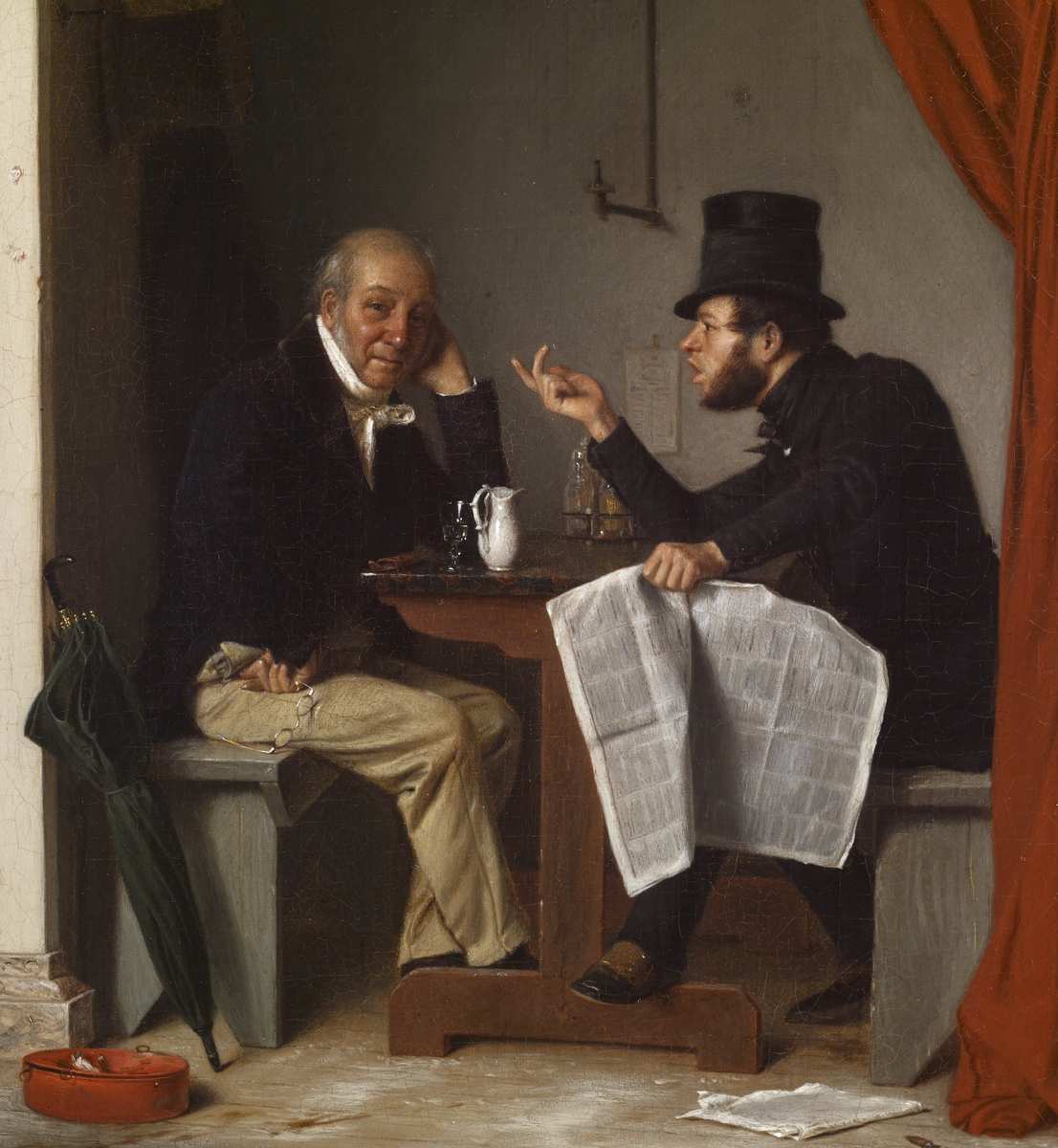
Richard Caton Woodville “Politics in an Oyster House,” 1848, oil on fabric.
15:54 JST, August 23, 2025
Even thinking about conspiracy theories can feel, well, conspiratorial. One would be a fool to deny that bad actors sometimes work behind the scenes to do terrible things, and cover their tracks with denials, misinformation and lies. But then there’s the rabbit hole of obsession, paranoia and the shadow worlds of intrigue and manipulation offered up by Hollywood, constantly blurring the line between reality and illusion.
Welcome to democracy, in which belief and skepticism are dual obligations of good citizenship, dating at least back to the Roman Republic and the city-states of ancient Greece. Consider an 1848 painting by the American artist Richard Caton Woodville, which suddenly feels uncanny and of the moment.
In “Politics in an Oyster House,” owned by the Walters Art Museum in Baltimore, the younger of two men sitting in a shabby restaurant is hectoring his elder with obnoxious vehemence. We don’t know what they are talking about, but based on body language we can make a guess: The loudmouth fellow in a rumpled hat, holding a newspaper and gesticulating aggressively, is expounding a theory of the world, tedious and detailed, based on a wild mix of reasonable and unfounded assumptions gleaned from haphazard reading, rumor and dubious research. He is, perhaps, in the grips of conspiracy thinking, a special feature of American politics at least since the Rev. Samuel Parris found the devil lurking in the shadows of Salem, precipitating the witch trials that led to the deaths of at least 20 innocent people. (Woodville later suggested that the young man was a communist.)
A recent Washington Post poll shows that 84 percent of Americans believe there is incriminating information about billionaires in Justice Department files relevant to the investigation of convicted sex offender Jeffrey Epstein, and 86 percent of Americans strongly or somewhat support releasing the information.
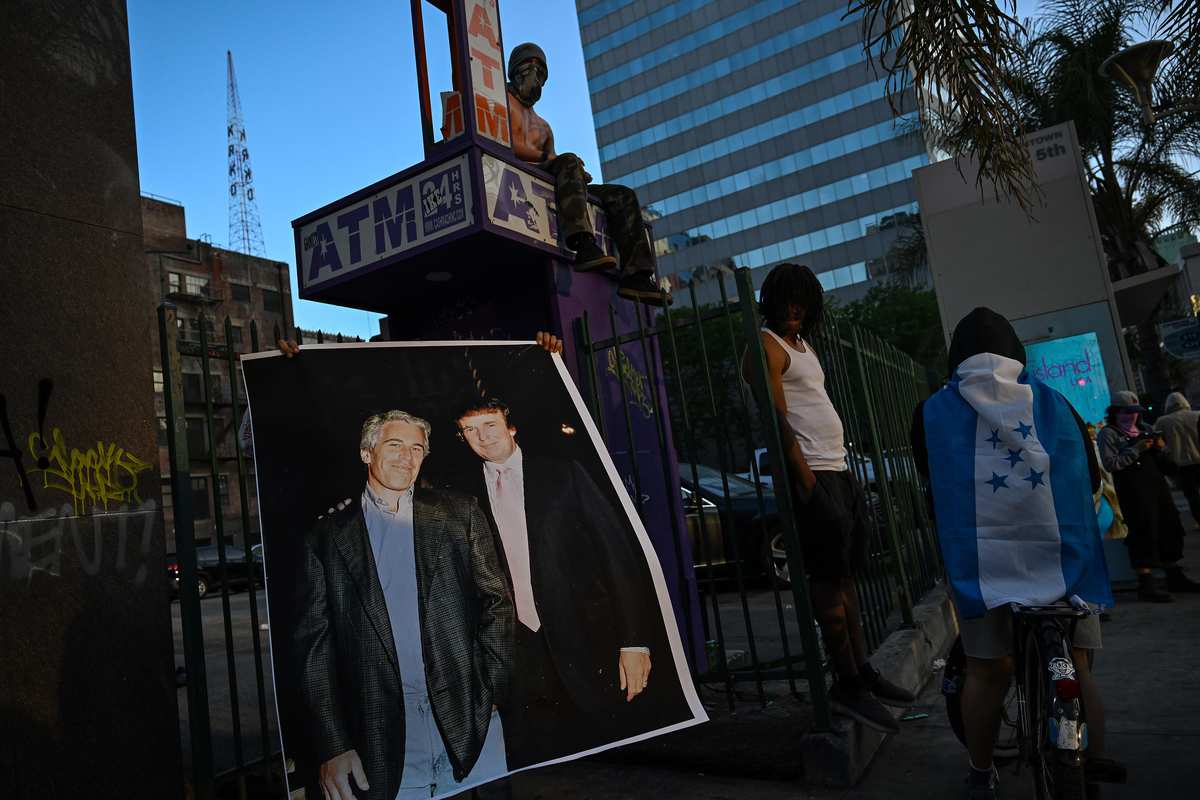
A protester holds up a photo of Jeffrey Epstein and Donald Trump at a demonstration in Los Angeles in June.
The federal takeover of law enforcement in the nation’s capital and the presence of National Guard troops on peaceful city streets has only raised the temperature for conspiracy thinking. Is this an intentional distraction from the real story, the Epstein files? The head of the NAACP has said yes: “There’s no emergency in D.C., so why would he deploy the National Guard? To distract us from his alleged inclusion in the Epstein files?” asked NAACP President Derrick Johnson.
The current moment is analogous to another critical turning point in America from the 1960s, when there was widespread suspicion about the official narrative of the 1963 assassination of President John F. Kennedy. The idea of conspiracy theories predated the Kennedy assassination, but it appeared in its current sense in an infamous 1967 CIA dispatch about the Warren Commission, which investigated the assassination and produced a report that became a kind of bible of supposed disinformation for the conspiracy minded. The authors of the cable – which is a source of its own conspiracy theories – fretted that “Conspiracy theories have frequently thrown suspicion on our organization, for example by falsely alleging that Lee Harvey Oswald worked for us.”
The tendency to believe conspiracy theories is closely associated with the paranoia that historian Richard Hofstadter anatomized as an essential current of American political thought. But the current moment, like the suspicion aroused by the Kennedy assassination, differs from the usual American paranoia. Today, as in 1963, a broad culture of conspiracy thinking is suddenly grappling with what philosophers would call a “warranted conspiracy theory.”
Brian Keeley, a professor of philosophy at Pitzer College in Claremont, California, uses the analogy of jury deliberations to explain “warranted” conspiracy theories.
“The ‘reasonable doubt’ standard is a warranted standard,” he says, meaning that when serving on a jury – or making sense of possible conspiracies – we must often decide whether we believe something about which we can never be entirely certain. “The world is full of conspiracies, so how do we figure out whether we should believe in a given conspiracy?”
That turns out to be extraordinarily difficult in the case of Epstein, who died in prison in 2019 after a suspiciously lenient 2008 plea deal brokered by the U.S. attorney for the Southern District of Florida, Alexander Acosta, who later served as Trump’s labor secretary. The deal was offered despite reams of evidence gathered by law enforcement, including the FBI, that detailed the trafficking and sexual abuse of minors.
It’s also made more complex by the tumultuous politics of the past half century, driven not just by differences in policy but by stark differences in identity and tribal affiliation, with distrust grounded not only in what your opponents may have done but also who they are. Among the more disturbing findings of those who have researched the history of conspiracy thinking is Joseph Uscinski’s pithy conclusion that “conspiracy theories are for losers,” meaning, when you are out of power, you are more likely to think in terms of hidden plots and covert malfeasance. And in America, about half the people are always out of power.
The United States was birthed with conspiracies in mind, says Keeley. “Just read the Declaration of Independence,” he says. “That long list of things that King George and Britain were up to, a lot of those were conspiracy theories.”
Place into a search browser the word “conspiracy” along with any major event of the past century, and the results are abundant. World War II? Franklin D. Roosevelt supposedly knew in advance about the attacks on Pearl Harbor but was intent on precipitating America into the war, and thus did nothing. Roswell, New Mexico, in 1947? Aliens among us. The moon landing? Fake news. The AIDS crisis? Biological warfare.
The past 20 years are no different. The July floods in Texas were the result of cloud seeding and weather manipulation; a 2015 U.S. military drill known as Jade Helm 15 was a plot to take over Texas; the levees in New Orleans were dynamited during Hurricane Katrina to protect White neighborhoods at the cost of Black ones. Immigration is part of a “great replacement” plan.
If the density of conspiracy thinking has been relatively constant in American political life, social media and its algorithms have exploded its reach into other realms, including health and wellness, sports, entertainment and financial matters.
“What’s the one thing that is ruining your health?” asks Keeley, citing a common rhetorical trope of advertising that mimics the conspiratorial mindset. Doctors won’t tell you about this miracle cure. Rich people don’t want you to know about this secret path to wealth. Your trainer isn’t sharing this trick for perfect abs.
Again, there are precedents. Fluoride in the water, a proven boon to dental health, was supposedly a communist plot or an effort to socialize medicine, according to conspiracy theorists in the 1940s and ’50s. And fluoride remains suspect to some key political figures today, including Health and Human Services Secretary Robert F. Kennedy Jr.
The tendency to incorporate the conspiracy mindset into the body is particularly evident in the curious career of Alex Jones, who was successfully sued and ordered to pay nearly $1.5 billion for claiming that the 2012 Sandy Hook Elementary School slaughter was a “false flag” operation and a “giant hoax.” Jones has made much of his money from the sale of what are billed as nutritional supplements, often marketed with explicitly political claims. His Infowars website advertises something called Survival Shield X-2 Nascent Iodine with this promotional text: “The globalists want you to be run down and unhealthy so they can dominate your life. Fight back with one of nature’s greatest essentials.”
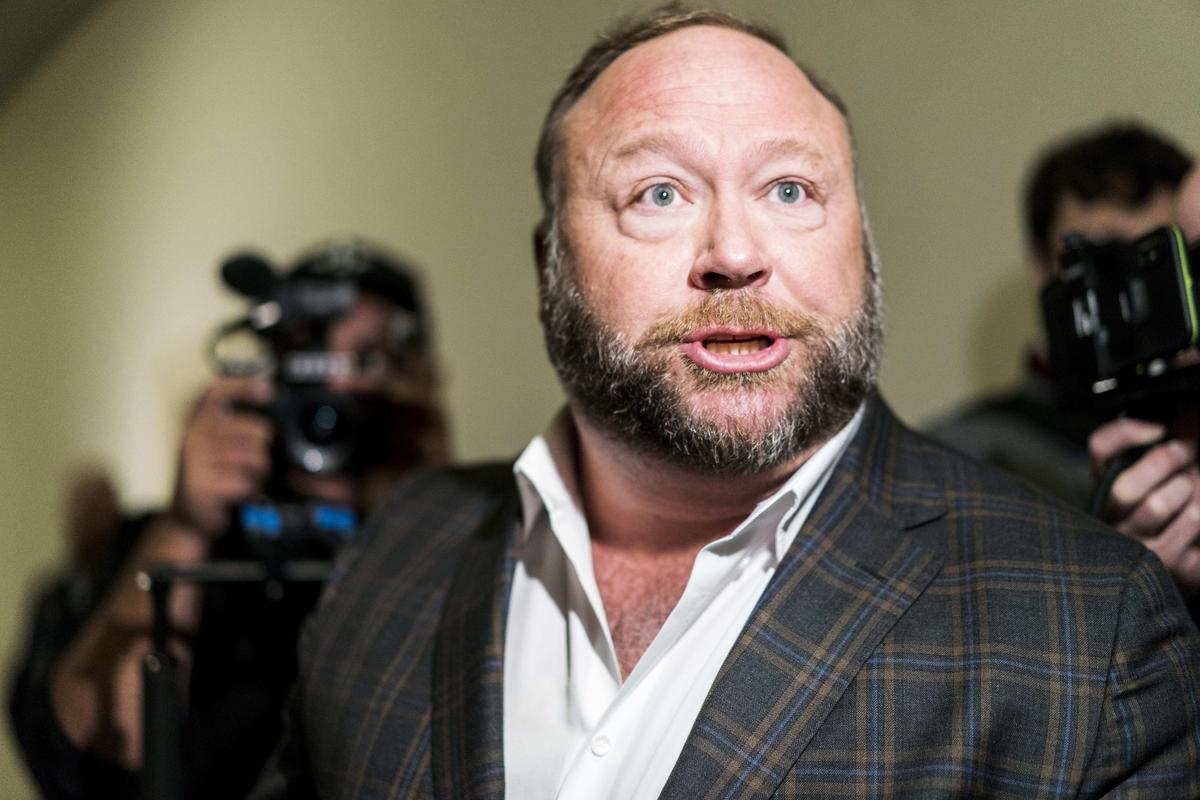
Alex Jones was ordered to pay nearly $1.5 billion in damages related to conspiracy theories about the Sandy Hook shooting.
Health concerns are also a conduit into other forms of conspiracy thinking. A 2023 paper published in Frontiers in Sociology studied entry points into the QAnon conspiracy ideology and found that yoga and wellness groups were a significant driver of interest in the theory, which claims that an elite group of pedophiles is manipulating almost all aspects of American politics and society. Susceptibility to conspiracies like QAnon also makes people vulnerable to financial and retirement scams. The apocalyptic thinking of some strands of QAnon ideology has led people into converting safe retirement accounts into risky cryptocurrency schemes or ill-advised investments in silver. “We also found that crypto ownership was associated with belief in conspiracy theories, ‘dark’ personality characteristics … and more frequent use of alternative and fringe social media platforms,” according to a 2024 study funded by the National Science Foundation.
Yet other studies have suggested a dark symbiosis between health, wealth, social isolation, education and conspiracy thinking. One of the fundamental beliefs of conspiracy thinking – the conviction that “everything is connected” – turns out to be an apt description of a social, economic and public health nexus that sustains broad belief in the conspiracy mindset. And access to that nexus isn’t limited to journalists, academics, economists or doctors. Anyone with a cellphone can manipulate public opinion, sometimes on a scale that dwarfs the old organs of mass messaging, including the government and traditional media.
The passage of time has not dulled the public’s interest in these cases,” said the interim U.S. attorney for the Southern District of New York, Jay Clayton, in a court filing last month, requesting the release of grand jury testimony relevant to the Epstein case. He was referring to Epstein, but he might as well have referenced the assassinations of Kennedy and the Rev. Martin Luther King Jr., the Roswell aliens or fluoride and anti-vaccination theories.
There is something self-reenforcing about conspiracy ideation that makes it remarkably resilient over decades, and, in the case of antisemitism, millennia. In a 1999 paper in the Journal of Philosophy, Keeley suggested some possible explanations. Unlike scientific theories, in which contrary evidence may scuttle a hypothesis, conspiracy thinking begins with an assumption that there are bad actors who may concoct false data, or hide affirmative evidence.
“Conspiracy theories are the only theories for which evidence against them is actually construed as evidence in favor of them.” They are also comforting, and they create a sense that the universe is ordered and meaningful. When “tragic events occur, they at least occur for a reason, and … the greater the event, the greater and more significant the reason.”
Other theorists have suggested some people engage with conspiracy theories as a form of play. “They’re immersed, without realizing it, in an imaginative game, in which they suspend disbelief in the theory,” writes Neil Levy in a 2022 paper published in Philosophical Topics. Thus, some people may “believe” without actually believing in the idea, simply because it’s fun. Whether one actually or deeply or fully believes an idea isn’t particularly relevant to politics or policy, if one votes to support people who signal belief in the theory.
In 2018, the Metropolitan Museum of Art opened an exhibition called “Everything Is Connected: Art and Conspiracy.” This was two years after the first election of Donald Trump, who spread the “birtherism” conspiracy theory that President Barack Obama wasn’t born in the U.S. and repeatedly claimed that the Bureau of Labor Statistics was manipulating unemployment numbers. But the exhibition didn’t touch on Trump. Instead, it focused on two strands of suspicion that have inspired robust artistic production since the Kennedy assassination.
The art on view tended in two directions: the journalistic on one hand, the phantasmagoric on the other. The 1960s and ’70s, an age of assassination, coups, hijackings and other violence, were a rich source of material for conspiracy thinking, especially on the left. That played out in the art world in the “institutional critique” movement, pioneered by artists such as Hans Haacke, whose “Shapolsky et al. Manhattan Real Estate Holdings, A Real Time Social System, as of May 1, 1971,” used photographs and typewritten text to document the hidden power, riches and influence of a wealthy New York slumlord. But it also inspired subcultures of outsider and paranoid art, including the work of Richard Sharpe Shaver, who mined the torrid world of cult and pulp fiction, comic books, and science fiction to create his own theory of alien domination.
The exhibition offered no systematic way of distinguishing truth from fantasy, but it did suggest that style, presentation, tone and aesthetics provide useful if not foolproof guidance. Some artists collect data; others stew it together. Some artists guide you through complex systems; others seem intent on getting you lost in the labyrinth. Some artists may prove that many things are connected; others insist that everything is connected.
Democracies are full of basic antinomies. We have both rights and responsibilities, private needs and collective obligations. Suspicion of power and faith in institutions is another basic opposition, fundamental to maintaining the vitality of self-governance. Credulousness and paranoia are the attendant dangers of this axis of democratic life.
Woodville recognized both in his 1848 painting. The older man, weary of the harangue, stares at us, looking for connection and perhaps sympathy. He has brought an umbrella, a sign of caution and foresight. The younger man, holding the newspaper as if it is a weapon, is lost in the force of his own diatribe, oblivious to the presence of others. If conspiracy thinking is an almost inevitable danger of the salutary suspicion that sustains democracies, social cues like those embedded in Woodville’s painting may be our best defense against it.
Put another way: Read the room, reconsider and don’t be that guy.







Most Read
Popular articles in the past 24 hours
-

Man Infected with Measles May Have Come in Contact with Many Peop...
-

Tokyo Had 65,000 More People Move In Than Out In 2025; Osaka Area...
-

Green Tea Exports Hit Record High in 2025 Amid Growing Demand, Li...
-

Russia: Visa Required for Visiting Graves in Northern Territories...
-

Earthquake with Magnitude 4.8 Occurs off Japan’s Ibaraki Pref., S...
-

Hunting for Small Details in PokéPark KANTO, Keep a Sharp Eye Out...
-

Japan's Nikkei Stock Average Slips after Sharp Gain as Software F...
-
Not Ready for Robots in Homes? The Maker of a Friendly New Humano...
Popular articles in the past week
-

Australian Woman Dies After Mishap on Ski Lift in Nagano Prefectu...
-

Foreign Snowboarder in Serious Condition After Hanging in Midair ...
-
Chinese Embassy in Japan Reiterates Call for Chinese People to Re...
-
Narita Airport, Startup in Japan Demonstrate Machine to Compress ...
-

Toyota Motor Group Firm to Sell Clean Energy Greenhouses for Stra...
-

Sakie Yokota, Last Surviving Parent of a North Korea Abductee, Ur...
-

Beer Yeast Helps Save Labor, Water Use in Growing Rice; Govt Hope...
-

Japan Tourism Agency Calls for Strengthening Measures Against Ove...
Popular articles in the past month
-
Univ. in Japan, Tokyo-Based Startup to Develop Satellite for Disa...
-
JAL, ANA Cancel Flights During 3-day Holiday Weekend due to Blizz...
-
China Confirmed to Be Operating Drilling Vessel Near Japan-China ...
-

China Eyes Rare Earth Foothold in Malaysia to Maintain Dominance,...
-

Japan Institute to Use Domestic Commercial Optical Lattice Clock ...
-
M6.2 Earthquake Hits Japan's Tottori, Shimane Prefectures; No Tsu...
-

Japan, Qatar Ministers Agree on Need for Stable Energy Supplies; ...
-
Japan, Italy to Boost LNG Cooperation; Aimed at Diversifying Japa...
Top Articles in News Services
-

Prudential Life Expected to Face Inspection over Fraud
-

Arctic Sees Unprecedented Heat as Climate Impacts Cascade
-

South Korea Prosecutor Seeks Death Penalty for Ex-President Yoon over Martial Law (Update)
-
Trump Names Former Federal Reserve Governor Warsh as the Next Fed Chair, Replacing Powell
-

Suzuki Overtakes Nissan as Japan’s Third‑Largest Automaker in 2025
JN ACCESS RANKING
-
Univ. in Japan, Tokyo-Based Startup to Develop Satellite for Disaster Prevention Measures, Bears
-
JAL, ANA Cancel Flights During 3-day Holiday Weekend due to Blizzard
-
China Confirmed to Be Operating Drilling Vessel Near Japan-China Median Line
-
China Eyes Rare Earth Foothold in Malaysia to Maintain Dominance, Counter Japan, U.S.
-
Japan Institute to Use Domestic Commercial Optical Lattice Clock to Set Japan Standard Time