
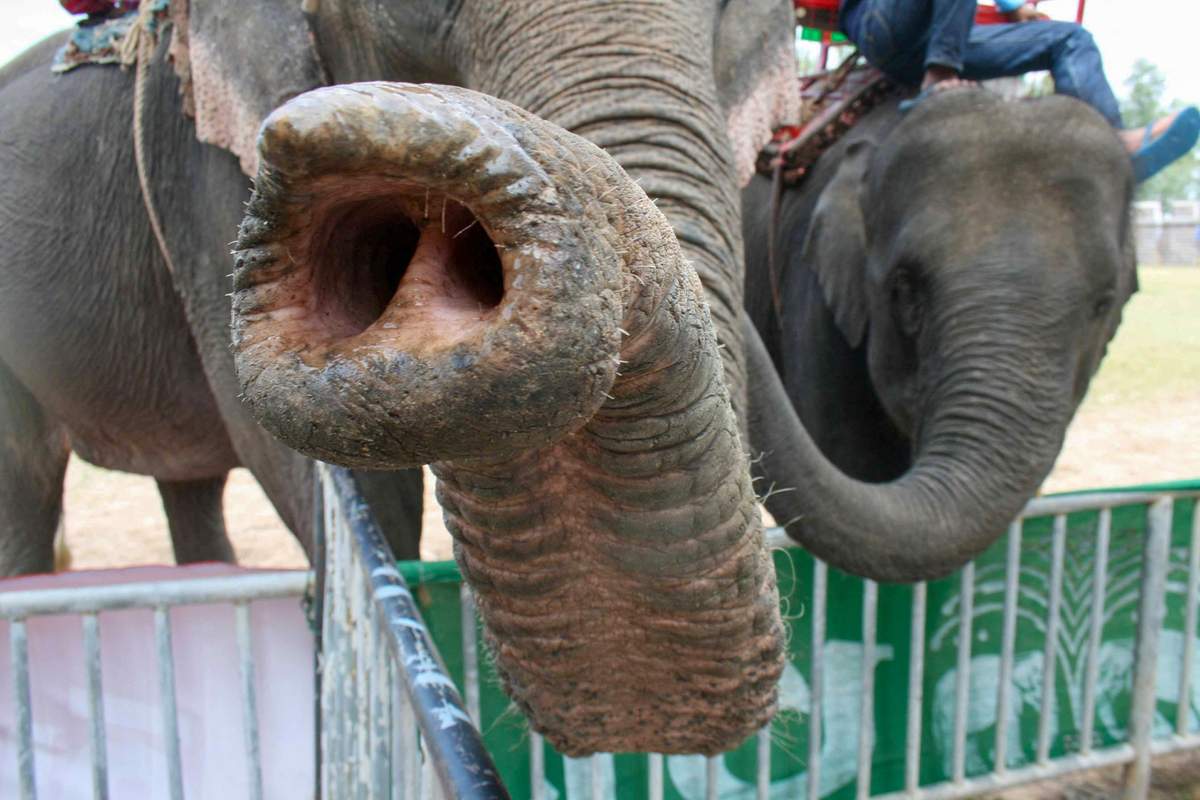
Two Asian elephants push their trunks over a stadium barrier and into the crowd at an elephant festival in Surin, Thailand, in November 2007.
13:33 JST, March 13, 2026
An elephant’s trunk is essential for most aspects of the animal’s life, from interacting with its environment and with other elephants to eating and drinking. And the roughly 1,000 whiskers covering the trunk are central to its utility, highly specialized for facilitating tactile feedback.
New research is providing the best understanding to date of the properties of these whiskers, which give the world’s largest land animals a keen sense of touch that makes up for their thick skin and relatively poor eyesight. It shows that an elephant’s whiskers possess qualities setting them apart from those of other mammals such as mice and rats, from hollow interior chambers to differing levels of stiffness along the shaft.
“They constantly feel their way through their surroundings with their trunks, searching for food and exchanging social touch,” said Andrew Schulz, a postdoctoral researcher in biomechanics at the Max Planck Institute for Intelligent Systems in Germany and lead author of the study published last month in the journal Science. “Each whisker on their trunk acts as a tactile sensory organ, extending their tactile range.”
The trunk, a fusion of an elongated nose and upper lip, is densely packed with tactile nerves. Its tip is sensitive enough to feel, pick up and manipulate objects just millimeters in size, like grasping a tortilla chip without breaking it or peeling a banana.
When a whisker touches an object, such as a tree branch, that contact bends the whisker and makes it vibrate, which is transmitted to touch-sensing cells called mechanoreceptors located at the whisker’s base.
An elephant’s whiskers do not grow back if damaged or lost so it is crucial they can withstand the physical abuse they experience as the animal finds and eats up to 200 kilograms of food daily. The researchers used scanning technology to determine the external shape and internal structure of the whiskers of Asian elephants.
The whiskers were found to be oblong in cross-section, akin to a blade of grass, with hollow chambers called tubules inside at the base, like those inside the horns of bighorn sheep.
Previous research has shown that rat and mouse whiskers have a circular cross-section, are almost completely solid and have approximately the same stiffness throughout.
“In contrast, elephant trunk whiskers have a flattened cross-section, so they bend easily in the direction the elephant trunk extends. Being resilient is important because elephant whiskers never grow back. Having internal hollow tubules also helps elephant whiskers survive impacts, much like animal horns and hooves, and it keeps them lightweight,” Max Planck Institute for Intelligent Systems robotics researcher and study senior author Katherine Kuchenbecker said.
The researchers used a technique called nanoindentation to press a tiny diamond point into the external wall of a whisker at the base and tip to determine its stiffness. The base turned out to be similar in stiffness to rigid plastic while the tip was about 40 times softer, like soft rubber. Scientists call this variation a functional gradient.
“Since the whisker material changes at different locations along the whisker, the feel of physical contact also changes based on where the whisker hits another object. We believe this functional gradient of material stiffness enhances the elephant’s ability to feel where items touch each of its whiskers, so it can be very dexterous with its trunk,” Kuchenbecker said.
“For example, if an elephant feels contact happening near the tips of the whiskers located on the left side of the end of its trunk, it can move efficiently to pick up the peanut that is sitting there. Similarly, if it feels something is hitting in the middle of its whiskers as it reaches through the hole in a tree trunk, it can quickly adjust its movements to avoid the obstacle and reach deep areas where food might be located,” Kuchenbecker said.
Elephants display remarkable traits beyond their dexterous trunks such as complex social systems and communication as well as sharp cognitive skills, including impressive memory.
“Their sensory world, with a strong bias towards olfaction, auditory and tactile perception, is certainly different from how we as primates perceive our surroundings, but nonetheless a captivating subject to study,” said study coauthor Lena Kaufmann, a neuroscientist at Humboldt University in Germany.
There may be practical applications from the new findings by inspiring new approaches to giving robots a better sense of touch.
“Future robots might be able to use elephant-like whiskers to be more successful at navigating the physical world and manipulating delicate objects,” Kuchenbecker said.









Most Read
Popular articles in the past 24 hours
-

‘King Kazu’ Discusses His Connection to Fukushima
-

JR Tokai Breaks Ground on Yamanashi Maglev Station; Will Be Part ...
-

The Japan News / Weekly Edition (3/13-3/19)
-

White House Takes First Step toward Permanent Fix for Illegal Tar...
-
Japan to Extend Drone No-fly Zones Near Key Facilities to 1 km
-

Honda Expects Up to 690 B. Yen in Net Loss for FY 2025
-

Japan Big Firms’ Biz Sentiment Remains Positive in Jan.-March
-

South Korea, Japan Finance Ministers to Hold Bilateral Meeting on...
Popular articles in the past week
-

Japan Figure Skating Legend Yuzuru Hanyu Is Proud Disaster Surviv...
-

Nippon Life Insurance's U.S. Arm Sues OpenAI Over Legal Assistanc...
-

Govt to Utilize ODA for Ensuring Economic Security; Securing Ener...
-

Massive Sewer Pipe Found Jutting Out of Highway in Osaka
-

Beckoning Cats Get Makeover to Fit Modern Lifestyles with Sleek D...
-

Japan Govt Survey Finds Just 10% of Workers Want Working Hours to...
-

Japan's 2nd Round of U.S. Investments May Be Worth Over $100 Bill...
-

Imperial Family Watches World Baseball Classic Game Against Austr...
Popular articles in the past month
-

Producer Behind Pop Group XG Arrested for Cocaine Possession
-

Japan PM Takaichi’s Cabinet Resigns en Masse
-

Man Infected with Measles Reportedly Dined at Restaurant in Tokyo...
-

Videos Plagiarized, Reposted with False Subtitles Claiming ‘Ryuky...
-
Japan Figure Skating Legend Yuzuru Hanyu Is Proud Disaster Surviv...
-

iPS Treatments Pass Key Milestone, but Broader Applications Far f...
-

Sanae Takaichi Elected Prime Minister of Japan; Keeps All Cabinet...
-

Nepal Bus Crash Kills 19 People, Injures 25 Including One Japanes...
Top Articles in News Services
-

Survey Shows False Election Info Perceived as True
-

Japan’s Nikkei Stock Average Falls as US-Iran Tensions Unsettle Investors (UPDATE 1)
-
Japan’s Nikkei Stock Average Rises on Tech Rally and Takaichi’s Spending Hopes (UPDATE 1)
-

Japan to Ban Use of Power Banks on Airplanes
-

North Korea Unveils Image of Kim Jong Un’s Teenage Daughter Firing Rifle
JN ACCESS RANKING
-
Producer Behind Pop Group XG Arrested for Cocaine Possession
-
Japan PM Takaichi’s Cabinet Resigns en Masse
-
Man Infected with Measles Reportedly Dined at Restaurant in Tokyo Station
-
Videos Plagiarized, Reposted with False Subtitles Claiming ‘Ryukyu Belongs to China’; Anti-China False Information Also Posted in Japan
-
Japan Figure Skating Legend Yuzuru Hanyu Is Proud Disaster Survivor and Gold Medalist, Vows to Continue Support Efforts