
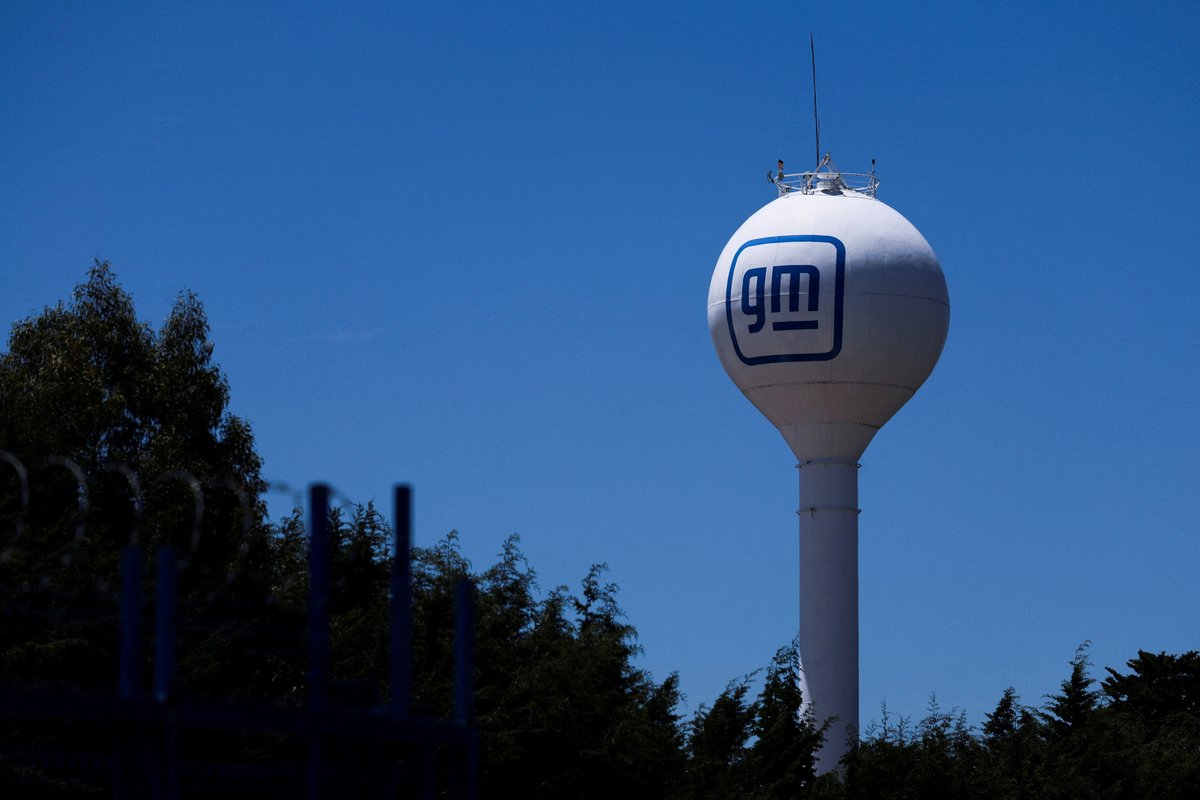
The logo of General Motors is pictured in Santa Ana Tlapaltitlan, Mexico, July 29, 2025.
11:39 JST, August 7, 2025
Aug 6 (Reuters) – General Motors GM.N and Hyundai Motor 005380.KSon Wednesday outlined plans to develop five vehicles as they seek to lower costs amid growing competition from nimble Chinese rivals.
Four of the vehicles — a compact SUV/car/ pickup, and a mid-size pickup — are targeted at Central and South American markets and will support both internal combustion and hybrid powertrains.
At full production scale, the companies expect to roll out at least 800,000 vehicles annually.
The partnership will help GM compete against rising Chinese players in the Latin American market, where the Detroit automaker has had a strong presence for decades.
The two global automakers will also co-develop an electric commercial van for the North American market. Reuters in March reported that the two companies were nearing a deal to share two commercial electric vans.
Global automakers face stiff competition from Chinese EV makers and a trade war impacting imports of crucial parts, including rare earth materials, which has pushed production costs higher.
This is the first major partnership for vehicle development for Hyundai Motor.
The deal would give GM access to hybrid technology it lacks, while enabling Hyundai to enter into new segments such as vans in North America and mid-sized pickups, Kim Sung-rae, an analyst at Hanwha Investment & Securities, said.
The two companies did not say where the models will be produced. Hyundai, which has a factory in Alabama, said it will expand the production capacity of its new factory in Georgia. The company also has a factory in Brazil.
GM’s budding partnership with Hyundai follows an unwinding of several projects the Detroit automaker had pursued with Honda over the past decade.Notably, GM and Honda in 2023 scrapped a $5 billion plan to jointly develop affordable electric vehicles.
Chinese automakers have released several high-tech, low-cost models, putting pressure on legacy automakers such as GM to slash expenses and streamline manufacturing processes. To compete with these rivals, many automakers have explored partnerships as a way to share development costs, especially for battery-powered models.
Cutting costs is even more pressing as tariffs have added billions of dollars in expenses for automakers around the globe. The Hyundai-GM announcement comes after the United States and South Korea last week reached a trade agreement to charge a 15% tariff on imports from South Korea, including autos.
This is among several deals between a South Korean company and a U.S. firm announced in recent weeks, following Samsung Electronics’ 005930.KS chip deal with Tesla TSLA.O and Apple AAPL.O, and LG Energy Solution’s 373220.KS battery deal with Tesla.



Most Read
Popular articles in the past 24 hours
-
Japan Govt to Tighten Requirements to Receive Permanent Residency...
-
Tail of ANA Plane Struck Runway During Landing in Houston; No Inj...
-

Medical Care at Home and Disasters: Ensure Systems to Provide Con...
-

Samurai Japan Holds First Practice in Miami; Team Will Play again...
-
White House Takes First Step toward Permanent Fix for Illegal Tar...
-

CARTOON OF THE DAY (March 12)
-
The Japan News / Weekly Edition (3/13-3/19)
-

Japan to Face Venezuela in World Baseball Classic Quarterfinals
Popular articles in the past week
-

Japan Figure Skating Legend Yuzuru Hanyu Is Proud Disaster Surviv...
-

Nippon Life Insurance's U.S. Arm Sues OpenAI Over Legal Assistanc...
-
Govt to Utilize ODA for Ensuring Economic Security; Securing Ener...
-

Massive Sewer Pipe Found Jutting Out of Highway in Osaka
-

Beckoning Cats Get Makeover to Fit Modern Lifestyles with Sleek D...
-
Japan Govt Survey Finds Just 10% of Workers Want Working Hours to...
-
Japan's 2nd Round of U.S. Investments May Be Worth Over $100 Bill...
-

Imperial Family Watches World Baseball Classic Game Against Austr...
Popular articles in the past month
-

Producer Behind Pop Group XG Arrested for Cocaine Possession
-

Japan PM Takaichi’s Cabinet Resigns en Masse
-

Man Infected with Measles Reportedly Dined at Restaurant in Tokyo...
-

Videos Plagiarized, Reposted with False Subtitles Claiming ‘Ryuky...
-
Japan Figure Skating Legend Yuzuru Hanyu Is Proud Disaster Surviv...
-

iPS Treatments Pass Key Milestone, but Broader Applications Far f...
-

Sanae Takaichi Elected Prime Minister of Japan; Keeps All Cabinet...
-

Nepal Bus Crash Kills 19 People, Injures 25 Including One Japanes...
Top Articles in News Services
-
Survey Shows False Election Info Perceived as True
-

Japan’s Nikkei Stock Average Falls as US-Iran Tensions Unsettle Investors (UPDATE 1)
-
Japan’s Nikkei Stock Average Rises on Tech Rally and Takaichi’s Spending Hopes (UPDATE 1)
-

Japan to Ban Use of Power Banks on Airplanes
-

North Korea Unveils Image of Kim Jong Un’s Teenage Daughter Firing Rifle
JN ACCESS RANKING
-
Producer Behind Pop Group XG Arrested for Cocaine Possession
-
Japan PM Takaichi’s Cabinet Resigns en Masse
-
Man Infected with Measles Reportedly Dined at Restaurant in Tokyo Station
-
Videos Plagiarized, Reposted with False Subtitles Claiming ‘Ryukyu Belongs to China’; Anti-China False Information Also Posted in Japan
-
Japan Figure Skating Legend Yuzuru Hanyu Is Proud Disaster Survivor and Gold Medalist, Vows to Continue Support Efforts