
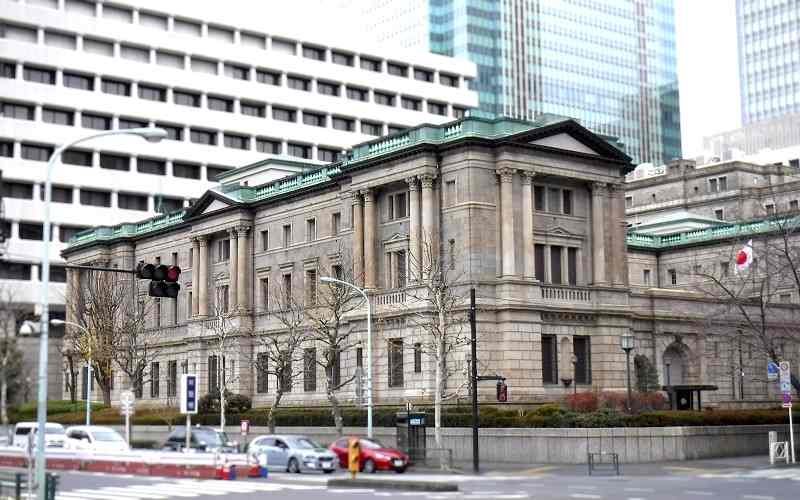
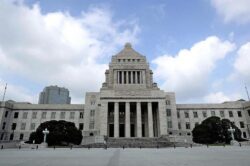
The Bank of Japan building
14:56 JST, May 2, 2023
TOKYO (Reuters) — The yen continued its steep descent on Tuesday, reaching a 15-year low to the euro, as the implications of a steadfastly dovish Bank of Japan continued to reverberate days after the decision.
Meanwhile, the Aussie dollar leapt to a one-week high after the Reserve Bank of Australia (RBA) surprised with a rate hike and signaled more tightening may come.
The central bank lifted the cash rate to 3.85% and said “some further” tightening may be required to ensure that inflation returns to target in a reasonable timeframe.
The Australian currency climbed 1% to just below 67 U.S. cents for the first time since April 25, after being mired near 66 cents for most of the past week.
“I would think the RBA now thinks they need to see a 4 in front of the cash rate before thinking they might be done,” said Ray Attrill, head of FX strategy at National Australia Bank.
“Certainly the data flow since April has been on the strong side,” he added. “It’s very probable that another one is to come, though whether it’s as soon as June remains to be seen.”
The euro added 0.24% to 151.31 yen, the highest since September 2008.
The greenback gained 0.21% to hit 137.74 yen for the first time since March 8. A move above 137.90 would be the highest level this year.
“The sign that the BOJ is not going to change its negative interest rate policy any time soon gave the green light for speculators to put yen carry trades back on,” said Naka Matsuzawa, chief Japan macro strategist at Nomura Securities.
The sale of First Republic Bank’s assets to JPMorgan Chase & Co also gave more confidence to investors over the outlook for the dollar, Matsuzawa said.
“The odds of the Fed continuing on the rate hike process, rather than rate cuts, is now a bit higher.”
The single currency edged 0.1% higher against the dollar to $1.0985, but still near the bottom of its range of the past week after data overnight showed U.S. manufacturing pulled off a three-year low last month despite a build-up of inflationary pressures.
That keeps the Federal Reserve on track to hike rates by a quarter point on Wednesday.
Investors will focus on whether the U.S. central bank indicates that it expects to pause rate increases after May, or if it keeps alive the possibility of another hike in June or later.
A potentially key clue to that will come on Friday, with the release of monthly employment data.
The European Central Bank (ECB), meanwhile, is widely expected to raise rates for a seventh straight meeting the following day, with a 50 basis-point increase on the table.
That lifted the euro to a more than one-year peak at $1.1096 last week.
By contrast, the BOJ on Friday opted to leave ultra-easy stimulus settings in place and embarked on a review of its monetary policy that could take 1-1/2 years, suggesting no hurry at all to normalize policy.
The ECB and Fed decisions, along with the U.S. jobs data all come when Japan will be observing the Golden Week holidays, which run from Wednesday through to the end of the weekend.








Most Read
Popular articles in the past 24 hours
-

Japanese Watermelon Shipments Starts in Leading Production Distri...
-

Takeshima Day: Persistently Demanding Resolution from South Korea...
-
Tokyo Skytree Observation Deck Remains Closed for Inspection afte...
-

Impact on Japanese Economy Unclear with Trump’s New Tariffs, Shif...
-
CARTOON OF THE DAY (February 25)
-

Hanzomon Line Service Suspended between Kudanshita, Oshiage Stati...
-
Hanzomon Line Service Resumes
-
Japan GSDF, Indian Army Begin Joint Antiterror Drills
Popular articles in the past week
-

Producer Behind Pop Group XG Arrested for Cocaine Possession
-

iPS Treatments Pass Key Milestone, but Broader Applications Far f...
-

Japan, U.S. Name 3 Inaugural Investment Projects; Reached Agreeme...
-

Tokyo Skytree's Elevator Stops, Trapping 20 People; All Rescued (...
-

Japan’s Major Real Estate Firms Expanding Overseas Businesses to ...
-

Baby Monkey Punch Captures Hearts at Chiba Pref. Zoo, on Social M...
-

Milano Cortina 2026: Japanese Figure Skater Kaori Sakamoto’...
-
Reciprocal Tariffs Ruled Illegal: Judiciary Would Not Tolerate Pr...
Popular articles in the past month
-
Producer Behind Pop Group XG Arrested for Cocaine Possession
-

Japan PM Takaichi’s Cabinet Resigns en Masse
-

Japan Institute to Use Domestic Commercial Optical Lattice Clock ...
-

Man Infected with Measles Reportedly Dined at Restaurant in Tokyo...
-

Israeli Ambassador to Japan Speaks about Japan’s Role in the Reco...
-

Videos Plagiarized, Reposted with False Subtitles Claiming ‘Ryuky...
-

Man Infected with Measles May Have Come in Contact with Many Peop...
-

Prudential Life Insurance Plans to Fully Compensate for Damages C...
Top Articles in News Services
-
Survey Shows False Election Info Perceived as True
-

Hong Kong Ex-Publisher Jimmy Lai’s Sentence Raises International Outcry as China Defends It
-

Japan’s Nikkei Stock Average Touches 58,000 as Yen, Jgbs Rally on Election Fallout (UPDATE 1)
-
Japan’s Nikkei Stock Average Falls as US-Iran Tensions Unsettle Investors (UPDATE 1)
-

Trump Names Former Federal Reserve Governor Warsh as the Next Fed Chair, Replacing Powell
JN ACCESS RANKING
-
Producer Behind Pop Group XG Arrested for Cocaine Possession
-
Japan PM Takaichi’s Cabinet Resigns en Masse
-
Man Infected with Measles Reportedly Dined at Restaurant in Tokyo Station
-
Israeli Ambassador to Japan Speaks about Japan’s Role in the Reconstruction of Gaza
-
Videos Plagiarized, Reposted with False Subtitles Claiming ‘Ryukyu Belongs to China’; Anti-China False Information Also Posted in Japan