
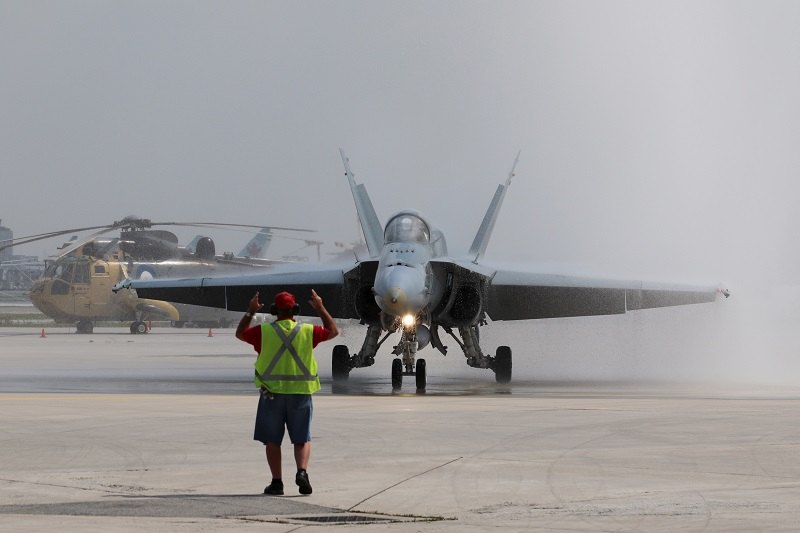
FILE PHOTO: A CF-188 Hornet from the 425 Alouettes, Tactical Fighter Squadron, 3 Wing Bagotville, Quebec, is guided under a water salute during media day for the Canadian International Air Show at Pearson Airport in Toronto, Ontario, September 3, 2015.
11:24 JST, June 7, 2022
BEIJING/OTTAWA (Reuters) – Diplomatic tensions between China and Canada are rising again, with each country accusing the other of using their military aircraft flying near North Korea of provocation and harassment.
Earlier on Monday, China’s foreign ministry warned Canada of potential “severe consequences” of any “risky provocation,” after Canada’s military last week accused Chinese warplanes of harassing its patrol aircraft monitoring North Korea’s compliance with sanctions.
“The U.N. Security Council has never authorized any country to carry out military surveillance in the seas and airspace of other countries in the name of enforcing sanctions,” foreign ministry spokesman Zhao Lijian said at a media briefing.
Canadian Prime Minister Justin Trudeau, speaking to reporters in Ottawa, responded that Canadian planes were participating in a U.N. mission.
China’s actions “are irresponsible and provocative” and “are putting people at risk, while at the same time not respecting decisions by the U.N. to enforce U.N. sanctions on North Korea,” Trudeau said.
Last week Trudeau was more measured, calling the harassment of Canadian warplanes “extremely troubling”.
Chinese aircraft have sometimes forced Canadian planes to divert from their flight paths, Canada’s military said last week.
Wu Qian, a defence ministry spokesman, said the Chinese military took reasonable measures to deal with Canada’s actions and have made “solemn representations” via diplomatic channels.
China’s defence ministry said in a statement that Canadian military jets have stepped up reconnaissance and “provocations” against China “under the pretext” of implementing U.N. Security Council resolutions, endangering China’s national security.
The rise in tensions between Canada and China follows Ottawa’s decision last month to ban the use of 5G gear from China’s Huawei Technologies Co. due to national security concerns.
That decision had been delayed after Canada’s detention of Huawei executive Meng Wanzhou in 2018 on behalf of the United States, and Beijing’s subsequent arrest of two Canadians on spying charges. That standoff ended when all three were released in September after U.S. prosecutors reached a deal with Meng.








Most Read
Popular articles in the past 24 hours
-
Power Outage Forces About 980 Passengers in Yokohama to Walk to T...
-

Masako Ikeda, Voice of Maetel in ‘Galaxy Express 999,' Dies at 87
-

Japan Defense Agency to Develop AI Intelligence Analysis System f...
-

Japan's TEPCO Releases Footage from Fukushima N-Plant Reactor
-

Japan Considering Taking Part in U.S. ‘Golden Dome’ Defense Syste...
-

Government to Establish ‘Command Center’ for Developing Nuclear P...
-

Oil Reserve Releases: G7 Members Unite against Growing Threat
-

Milano Cortina 2026: Japan’s Momoka Muraoka Takes Silver in...
Popular articles in the past week
-

Japan Figure Skating Legend Yuzuru Hanyu Is Proud Disaster Surviv...
-

Nippon Life Insurance's U.S. Arm Sues OpenAI Over Legal Assistanc...
-
Govt to Utilize ODA for Ensuring Economic Security; Securing Ener...
-
15 Measles Patients Confirmed in Tokyo in Past 6 Days; 1 May Have...
-
Massive Sewer Pipe Found Jutting Out of Highway in Osaka
-
Japan Govt to Tighten Requirements to Receive Permanent Residency...
-

Beckoning Cats Get Makeover to Fit Modern Lifestyles with Sleek D...
-
JR Tokai Breaks Ground on Yamanashi Maglev Station; Will Be Part ...
Popular articles in the past month
-

Producer Behind Pop Group XG Arrested for Cocaine Possession
-

Japan PM Takaichi’s Cabinet Resigns en Masse
-

Man Infected with Measles Reportedly Dined at Restaurant in Tokyo...
-

Videos Plagiarized, Reposted with False Subtitles Claiming ‘Ryuky...
-
Japan Figure Skating Legend Yuzuru Hanyu Is Proud Disaster Surviv...
-

iPS Treatments Pass Key Milestone, but Broader Applications Far f...
-

Sanae Takaichi Elected Prime Minister of Japan; Keeps All Cabinet...
-

Nepal Bus Crash Kills 19 People, Injures 25 Including One Japanes...
Top Articles in News Services
-
Survey Shows False Election Info Perceived as True
-
Japan’s Nikkei Stock Average Falls as US-Iran Tensions Unsettle Investors (UPDATE 1)
-
Japan’s Nikkei Stock Average Rises on Tech Rally and Takaichi’s Spending Hopes (UPDATE 1)
-
Japan to Ban Use of Power Banks on Airplanes
-

North Korea Unveils Image of Kim Jong Un’s Teenage Daughter Firing Rifle
JN ACCESS RANKING
-
Producer Behind Pop Group XG Arrested for Cocaine Possession
-
Japan PM Takaichi’s Cabinet Resigns en Masse
-
Man Infected with Measles Reportedly Dined at Restaurant in Tokyo Station
-
Videos Plagiarized, Reposted with False Subtitles Claiming ‘Ryukyu Belongs to China’; Anti-China False Information Also Posted in Japan
-
Japan Figure Skating Legend Yuzuru Hanyu Is Proud Disaster Survivor and Gold Medalist, Vows to Continue Support Efforts